Kenya’s EV charging network ranks second in Africa, driven by fleets and utility investment

Kenya had the second-highest number of electric vehicle charging stations in Africa in 2025, according to a survey by the United Nations Economic Commission for Africa (ECA).
The country recorded 235 stations, placing it behind Egypt, which had 300. Ethiopia followed with 100 stations, while Rwanda had 40, highlighting the uneven development of electric mobility infrastructure across the continent.
The ECA survey also found that more than 25 African countries had no electric vehicle charging station during the period covered. While the figures position Kenya among the continent’s leading markets for charging infrastructure, they do not by themselves show how evenly the stations are distributed, how many vehicles they serve, or whether they are designed for private cars, electric buses, motorcycles or commercial fleets.
Kenya’s charging network ranks behind Egypt
Kenya’s charging infrastructure has largely been developed by private-sector companies, with most installations concentrated in Nairobi and its surrounding satellite towns. Kenya Power has also installed charging stations at some of its offices, adding a utility-led component to a network that has otherwise grown through commercial operators and fleet-focused projects.


The ECA identifies Kenya as one of the African countries creating conditions for investment in electric mobility and related technical services, alongside Morocco and Rwanda. Its assessment points to measures such as tax incentives, rebates and infrastructure improvements as part of the country’s effort to encourage the adoption of electric vehicles.
The ranking comes against the backdrop of earlier plans to expand charging infrastructure across the country. In 2025, Kenya Power reported plans for new charging locations in Nairobi, Nyeri, Kisumu, Eldoret, Nakuru, Mombasa and Taita Taveta. A separate national rollout proposal outlined an investment of about KSh6.12 billion in 10,000 charging stations by 2030, beginning with towns along major highways before extending to additional urban centres and county headquarters.

Those plans represent future targets rather than proof that all proposed stations have been installed. They do, however, show that the charging network is being considered as a national infrastructure project rather than an initiative limited to Nairobi.
Private firms and utilities drive infrastructure expansion
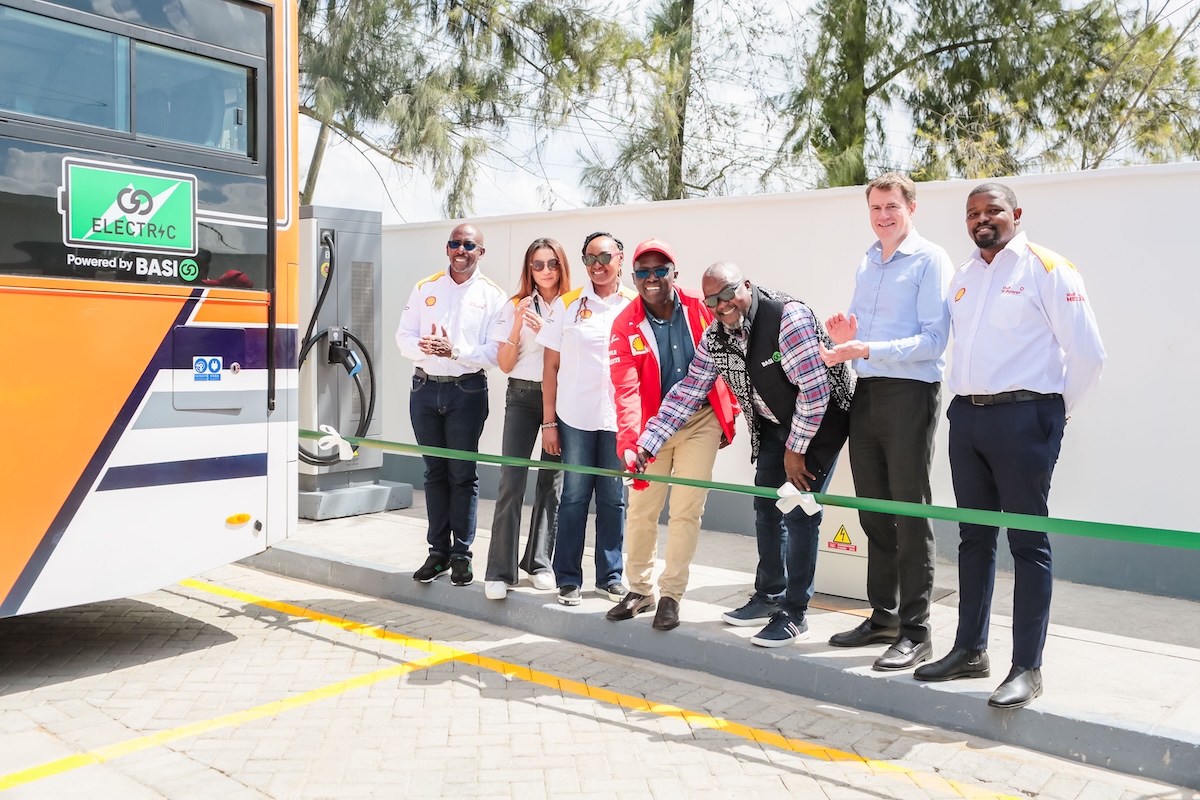
Several companies are building charging infrastructure around the needs of commercial fleets and high-traffic routes. BasiGo, which operates electric buses in Kenya, has been developing charging facilities near depots, terminals and established bus routes, where vehicles can charge according to predictable operating schedules.
BasiGo has also partnered with Rubis Energy Kenya to establish public electric vehicle charging points at fuel stations. The first facility under the partnership was launched at Rubis Sabaki along Mombasa Road, with additional sites announced for towns including Meru, Nanyuki and Nyeri. The model uses existing fuel-station locations to provide access to transport corridors and support charging for buses, vans, trucks and passenger vehicles.
The Sabaki facility was reported to use 100kW direct-current fast chargers supporting CCS2 and GB/T standards. The reported charging price was approximately KSh48 per kilowatt-hour, although charging costs can vary by operator, tariff, vehicle type and location.
Kenya Power’s role is also expanding beyond the installation of individual charging stations. The utility has introduced a dedicated e-mobility tariff and has been connecting charging sites to the electricity grid, including through transformer and other network upgrades where required. In a May 2026 report, Kenya Power said it had recorded KSh382 million in cumulative EV-charging revenue over 34 months, from July 2023 to April 2026.
The same figures illustrate the geographical concentration of demand. Nairobi accounted for 71 percent of Kenya Power’s cumulative EV-charging revenue during the period reported, suggesting that the country’s charging market remains closely tied to the capital’s vehicle population, commercial activity and electricity infrastructure.
Charging coverage remains concentrated around major cities and corridors
The number of stations is an important measure of infrastructure availability, but it does not capture the full experience of an EV owner or operator. A station count does not indicate how many charging points each facility contains, whether the equipment supports fast charging, how often it is available, or whether it is accessible to the public.
Location is another important factor. A dense network in Nairobi can support urban fleets and private vehicles while leaving long-distance drivers with limited options outside major towns. This is particularly relevant for electric buses and commercial vehicles, whose operating schedules require predictable charging access and sufficient power capacity.
Kenya’s recently gazetted charging guidelines reportedly provide for public charging stations every 25 kilometres on both sides of major highways. In urban areas, the guidelines also provide for heavy-duty charging stations for lorries and buses at bus stops. The effectiveness of these provisions will depend on implementation, land availability, grid capacity, permitting, maintenance and the commercial demand needed to sustain the facilities.
The country’s earlier charging plans also identified several towns along major transport corridors as priorities. The expansion of BasiGo and Rubis facilities beyond Nairobi suggests that private operators are beginning to follow this corridor-based approach, although the operational status and coverage of every announced location should be confirmed individually.
Electric buses and motorcycles are shaping demand
Kenya’s electric mobility market is broader than private passenger cars. Electric buses, commercial motorcycles and other fleet vehicles are influencing where infrastructure is installed and what type of charging equipment is required.
Electric buses often rely on depot charging or high-capacity fast chargers positioned along routes and near terminals. This gives operators a more predictable demand profile, because vehicles return to known locations and can be charged according to fleet schedules. It also means that charging infrastructure may be concentrated in places with strong commercial use rather than distributed evenly according to population.
Electric motorcycles present a different infrastructure model. Battery-swapping networks can allow riders to exchange depleted batteries for charged units instead of waiting for a vehicle battery to recharge. Companies such as Ampersand have helped develop this model, which is particularly relevant to commercial riders who depend on their vehicles for daily income.
The latest figures from the National Transport and Safety Authority put Kenya’s registered electric vehicle population at 35,661. Electric motorcycles accounted for 33,374 of those vehicles, while motor vehicles accounted for 829, with the remainder consisting of three-wheelers. The composition of the fleet is important because it affects the type, location and economics of infrastructure required.
A charging network designed primarily for electric buses or motorcycles cannot automatically be treated as equivalent to a nationwide network for private electric cars. Each segment has different requirements for charging speed, connector standards, operating hours, payment systems, grid capacity and geographic coverage.
National rollout plans face practical infrastructure questions
Kenya’s second-place ranking provides evidence that charging infrastructure is being deployed at a significant scale compared with many other African markets. It does not, however, establish whether the network is sufficient for the country’s projected EV growth or whether its stations are being used efficiently.
The next questions concern the quality and reach of the infrastructure. How many of the 235 stations are publicly accessible? How many are operational? How many charging points are available at each site? What proportion supports fast charging, and how many are dedicated to buses, motorcycles or private vehicles? The ECA survey’s methodology and definitions will be important in answering those questions.
The distribution of stations also matters. Kenya’s charging market has historically been concentrated in Nairobi, while recent projects are extending infrastructure along major highways and into regional towns. This expansion could make electric mobility more practical for intercity transport, but only if charging sites are reliable, compatible with the vehicles using them and connected to adequate electricity supply.
The wider vehicle market may create additional pressure for infrastructure investment. Africa imports large numbers of used vehicles, and the global expansion of electric and hybrid vehicle production could eventually increase the number of electrified vehicles entering African markets. China has set a target for 70 percent of newly manufactured cars to be electric or hybrid by 2030, while Japan has announced a goal for all new passenger vehicle sales to be electrified or hybrid by 2035.
For Kenya, the immediate challenge is to ensure that infrastructure growth keeps pace with the types of vehicles entering the market. The country’s reported second-place position is therefore a useful measure of progress, but the more consequential question is whether charging stations are accessible, functional and distributed in ways that support the next stage of electric mobility adoption.
Real ESG impact doesn’t happen in panels alone, it happens in the rooms where financiers, operators, and policymakers actually align. Our GreenShift Forum 2026 cuts the noise, bringing together the people rewiring Africa’s sustainability and energy frameworks for one focused day in Nairobi. Secure your seat.
Go to TECHTRENDSKE.co.ke for more tech and business news from the African continent and across the world.
Follow us on WhatsApp, Telegram, Twitter, and Facebook, or subscribe to our weekly newsletter to ensure you don’t miss out on any future updates. Send tips to info@techtrendsmedia.co.ke