
NCBA, BasiGo target 1,000 electric vehicles as Kenya’s transport market grows

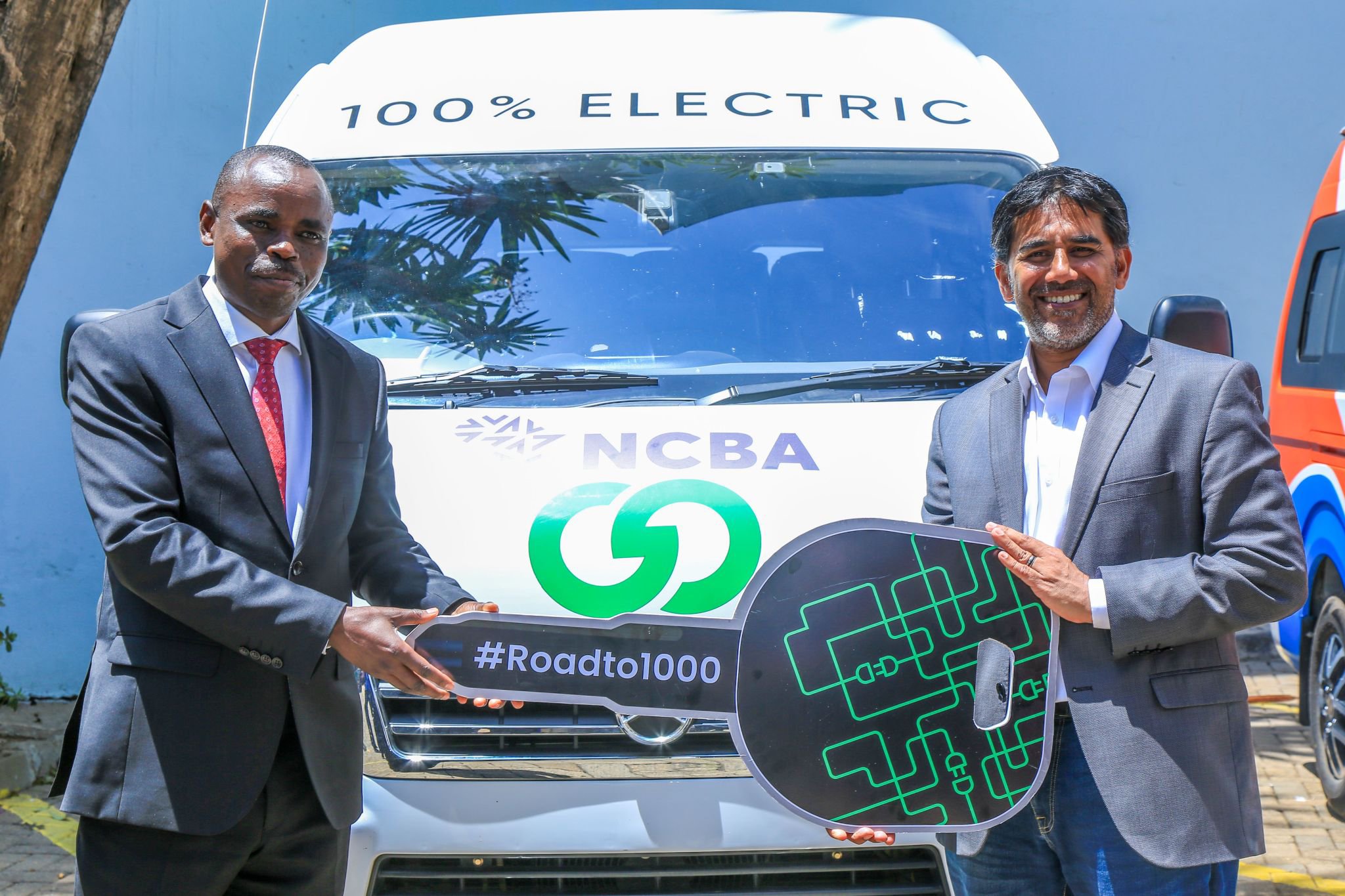
Kenya’s electric public transport market is getting a new financing push as NCBA Group and BasiGo target 1,000 electric vehicles for public service vehicle operators, businesses and institutions.
The partnership combines asset finance and leasing, giving operators another route to acquire BasiGo electric vans without carrying the full purchase cost upfront.
For established PSV SACCOs and companies, NCBA will finance up to 90% of the asset value over 60 months, while individual SACCO members can access up to 80% over 48 months, with both structures carrying a discounted 1.5% processing fee.
The arrangement also brings NCBA financing alongside BasiGo’s Pay-As-You-Drive model, putting the focus squarely on the cost of getting electric vehicles into commercial fleets.


NCBA Group said that it will work with BasiGo to finance 1,000 electric vans, with the vehicles expected to serve PSV SACCOs, established operators, individuals, schools, hospitals and other businesses. The bank described the partnership as part of its wider e-mobility strategy and said it has already invested more than KES 800 million through a KES 2 billion e-mobility financing facility.
NCBA also becomes, according to the company announcement, the first local investor to finance BasiGo itself, adding another layer to a relationship that now reaches beyond individual vehicle purchases.
NCBA Adds Financing to BasiGo’s Electric Vehicle Expansion
The timing matters because BasiGo has already built a customer pipeline that extends well beyond demonstration projects. The company has received more than 1,200 reservations for electric buses and vans across Kenya and Rwanda, while 136 vehicles were operating in the two countries, including 102 in Kenya. The gap between reservations and deployed vehicles puts production, financing and delivery capacity at the centre of the company’s next stage of expansion.
BasiGo’s commercial model has also moved beyond a single ownership structure. Operators can lease complete vehicles, purchase buses separately from the battery under battery-leasing arrangements, or buy vehicles directly while taking separate charging and maintenance services. NCBA’s new financing options add another route into that system, particularly for operators that have the capacity to run an electric vehicle but cannot comfortably absorb the initial capital requirement.
That financing question has been present throughout Kenya’s EV market. NCBA had already announced a KES 2 billion facility for electric vehicles, with earlier financing structures covering a substantial portion of an EV’s cost. The bank has also installed EV charging stations and positioned the programme under its broader sustainability strategy, so the BasiGo deal extends an existing financial commitment into a larger commercial fleet application.
BasiGo Already Has Demand Waiting for Vehicles
The 1,000-vehicle target is significant because it sits close to the scale of demand BasiGo has been reporting. The company had more than 1,200 reservations for buses and vans, while its operating fleet was still measured in the low hundreds. That does not mean the new financing arrangement will automatically convert all reservations into deliveries, since production schedules, operator approvals, route economics and charging availability still determine when vehicles can enter service. It does show, however, that the financing programme is being introduced into a market where operators are already placing orders.
The company has been placing those vehicles on ordinary passenger routes rather than keeping them confined to controlled pilots. BasiGo electric buses are operating on commuter corridors including Thika Road, Mombasa Road, Waiyaki Way, Jogoo Road and Ngong Road, with operators such as Super Metro, Citi Hoppa and other SACCOs running the vehicles in daily service. That operating experience gives the financing proposition a practical reference point: customers can evaluate electric vehicles against actual commercial use rather than an untested technology proposition.
There is also a broader Kenyan market behind the BasiGo numbers. Kenya had registered more than 35,000 electric vehicles by the end of 2025, according to data from the Electric Mobility Association of Kenya. Most of those vehicles were electric motorcycles and other two-wheelers, which means the passenger and commercial four-wheel market remains considerably smaller. The financing of 1,000 electric vans therefore matters less as a contribution to the overall EV registration count and more as a potential acceleration of the commercial vehicle segment.
Local Assembly Is Expanding the Supply of Electric Vans
The financing deal arrives as BasiGo expands the physical supply of vehicles in Kenya. In April, the company began assembling its Ma3e electric van at Associated Vehicle Assemblers in Mombasa using Complete Knocked Down kits, with an initial batch of 22 units. BasiGo said the van had undergone testing on intercity corridors including Nyahururu, Nyeri, Nakuru and Thika, while its reservation pipeline had already exceeded 500 units at that point.
The Ma3e is designed for high-frequency transport and has a stated range of up to 300 kilometres under standard testing conditions. BasiGo has positioned it for several applications, including public service routes, school transport and corporate mobility, giving the financing arrangement a potential customer base beyond traditional matatus.
Local assembly also changes the supply equation. BasiGo’s earlier electric-bus expansion involved raising KES 5.4 billion and doubling monthly assembly output from 10 to 20 buses, with the additional capacity intended to address a backlog of more than 500 vehicles. The company has since expanded into electric vans, meaning the financing programme is arriving alongside a manufacturing operation that is being built to support higher volumes.
That combination matters to operators. A financing product is useful only when vehicles can actually be delivered, while additional assembly capacity has limited commercial value if customers cannot secure funding. The NCBA-BasiGo arrangement brings those two sides closer together, linking vehicle production with a defined route to acquisition.
Charging Infrastructure Is Growing Alongside the Fleet
The vehicles also need somewhere to charge, and BasiGo has been building that network alongside its fleet. Its charging sites are operational or under expansion in towns including Nakuru, Nyeri, Meru and Nanyuki, while the company has been working to support routes beyond Nairobi. Some sites are designed around multiple high-power chargers, with BasiGo reporting charger capacities in Kenya ranging from 60 kW to 200 kW.
That infrastructure becomes particularly important as financing makes it easier for more operators to acquire vehicles. A larger fleet increases the need for predictable charging access, suitable grid connections, depot capacity and maintenance support. BasiGo’s model therefore ties the vehicle, charging and service components together, while NCBA is adding the financial layer required by the operator.
Kenya’s wider charging market is also developing. Kenya Power is expanding EV charging infrastructure and its involvement in the sector, while NCBA itself has installed charging stations in Kenya and Rwanda. The bank’s earlier EV programme was therefore already connected to infrastructure development; the BasiGo partnership takes that broader e-mobility strategy into a high-utilisation transport segment.
Why Financing Matters for Kenya’s Electric Public Transport
For a PSV operator, the decision to adopt an electric vehicle is ultimately a business calculation. The vehicle has to generate enough revenue while keeping energy, maintenance, financing and downtime costs within a workable range. Electric vehicles can reduce exposure to fuel and some maintenance expenses, but the initial acquisition cost can still make the transition difficult for an operator whose existing fleet can be replaced with a cheaper used diesel vehicle.
That is where leasing becomes important. Instead of requiring an operator to purchase the entire asset upfront, a lease spreads the cost across the vehicle’s operating period. NCBA’s offer of up to 90% financing over five years for established PSV operators also reduces the amount of capital required at the point of acquisition, while the Pay-As-You-Drive structure gives BasiGo another way to tie payments to vehicle use.
The structure has a precedent in Kenya. KCB Group partnered with BasiGo in 2022 to provide financing for electric PSV buses, demonstrating that banks had already identified vehicle finance as a barrier to adoption. The NCBA deal adds a longer financing period for established operators, an asset-leasing option and a direct connection to BasiGo’s existing Pay-As-You-Drive model.
The distinction is important because Kenya’s EV market has developed unevenly. Electric motorcycles have found a comparatively accessible commercial model, while larger vehicles require much more capital and depend on reliable charging infrastructure. Financing 1,000 electric vans targets the segment where the cost of the asset is materially higher and where the vehicle can be used intensively enough for operating economics to matter.
NCBA’s E-Mobility Strategy Is Moving Into Commercial Fleets
NCBA’s involvement in electric mobility predates the BasiGo agreement. The bank announced its KES 2 billion e-mobility facility in 2023, later installed charging stations and continued financing initiatives around electric and hybrid vehicles. In 2024, it said it had installed charging stations at its Nairobi and Kigali facilities, while its sustainability programme included a wider commitment to green and sustainable financing.
The bank’s latest figures suggest that the financing programme has moved beyond an allocation on paper. NCBA says more than KES 800 million has already gone into sustainable mobility assets from the KES 2 billion facility. The BasiGo partnership now gives that capital a defined commercial application, with 1,000 vehicles targeted for operators that already understand the demands of public transport.
That also fits NCBA’s established asset-finance business. The bank has previously offered high loan-to-value financing for new vehicles with repayment periods of up to 60 months and competitive processing fees in vehicle-financing partnerships, so the structure announced with BasiGo builds on capabilities NCBA already operates rather than requiring an entirely new lending model.
The Next Test Is Turning Financing Into Vehicles on the Road
The immediate question is execution. BasiGo has reservations, local assembly capacity and a growing charging network; NCBA brings an established asset-finance operation and a financing facility dedicated to e-mobility. The 1,000-vehicle target will show how effectively those pieces can be connected at the operator level.
There are still constraints outside the financing arrangement. Kenya’s EV industry has faced questions around taxation, vehicle pricing, charging infrastructure and local supply chains, with proposed tax changes in 2026 prompting concerns about the cost of electric vehicles and local assembly. A financing product can reduce the initial capital burden, but it cannot by itself resolve higher vehicle prices, insufficient charging coverage or policy uncertainty.
For BasiGo, the partnership comes at a useful point in its expansion. The company has moved into local van assembly, electric buses are operating across major Nairobi commuter routes, charging infrastructure is reaching regional towns, and reservations have grown beyond its current deployed fleet. NCBA’s financing gives operators another mechanism to turn that expanding supply and demand into actual vehicles on Kenyan roads.
The significance of the agreement will ultimately be measured by deployment rather than the announcement itself. If the financing helps BasiGo convert a substantial share of operator demand into working electric fleets, it could provide a useful model for how banks, manufacturers, charging providers and PSV operators can work together to scale electric transport in Kenya.
Download the FREE Kaspersky Next Enterprise Security Guide here to explore the complete framework for simplifying security operations and building cyber resilience.
Go to TECHTRENDSKE.co.ke for more tech and business news from the African continent and across the world.
Follow us on WhatsApp, Telegram, Twitter, and Facebook, or subscribe to our weekly newsletter to ensure you don’t miss out on any future updates. Send tips to editorial@techtrendsmedia.co.ke


