
South Africa courts Silicon Valley as Ramaphosa seeks a bigger role in the global AI economy

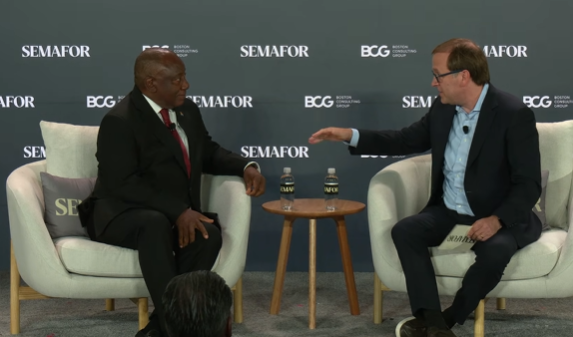
South Africa wants a larger role in the global artificial intelligence industry, with President Cyril Ramaphosa taking a delegation of startups, university graduates and government officials to the United States to pursue investment and technology partnerships.
The delegation’s planned engagements with OpenAI, Anthropic, Microsoft and Google form part of an effort to build domestic AI capabilities, attract foreign capital and expand the country’s technology industry. Ramaphosa says South Africa wants to participate in the development of AI rather than remain a consumer of systems built elsewhere.
He brought approximately 300 South Africans to the United States, including 27 postgraduate students with knowledge of AI, about 24 startups and ministers responsible for portfolios including finance, trade and industry. The visit also included planned discussions with investors and US businesses already operating in South Africa.
Ramaphosa said about 600 US companies have a presence in the country and that his government wants more of them to expand their operations. He is seeking investment agreements and partnerships that can support the development of local businesses and technical expertise.

South Africa wants more than access to foreign AI technology
The investment campaign comes as AI infrastructure and computing capacity become increasingly important to the technology industry’s development. Countries seeking to participate in the sector need access to data centres, advanced processors, reliable electricity, connectivity and skilled workers.
South Africa has an existing base on which to build. Ramaphosa told the Semafor Silicon Valley & The World event that the country is home to almost 70% of the data centres established on the African continent. He also said South Africa has electricity generation capacity that can support further data centre development.
Local technology companies are already developing infrastructure and commercial relationships around AI. Cassava Technologies, for example, operates an AI factory in Cape Town equipped with 2,048 NVIDIA GPUs, according to its executive Ziaad Suleman in a November interview with TechTrendsKE.
Cassava has also been building relationships with international technology providers. The company has an arrangement to distribute Anthropic’s Claude models through Amazon Bedrock, while its partnership with Mauritius Telecom is intended to expand access to AI computing and services. It is also involved in a World Bank initiative with Nvidia to develop African AI computing capacity.
These relationships give South Africa an established commercial base from which to pursue further investment. Ramaphosa’s planned engagement with Anthropic is particularly relevant given the existing Cassava distribution arrangement, while discussions with other global technology companies could open opportunities around infrastructure, research and local AI development.
Cassava’s infrastructure gives the investment drive a local foundation
The presence of an operating AI facility in Cape Town offers a practical example of the infrastructure South Africa wants to develop. Cassava’s investment connects computing hardware to a wider network of data centres, fibre infrastructure and regional partnerships.
The company’s agreement with Mauritius Telecom also illustrates the potential for South African infrastructure to serve businesses in other African markets. Its involvement in the World Bank’s AI computing initiative points to a wider effort to make advanced computing resources accessible to organisations that may not be able to finance their own large facilities.
Other technology companies are developing similar relationships across the continent. Google’s African AI Lab has selected startups working on applications in areas such as healthcare, agriculture and digital access. Its programme provides technical support and access to AI models, with Kenya’s Satlyt among the participating companies.
Such programmes offer a route for local businesses to develop applications using technology supplied by global companies. Ramaphosa’s inclusion of approximately 24 startups in the US delegation puts those businesses within the investment and partnership discussions he hopes to advance.
The South African government also wants universities and graduates involved in the sector. Bringing 27 postgraduate students to the United States gives the delegation a skills and research component alongside its commercial objectives.
Starlink dispute exposes the terms of foreign technology entry
Ramaphosa’s remarks about Elon Musk and Starlink provide another dimension to South Africa’s approach to international technology companies.
The satellite internet service has struggled to secure entry into the South African market because of regulatory requirements linked to Black Economic Empowerment. The policy framework is intended to address economic inequalities created under apartheid, including the limited ownership and participation of Black South Africans in major businesses.
Ramaphosa said foreign companies must comply with South African policies if they want to operate in the country. He also criticised Musk’s understanding of apartheid’s legacy, arguing that the technology billionaire had benefited from an education system that gave white South Africans advantages denied to most Black citizens.
The dispute extends beyond the two men. Telkom has challenged aspects of the ownership rules affecting Starlink’s entry, with the company arguing that regulators should recognise other contributions to economic empowerment, including investment in infrastructure, skills development and local supply chains.
TechTrendsKE’s reporting on Starlink across Africa shows that the company has faced different regulatory outcomes in individual markets. Uganda shut down unauthorised Starlink use before the company secured approval and moved towards commercial distribution through Paratus. Namibia rejected Starlink’s application and appeal, while Côte d’Ivoire approved its entry. In the Democratic Republic of Congo, Airtel and Starlink have pursued satellite-to-mobile services.
The company has also developed commercial relationships with established telecommunications operators. Amazon’s Leo satellite service, for example, has pursued a South African arrangement through Herotel, which handles the consumer-facing broadband business under its local licences.
These developments show the range of market-entry arrangements available to satellite operators across Africa. In South Africa, the dispute over Starlink remains tied to the country’s requirements for local participation in telecommunications businesses.
Computing capacity, skills and jobs remain central to the ambition
Ramaphosa wants AI investment to support productivity and the development of services in education, healthcare and agriculture. He has also argued that the technology should create employment opportunities rather than simply displace workers.
The scale of that ambition will depend on how effectively infrastructure investment connects with local businesses and the wider workforce. Data centres provide computing capacity, while startups and established companies develop the applications that can be sold to businesses, governments and consumers.
African technology companies are already working on those applications. Google’s AI Lab supports startups developing products for local markets, while Orange has been working on AI models and voice-based services in African languages. Its work includes integrating voice capabilities into financial services, including mobile transactions.
Enterprise adoption also requires technical staff and governance systems. Safaricom CTO James Maitai has described the telecommunications company’s work on data platforms, AI teams and internal expertise as part of its approach to deploying AI.
Ramaphosa’s concern about the effect of AI on employment and human decision-making also extends to international governance. He called for global guardrails and human control over AI systems, citing risks that include job displacement and the use of autonomous weapons.
Ramaphosa pursues US technology partnerships despite diplomatic tensions
The visit comes as relations between Washington and Pretoria remain strained. Ramaphosa told the Semafor event that he had attempted to contact US President Donald Trump before travelling to the United States but did not receive a response.
He described their previous Oval Office encounter as an ambush, arguing that Trump had been seriously misinformed about South Africa. Ramaphosa disputed allegations of white genocide and said footage and press material presented during the meeting did not accurately depict the country.
The disagreement has unfolded alongside US aid cuts, trade tensions and Trump’s absence from the G20. Ramaphosa nevertheless said the relationship between the two countries remains important and should be based on mutual respect, transparency and international law.
His engagement with US technology companies is taking place within that difficult political relationship. The South African president wants American businesses to expand their presence in the country while maintaining the government’s position that foreign investors must comply with local policies.
For South Africa, the immediate investment pitch is directed at companies developing AI models, cloud services and advanced computing. The wider ambition is to expand the domestic businesses, infrastructure and technical workforce that can participate in the industry.
Visit TECHTRENDSKE.co.ke for more tech and business news from across Africa and the world.
Follow us on WhatsApp, Telegram, Twitter, and Facebook, or subscribe to our weekly newsletter so you don’t miss future updates. Send tips to info@techtrendsmedia.co.ke

