
The next smartphone battle will extend beyond processors and camera megapixels

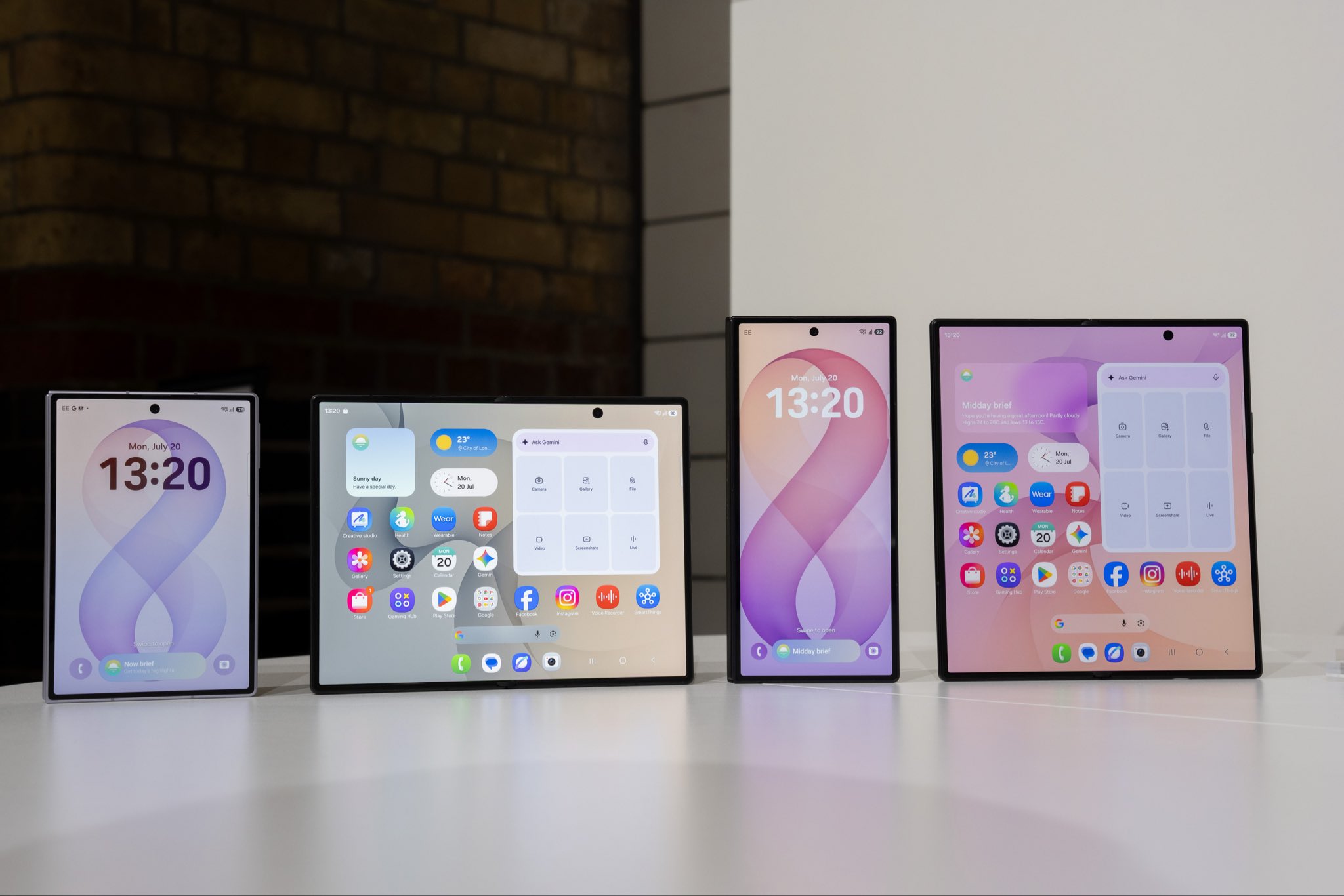
The premium smartphone market is moving beyond the familiar annual contest over faster processors, higher megapixel counts and larger batteries. Recent launches have expanded the range of premium devices, with foldables taking a larger role and manufacturers revisiting display construction, camera hardware and software services.
Samsung’s Galaxy Z Fold8 range illustrates the growing variety within the foldable category, while Apple’s iPhone 18 Pro models have brought variable aperture cameras to its flagship lineup. Oppo and other manufacturers are also exploring new display designs, while reports point to further developments in triple-folding devices and slidable smartphones.
The next round of competition is already taking shape. Samsung is reportedly considering new display technology for its Galaxy S27 range, Apple is working towards its 20th-anniversary iPhone, and Google is developing a feature that could make it easier to use one mobile number across two Android phones. These developments cover different approaches to premium hardware, software and device connectivity.
Smartphone makers are changing the shape of flagship devices
Display design remains one of the most visible areas of competition. Samsung is reportedly considering an extremely bezel-less screen for some future Galaxy flagships, bringing the display closer to all four edges of the phone.



The report does not identify a specific Galaxy model or launch date. Samsung Display’s position as a major OLED supplier to Apple has prompted speculation about similarities between its development work and the display planned for Apple’s 20th-anniversary iPhone, expected in 2027. There is no confirmation that Samsung has access to Apple’s confidential product plans.
Apple is also reported to be developing a more rounded design for its anniversary iPhone, with quad-curved front glass and much slimmer bezels. Separate reports suggest the iPhone 20 Pro could return to a titanium frame after Apple used aluminium on the iPhone 17 Pro and iPhone 18 Pro generations. Early engineering work on the frame is reportedly underway, although Apple has not confirmed the design.
Oppo is pursuing a similar visual direction. A reported design for a future Pro Max model combines a flat display panel with cover glass curved along all four sides. The visible bezel is said to measure approximately 0.3mm. The design remains at an early stage and has not been confirmed by Oppo.
Samsung’s next Galaxy S series is also expected to introduce changes to display technology. Reports point to M16 OLED material for the higher-end S27 Pro and S27 Ultra, while the standard S27 and S27+ are expected to use a different OLED material. Other reported features include DC dimming and Privacy Display technology on selected models.
The exterior construction is less settled. Current expectations point towards aluminium frames and glass panels for the S27 family, but Samsung has not confirmed the materials. The standard and Plus models are expected to use Armor Aluminum, while the precise frame material for the Ultra remains unclear. Samsung and Corning may also be developing a self-healing surface coating for a future Gorilla Armor product.
Camera hardware is receiving renewed attention
Smartphone camera development has relied heavily on larger sensors, computational photography and software processing. Variable aperture is one hardware feature receiving renewed attention.
Samsung introduced a variable-aperture main camera on the Galaxy S9 and S9+ in 2018, allowing the lens to switch between wider and narrower openings. The company dropped the feature with the Galaxy S20 generation. Recent reports suggest it could return on the Galaxy S28 Pro and S28 Ultra, potentially in early 2028.
Apple introduced variable aperture on the iPhone 18 Pro and iPhone 18 Pro Max in 2026. Huawei has also used the technology, while Honor is reportedly preparing to bring it back on a future Magic-series flagship.
A variable aperture controls how much light reaches the camera sensor. A wider opening allows more light into the lens, while a narrower one can increase depth of field. The results depend on the sensor, lens and image-processing system.
Apple is also reportedly preparing a new main camera sensor and image signal processor for the iPhone 20 Pro. One report points to a 17nm image-processing chipset, although the expected improvements have not been detailed. The phone is also expected to retain variable aperture.
Foldables are expanding into new form factors
Samsung’s Galaxy Z Fold8 and Fold8 Ultra illustrate how manufacturers are developing distinct products within the premium foldable category. Both devices received Best of Innovation recognition in the Mobile Devices, Accessories and Apps category ahead of CES 2027, according to Samsung.
The standard Fold8 has a 7.6-inch internal display, while the Ultra increases that to 8 inches. The larger model also has a camera system built around a 200MP main sensor, alongside a 10MP telephoto camera and a 50MP ultrawide camera.
The Fold8 Ultra measures a reported 4.1mm when unfolded and weighs 215g, with a 5,000mAh battery. Samsung has positioned it as its higher-performance foldable, while the standard Fold8 offers a different configuration within the same product family.
Apple has entered the foldable category with the iPhone Duo, which uses Touch ID. Reports about its successor, the Duo 2, say Apple is prioritising Face ID integration into the outer display. A telephoto camera and a thinner, lighter body are also among the reported development goals.
Samsung is reportedly working on another generation of its triple-folding phone. The proposed Galaxy Z TriFold 2 is expected to address the thickness and weight of the first model, which measured 12.9mm thick and weighed 309g. A redesigned hinge mechanism is among the reported changes.
The original TriFold was priced at $2,899 and was discontinued three months after its December 2025 release. Reports suggest Samsung could launch its successor as early as July 2027, potentially at the same price as the first model. Neither the launch timing nor the pricing has been confirmed.
The company is also reportedly developing a slidable smartphone. Rather than using hinges to open a larger screen, the device would extend its display from the handset. Specifications and a possible launch date have not emerged.
These projects extend Samsung’s foldable development beyond the conventional book-style design. The company is exploring devices with additional folding sections and screens that expand without a traditional hinge.
Smartphone software is becoming a separate revenue opportunity
Artificial intelligence is becoming part of how manufacturers differentiate flagship devices. Samsung is considering a Galaxy AI subscription that would offer advanced capabilities and higher usage allowances while retaining core features at no charge.
The proposed services include AI video generation, automated actions across applications and additional usage credits. Samsung has said its core Galaxy AI features will remain free, while certain advanced capabilities or new services could be offered as paid options.
Google is exploring a different software development through Android Fast Switch. Code discovered in Google’s SIM Manager points to a feature that could allow one mobile number to operate across two phones, automatically switching service to the unlocked device.
The concept resembles Apple’s implementation on the iPhone Duo. Google’s feature has not been announced, and carrier support, pricing and device compatibility remain unknown. The feature may also require both phones to use the same Google account.
Component costs are putting pressure on smartphone portfolios
The development of more specialised flagship devices is happening as manufacturers face higher production costs. Memory prices and competition for electronic components have put pressure on smartphone margins, particularly in entry-level and midrange segments where manufacturers have less room to increase retail prices.
Samsung’s reported plans to reduce Galaxy A production in late 2026 and into 2027 provide an indication of the pressure. The company is reportedly planning a 20% reduction in its fourth-quarter 2026 Galaxy A production target compared with its original plan. It is also considering a further reduction of at least 10% in 2027. Rising memory and component costs are among the factors cited in the reports.
The Galaxy A range remains central to Samsung’s smartphone volumes, while the Galaxy S and Z families target higher-priced segments. The reported production adjustments come as the company continues to develop its premium portfolio.
According to TechInsights figures, Samsung’s smartphone unit sales in Africa increased 34.8% year on year in the second quarter of 2026, while the wider market contracted by 16.6%. The company led the region in both revenue and unit sales during the quarter.
Samsung attributed part of its performance to instalment plans that allow customers to pay for devices in daily or weekly amounts. The company said these arrangements accounted for 46% of its smartphone revenue in Africa during 2026. Sales of its Galaxy S and Z series in the region also increased by 20% year on year.
The company has also cited its after-sales network, which covers 281 locations across 38 African countries, as part of its regional strategy. Financing arrangements, retail availability and support services form part of its efforts to reach customers across different price segments.
Samsung’s African business therefore spans both its lower-priced Galaxy A range and its premium S and Z devices. Its regional sales growth has coincided with increased sales of the flagship families, even as the wider smartphone market contracted.
The next product cycles will bring further developments in display construction, camera hardware, foldable formats and AI services. Manufacturers are also adjusting production plans as component costs influence the economics of devices across their portfolios.
Visit TECHTRENDSKE.co.ke for more tech and business news from across Africa and the world.
Follow us on WhatsApp, Telegram, Twitter, and Facebook, or subscribe to our weekly newsletter so you don’t miss future updates. Send tips to info@techtrendsmedia.co.ke

