
Dangote’s refinery IPO is crossing into Kenya, but Lamu is a different story
A proposed NSE GDR could give Kenyan investors local access to Dangote’s Nigerian refinery IPO as a separate Lamu project takes shape.

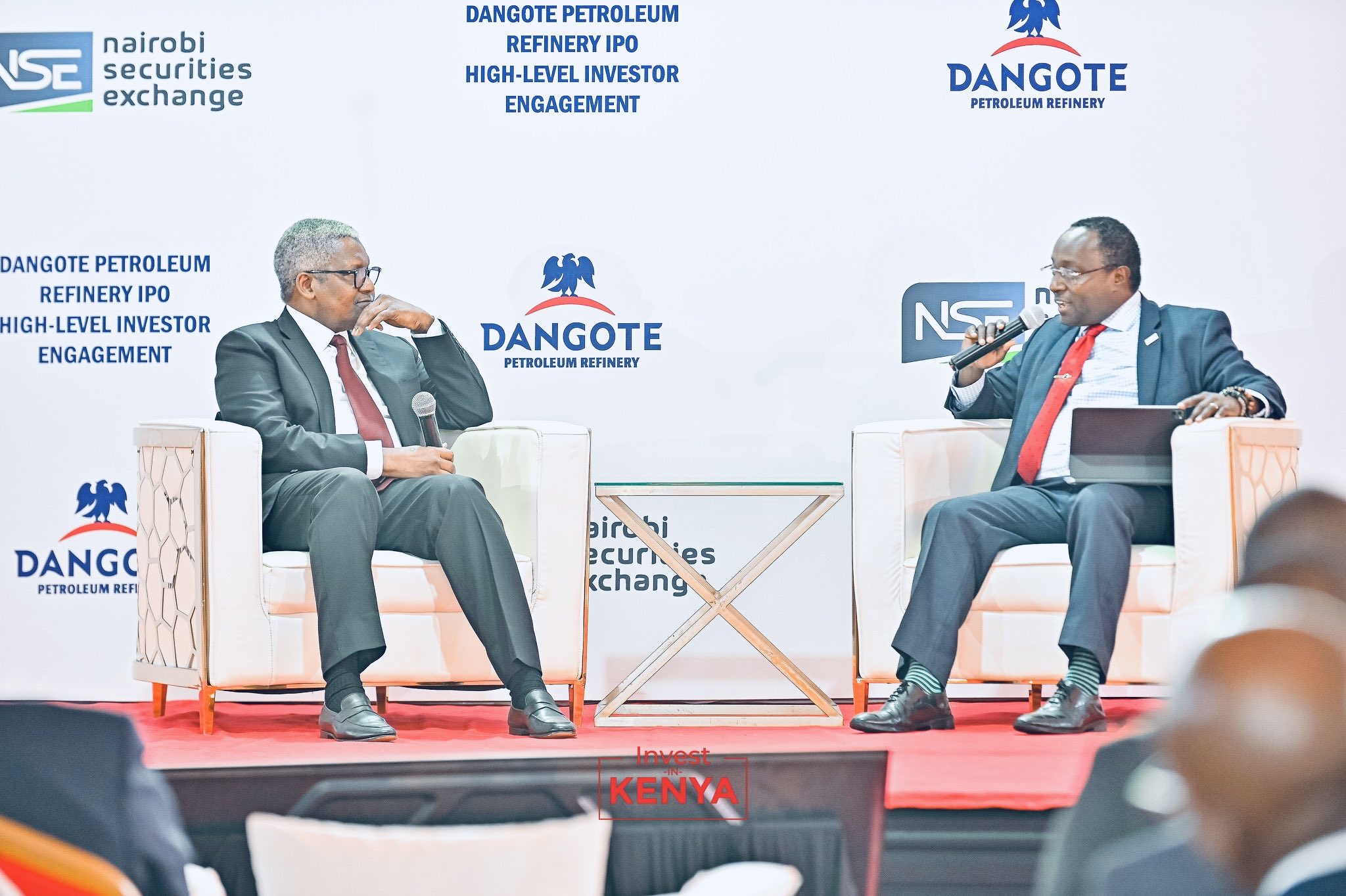
The Dangote IPO is now open to eligible Kenyan investors through a global depositary receipt (GDR) structure, but the final terms have introduced a much higher entry point than the roughly Sh490 minimum that had previously been discussed for the local market.
The Capital Markets Authority (CMA) approved a Short Form Prospectus submitted by Renaissance Capital (Kenya) Limited on October 5, clearing the regulatory route for Kenyan participation in the initial public offering of Dangote Petroleum Refinery & Petrochemicals in Nigeria. The Nigerian IPO opened on September 14 and closes on October 13, with 4.1 billion shares being offered at ₦525 each.
Under the approved GDR programme, investors will need to buy at least 2,000 receipts at Sh53.50 each, putting the minimum subscription at Sh107,000. Additional subscriptions will be available in multiples of 100 GDRs, with no stated upper limit. Renaissance Capital has targeted December 8 for the official NSE listing, although the admission remains subject to the required Nigerian regulatory approvals and completion of the underlying share allocation.
That makes the final structure materially different from the entry point that had been discussed before CMA approval. Earlier plans had envisaged a minimum investment of roughly Sh490, equivalent to the Nigerian IPO’s minimum subscription of 10 shares at ₦525 each. The two investments are structured differently, but the difference in the minimum cash commitment is significant.

How the Dangote GDR route works
A global depositary receipt is a negotiable security issued against shares held in another market. It allows an investor to obtain exposure to a foreign company without directly buying and settling the underlying shares in that company’s home market.
For the Dangote transaction, the underlying ordinary shares will remain in Nigeria while the GDRs are intended to provide Kenyan investors with a security that can be traded through the Nairobi Securities Exchange.

The structure can be understood in simple terms:
Kenyan investor → local selling agent or intermediary → Renaissance Capital Kenya → Nigerian transaction arrangements → Dangote IPO allocation → custody of underlying shares → GDR creation → NSE admission and trading.
Renaissance Capital Kenya is responsible for the GDR structure and will work with Renaissance Capital Africa, which is licensed in Nigeria. Stanbic Bank Kenya is expected to act as custodian for the underlying shares and support the link between the Nigerian securities and the receipts traded in Kenya.
The attraction for investors is that the eventual receipts can be traded and settled through Kenya’s existing capital-market infrastructure rather than requiring each investor to establish a separate arrangement in Nigeria.
But the GDR is not yet an NSE-listed security.
CMA’s approval clears the Kenyan regulatory hurdle for the prospectus and allows Renaissance Capital Kenya to pursue the listing. The Nigerian IPO must first close and allocations must be confirmed before the underlying shares required to create the receipts can be established. The proposed NSE admission also remains subject to relevant approval from Nigeria’s Securities and Exchange Commission.
The Sh107,000 entry point changes the retail equation
The biggest change for Kenyan investors is the minimum subscription.
The approved programme requires at least 2,000 GDRs, each priced at Sh53.50. That gives an initial commitment of Sh107,000 before any applicable transaction, brokerage or other charges.
The Nigerian IPO itself has a minimum subscription of 10 shares at ₦525, or ₦5,250. At the exchange rate used when the Kenyan structure was initially being discussed, that was equivalent to roughly Sh490.
The comparison needs some care because a Nigerian ordinary share and a Kenyan GDR are not the same market instrument. The GDR incorporates the depositary and cross-border infrastructure needed to represent and trade the underlying foreign shares.
Even so, the difference in minimum cash commitment changes the accessibility of the Kenyan route.
Earlier expectations had been that the local structure would allow Kenyan investors to participate at roughly the same low entry point as the Nigerian retail offer. The approved terms instead put the minimum at Sh107,000.
For smaller investors, the question is therefore no longer simply whether Kenya has a route into the Dangote IPO. It is whether the approved structure fits the amount they are prepared to commit.
The GDR price is not the same as the Nigerian IPO price
The Sh53.50 GDR price should also not be confused with the ₦525 price of the underlying Nigerian IPO shares.
The GDR is a separate tradable instrument whose price and terms are determined by the structure of the depositary programme. Its value can be affected by the underlying Dangote shares, exchange-rate movements, liquidity and other market factors.
The final investment proposition therefore needs to be assessed using the GDR’s own terms rather than treating the Sh53.50 price as a simple conversion of ₦525.
CMA has also cautioned investors that GDRs have features that differ from conventional securities traded through the NSE. The regulator has advised interested investors to read the Short Form Prospectus and seek independent professional investment advice.
A new route for cross-border investing
The Dangote transaction is significant beyond the company itself because it puts Kenya’s depositary-receipt framework into practical use.
CMA describes the transaction as the first of its kind since Kenya introduced its policy framework for Global Depositary Receipts and Global Depositary Notes. The framework is intended to allow Kenyan investors to gain exposure to securities connected to companies outside the domestic market while using regulated local-market infrastructure.
That gives the Dangote offer a wider capital-markets dimension.
A Kenyan investor does not need to become a direct participant in the Nigerian market simply to obtain exposure to the refinery. Instead, the GDR provides a local instrument through which the investment can eventually be traded and settled in Kenya.
For the NSE and Kenyan financial intermediaries, the transaction also provides a practical demonstration of whether this kind of cross-border structure can be used for other African securities in future.
Other Kenyan firms are facilitating the Nigerian IPO
Renaissance Capital Kenya’s GDR programme is separate from the arrangements being used by other Kenyan firms to help their clients participate directly in the Nigerian IPO.
CMA lists CPF Capital & Advisory, SBG Securities/Stanbic Bank, Francis Drummond & Co, National Bank of Kenya/Access Bank, Sterling Capital, Kestrel Capital and AXYS Investment Bank among firms facilitating clients through arrangements or correspondent relationships with authorised transaction parties in Nigeria.
This distinction is important.
There are effectively two related routes being discussed in Kenya. Investors can participate in the Nigerian primary offer through approved arrangements with Nigerian transaction parties, while the GDR structure is designed to create a Kenyan-traded security against underlying shares acquired through the Nigerian process.
They should not be presented as if they are the same transaction.
What investors should expect next
The Nigerian IPO closes on October 13.
Investors in the GDR programme are expected to receive their units or receipts after the allocation process, with the published timetable providing for allotment on November 11 and the transfer of proceeds and crediting of units to investors’ CDSC accounts between November 12 and December 2. The proposed official NSE listing is targeted for December 8.
Those dates remain dependent on the completion of the underlying transaction and the outstanding regulatory requirements.
For investors, the immediate issue is therefore the terms of participation rather than the headline announcement that Kenya has access to Dangote.
The CMA approval has opened the route. The Sh107,000 minimum defines who can realistically use it.
This is not the Lamu refinery
There is another distinction Kenyan investors need to keep clear.
The IPO concerns Dangote Petroleum Refinery & Petrochemicals FZE in Nigeria. It does not represent an ownership interest in the proposed Dangote East African Petroleum Refinery and Petrochemicals project in Lamu County.
CMA explicitly clarified that the Nigerian IPO is not an offer of shares in the Lamu project.
That matters because Dangote’s plans for a major refinery and petrochemical complex in Lamu have generated considerable interest in Kenya.
The Nigerian GDR and the proposed Kenyan project are separate investment propositions.
If Dangote eventually lists the Lamu refinery on the NSE, as has been discussed, that would create a different opportunity involving a Kenyan industrial asset rather than a depositary receipt representing shares in an existing Nigerian refinery.
A bigger question for Kenya’s capital market
The Dangote transaction gives Kenya a new way of looking at cross-border investment.
The immediate attraction is access to one of Africa’s largest industrial IPOs. But the longer-term question is whether the infrastructure being assembled around the transaction can make Nairobi a practical gateway to other African securities.
The GDR route does not eliminate the complexities of investing across borders. It still involves two regulatory jurisdictions, custodial arrangements, currency exposure, allocation risk and a separate tradable instrument.
What it does is place much of that structure behind a security that Kenyan investors can access through their domestic market.
That is the real significance of the Dangote GDR.
CMA has cleared the Kenyan route. The Nigerian IPO is still running. The GDRs still need to be created and admitted to the NSE, and the Sh107,000 minimum means the eventual product will reach a different segment of investors from the mass retail audience targeted by the Nigerian offer.
The transaction therefore brings Dangote closer to Kenyan investors while also showing the limits of what cross-border access means in practice.
Real ESG impact doesn’t happen in panels alone, it happens in the rooms where financiers, operators, and policymakers actually align. Our GreenShift Forum 2026 cuts the noise, bringing together the people rewiring Africa’s sustainability and energy frameworks for one focused day in Nairobi. Secure your seat.
Go to TECHTRENDSKE.co.ke for more tech and business news from the African continent and across the world.
Follow us on WhatsApp, Telegram, Twitter, and Facebook, or subscribe to our weekly newsletter to ensure you don’t miss out on any future updates. Send tips to info@techtrendsmedia.co.ke


