

RhingGo takes electric tuk-tuks to Kisumu as its Kenyan mobility network expands

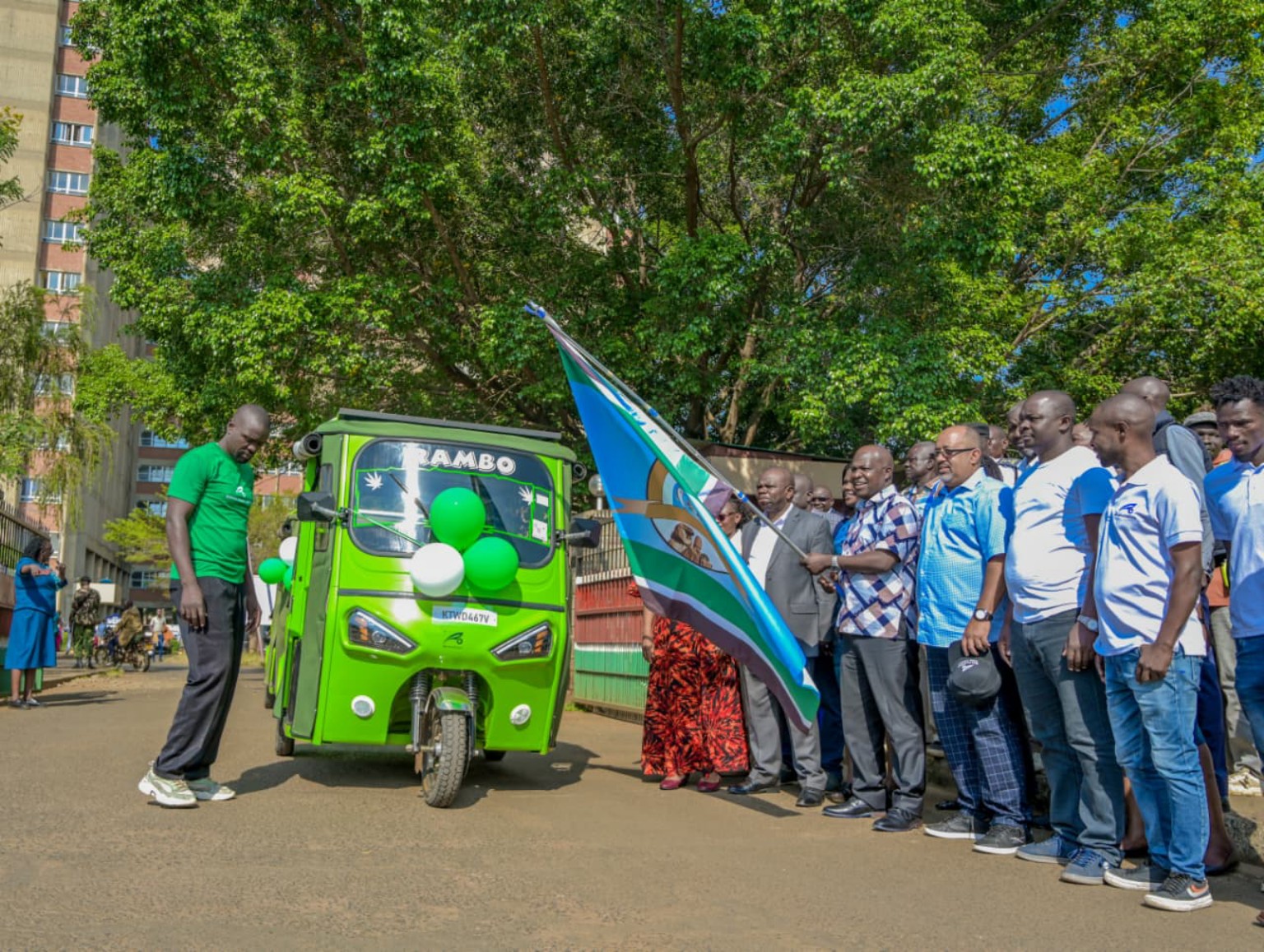
Electric tuk-tuks in Kenya are moving beyond the Coast as RhingGo Emobility expands its commercial mobility business into Kisumu. The company’s RM-T300, which is already being marketed and deployed in markets including Mombasa, Malindi and Nairobi, is now part of a wider push to make electric three-wheelers a practical option for passenger transport operators. The Kisumu launch, led by Deputy Governor Mathews Owili, puts another Kenyan city into the company’s growing operating network.
Owili said the move could help businesses deal with rising energy costs while supporting cleaner urban transport. His remarks were backed by officials responsible for trade, environment and roads and transport, reflecting the county government’s interest in electric mobility as both a transport technology and a potential source of economic activity.
For RhingGo, however, Kisumu is better understood as an expansion of an existing business than the beginning of its Kenyan electric tuk-tuk story. The company launched its RM-T300 in Mombasa in late 2025, promoting the vehicle around its 110-kilometre claimed range, swappable battery and solar range extender. RhingGo’s own website now lists the RM-T300 from KSh380,000 and describes it as a 45 km/h electric tuk-tuk with a swappable battery and a claimed additional 30 kilometres of daily solar range.
The company’s wider footprint is visible in its battery infrastructure. RhingGo currently lists swap stations in Nairobi, Kisumu, Mombasa and Malindi, with the Kisumu station located on Obote Road. The company says its battery exchange process takes under two minutes, allowing operators to replace a depleted battery rather than wait for the vehicle to recharge.


That infrastructure matters because an electric tuk-tuk used commercially has a different set of requirements from a privately owned electric vehicle. A driver depends on the vehicle being available for much of the day, so charging time becomes part of the business calculation. Battery swapping can reduce that downtime, but it also creates another dependency: operators need convenient stations and a reliable supply of charged batteries.
RhingGo’s own company profile describes its business around electric motorcycles, tricycles and battery solutions for emerging markets, with affordability and reliability at the centre of its proposition. It also links the technology directly to lower fuel costs and cleaner transport for riders and businesses.
The RM-T300 therefore comes with a proposition that goes beyond replacing a petrol engine with an electric motor. RhingGo is combining the vehicle with a battery-swapping network, financing arrangements and, according to its own product material, a solar range extender. The company’s current financing page lists Watu Credit, M-KOPA, Navi and Rafiki Microfinance among its financing partners.
The price makes the proposition easier to examine. RhingGo advertises the RM-T300 from KSh380,000, while promotional material for the vehicle shows financing options with deposits of roughly KSh75,000 to KSh78,000 and daily repayments ranging from about KSh764 to KSh816 over two years. Those figures make the acquisition cost more accessible, but they also illustrate one of the central questions facing electric mobility in Kenya: lower running costs do not automatically mean a lower total cost of ownership.
A separate LinkedIn account about a RhingGo owner in Diani provides another example of the calculation. The post describes a KSh360,000 financed vehicle, an 18-month repayment period and daily payments of about KSh900, alongside a reported fuel saving of roughly KSh1,000 a day. Those figures should be treated as an individual operator’s account rather than a representative measure of what every RhingGo owner can expect, but they show why financing and energy costs are becoming closely linked in the electric transport business.
The economics also depend on utilisation. A tuk-tuk that spends most of its day carrying passengers can capture more value from lower energy costs than one that makes only a few trips. That is one reason the reported addition of RhingGo’s RM300 to the Bolt fleet is worth watching. RhingGo Global Sales Director and Co-Founder Peiming Song said on LinkedIn that the RM300 had officially joined Bolt’s fleet, pointing to another route through which electric three-wheelers could enter Kenya’s organised ride-hailing economy.
That connection could matter beyond the individual vehicle. Ride-hailing platforms provide a source of passenger demand, while electric vehicles offer operators the possibility of reducing energy costs when utilisation is high. The commercial model still has to absorb platform commissions, financing, maintenance, battery-swapping costs and other operating expenses, but the combination creates a clearer business case than relying on private consumers to adopt electric vehicles simply because they are cleaner.
RhingGo’s expansion also arrives as Kenya’s wider electric mobility market moves beyond the capital. Data cited by TechTrends from the Electric Mobility Association of Kenya put registered electric vehicles in the country at more than 35,000 by the end of 2025, with electric motorcycles accounting for much of the growth. Kenya Power has also reported rising electricity consumption from the e-mobility sector, while charging and swapping infrastructure is spreading into secondary cities and transport corridors.
Kisumu is particularly relevant to that infrastructure story. Kenya Power, GIZ Kenya, the Electric Mobility Association of Kenya and the Kühne Foundation have already used the Nairobi-Kisumu corridor for electric vehicle trials aimed at assessing charging readiness and range concerns. RhingGo’s decision to establish a battery-swapping point in the city adds another piece of that emerging ecosystem.
The company also arrives with evidence of activity at the Coast. The Electric Mobility Association of Kenya said in July that RhingGo had marked its first anniversary in Kenya and reported company figures of 2,000 units sold, 24 million kilometres covered and 1.6 million kWh of energy delivered. EMAK also attributed reported fuel savings and avoided emissions to the company’s operations. These are company figures shared by the industry association, rather than independently audited market data, but they provide an indication of the scale RhingGo says it has reached during its first year in the country.
The challenge now is whether that model travels well between markets. Mombasa has a long-established tuk-tuk economy and a large passenger market, while Kisumu has its own transport patterns, road network and operating conditions. Nairobi presents another set of constraints, including traffic, regulation and competition from motorcycles, matatus and ride-hailing cars.
That makes the Kisumu rollout more interesting than a simple county launch. RhingGo is bringing together a vehicle, energy infrastructure and financing model in a city where electric mobility is already gaining ground. The company says more swap stations are planned in places including Nakuru and Eldoret, suggesting that Kisumu is part of a wider geographic expansion rather than an isolated deployment.
The harder test will be whether operators can make the numbers work consistently. An advertised KSh380,000 purchase price, a claimed 110-kilometre range and a two-minute battery swap are useful starting points, but the real measure will be how much an operator spends each day, how much revenue the vehicle generates, how often it needs servicing and how reliably batteries can be swapped when the vehicle is working a full commercial shift.
That is where Kenya’s electric tuk-tuk market is likely to be decided. Cleaner transport is an important part of the proposition, but for the driver buying the vehicle on finance, the calculation remains grounded in daily income, energy costs, repayments and uptime. RhingGo’s expansion from the Coast into Kisumu, alongside its Nairobi presence and reported ride-hailing activity, provides a useful test of whether an electric three-wheeler can make that calculation work outside its earliest market.
Download the FREE Kaspersky Next Enterprise Security Guide here to explore the complete framework for simplifying security operations and building cyber resilience.
Go to TECHTRENDSKE.co.ke for more tech and business news from the African continent and across the world.
Follow us on WhatsApp, Telegram, Twitter, and Facebook, or subscribe to our weekly newsletter to ensure you don’t miss out on any future updates. Send tips to editorial@techtrendsmedia.co.ke