From irregular contributions to inadequate pensions, Jacqueline Karasha outlines Kenya’s retirement challenge as Sanlam Allianz prepares for change
Sanlam Allianz’s Jacqueline Karasha faces Kenya’s retirement income gap as she prepares to lead the group

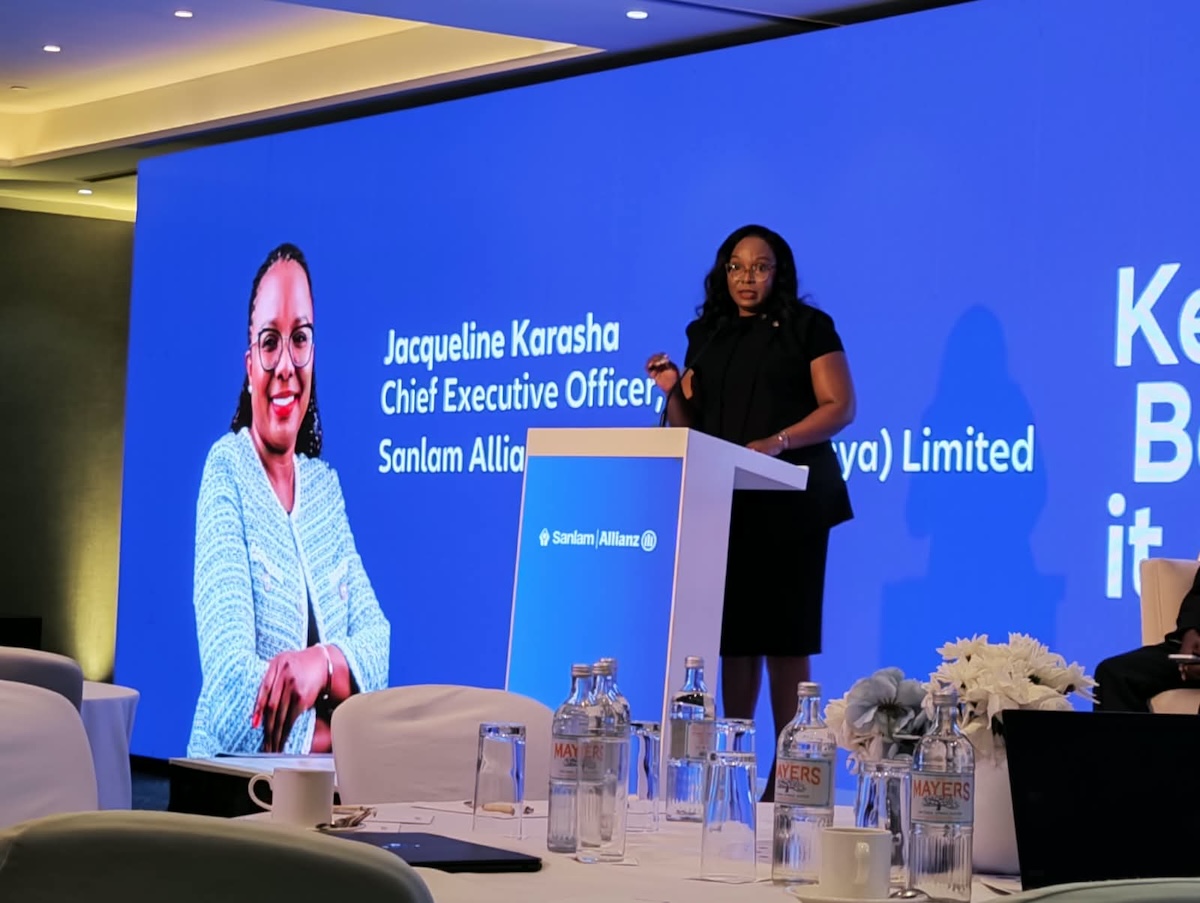
Kenya’s retirement savings challenge extends beyond getting people to contribute to a pension. It also concerns whether workers can keep their savings intact when they change jobs, understand how much income their accumulated funds can provide and afford to prepare for life after employment. Jacqueline Karasha, incoming Group CEO of Sanlam Allianz Holdings (Kenya) PLC, says the scale of that challenge is visible in the incomes many retirees receive.
“Over 40% of Kenyans earn less than 20,000 in retirement. Those who have had a pension scheme,” Karasha said, discussing the SanlamAllianz Retirement Benchmark Report Kenya 2026. She said that level of income was barely enough to make ends meet, describing the risk facing the country as “avoiding retirement poverty.”
Karasha is currently chief executive of Sanlam Allianz Life Insurance (Kenya) Limited and is due to take over the group leadership on November 1, 2026, succeeding Dr. Nyamemba Patrick Tumbo, who retires on October 31 after leading the listed insurer for more than eight years. Her appointment comes as Sanlam Allianz pursues the planned absorption of its life insurance subsidiary into the listed parent, following a period of corporate restructuring that included a KSh2.5 billion rights issue completed in May 2025.
The retirement benchmark, based on a survey of 300 respondents across different retirement life stages, found that seven in 10 were not on track for a comfortable retirement. Only 29% said they were on track, while 44% expected some provision but a lower standard of living and 21% thought they were unlikely to have enough. Six per cent were unsure. The sample was predominantly urban, reasonably well educated and broadly middle income, making the results indicative of the experiences captured by the survey rather than a nationally representative estimate.


Kenya’s retirement gap starts with household finances
Karasha said the findings pointed to financial pressure rather than a simple lack of interest in retirement planning. “The most interesting thing is not that Kenyans do not want to save or do not have the desire or they’re ignorant about the importance of this item of retirement planning. It really is about the pressures,” she said.
Those pressures often converge around payday, when one income must support several people and obligations. “One wallet has so many dependents,” Karasha said, describing how money arriving in an account can quickly be absorbed by household demands. The report reflects that squeeze: 44% of respondents cited family or household costs as a barrier to saving more regularly, 37% pointed to low or irregular income, and 24% cited debt repayments. Respondents could select more than one answer.
Some 62% said supporting dependants reduced their ability to save for retirement either a lot or somewhat, rising to 66% among respondents aged 40 to 64. Meanwhile, 75% said they would increase the amount they set aside if they could revisit their decision. The latter is a stated preference rather than evidence of actual contributions, but it reinforces Karasha’s argument that the ability to save competes with immediate responsibilities.
The pressure also reflects changes in employment. Karasha contrasted today’s more mobile workforce with previous generations who could remain in one job for decades, take out a mortgage and educate several children on a single payslip. “The reality of today’s Kenyan is that jobs are not certain,” she said, pointing to employment uncertainty and high unemployment as challenges for a pension system still structured largely around formal employment.
The report found that 39% of working-age respondents said the amount they earned changed even when their income generally arrived monthly. For workers whose earnings fluctuate, a fixed contribution can be hard to maintain alongside rent, school fees, food and debt. In a separate informal-worker module, 33% of working-age respondents preferred to contribute small amounts whenever money was available.
Why pension savings leak when workers change jobs
Changing jobs can also scatter pension savings across different schemes, leaving workers without a clear picture of what they have accumulated. Karasha said some people withdraw part of their savings when they leave employment, while others forget that they have money in a previous employer’s scheme.
“You have scattered savings all over the place. You have no visibility,” she said. Without a consolidated view of their pension balances, savers may struggle to assess whether they are on course for retirement or how much more they need to contribute.
The benchmark found that among a subgroup of 90 respondents who had left a job or closed a business while holding retirement savings, 53% had withdrawn at least some of the money available to them. Another 32% had kept or transferred all accessible savings, while 15% did not know withdrawal was possible. The figures apply to that subgroup, not to the full survey.
Among those who withdrew savings, 33% used the money to start or support a business or farm, while 17% used it for daily living costs, rent or household bills. Another 17% invested in property, land, livestock or another asset, and 16% used the money for healthcare or emergencies.
Karasha acknowledged the immediate pressures behind such decisions. “They knew at the back of their mind, this is going to have a long-term impact eventually to their overall retirement savings, but the immediate pressures of now then really come through,” she said.
The report found that 53% of those who withdrew savings later regretted the decision, even though 65% said they understood the effect it could have on their retirement. The findings point to a difficult balance for pension providers: protecting long-term savings while recognising that job loss, business closure and household emergencies can make access to that money attractive.
Turning pension balances into retirement income
Karasha said pension statements can give savers an encouraging impression without showing what their money will provide in retirement. She illustrated the difference using a balance of KSh3 million.
“If you told someone today that they have accumulated 3 million shillings so far, they’ll probably feel, ‘Wow, okay, that’s decent. That’s a tidy sum,’” she said. “But if you actually translate what that means in terms of retirement income, then you will find that that translates to probably less than 30,000 shillings a month for the rest of their life.”
She said pension planning needed to move beyond the size of accumulated assets and their investment growth to consider the income they could provide. “What does that mean in terms of retirement income for Kenyans? Is it really addressing that gap? Unfortunately not,” she said.
The report found that only 29% of respondents knew roughly how much monthly income they would need in retirement. Another 26% had a rough idea, while 25% had a savings target but no retirement-income target. Fifteen per cent had no retirement target.
The preference for dependable income is stronger than familiarity with the available options. Some 51% of respondents preferred a guaranteed monthly income for life, but 45% had never heard of income drawdown and another 27% had heard of it without understanding it well. For guaranteed annuities, 38% had never heard of the product and 31% said they did not understand it well.
Sanlam Allianz has products aimed at this stage of retirement planning. Its Income Drawdown Fund was launched in February 2026, while its retirement offering also includes annuities and savings products. The survey findings place these options in a market where many respondents favour predictable retirement income but are unfamiliar with some of the mechanisms used to provide it.
Digital pensions and the challenge of reaching informal workers
Karasha estimates that 25 million working Kenyans are outside a formal pension system. Many still have their own ideas about how they will support themselves in old age, including relying on land, property or their children.
“When you go on the ground and you speak to mama mboga, she’ll tell you that plot I have bought somewhere is my pension,” she said. Such assets can form part of a household’s financial plans, but Karasha said the assumptions behind informal retirement arrangements are becoming harder to sustain as family responsibilities change.
She argued that pension products need to fit the way people earn. “The way we have set up our products and the solutions we have around pension then have to totally shift from when I am earning to I can save as I earn,” she said, describing a model in which someone running a small business could direct a portion of daily sales or profits towards retirement savings.
That approach builds on the use of digital financial services in Kenya. Karasha said more than 80% of Kenyans had access to digital platforms, including mobile money, but that access had not translated into comparable participation in retirement saving. “Financial access does not mean financial inclusivity,” she said. The challenge, in her view, is to make saving part of routine financial activity rather than something people must remember to do separately.
She cited embedded saving as one way to address that problem. “If we embed the solutions in the day-to-day activity of Kenyans without them having to think about it,” she said, people could contribute more consistently. Karasha referred to a case study discussed during the report launch involving an automated savings solution on Safaricom’s Ziidi platform, saying its uptake showed how automatic contributions could help people build savings without having to make a separate decision each day.
The report supports the case for flexibility: 51% of respondents in its informal-worker module selected mobile money as their preferred contribution method, while 76% said they would join an affordable, flexible retirement product designed for informal workers. Another 78% said they would allow a small share of income, sales or a SACCO or chama payout to move automatically into retirement savings. These are stated preferences, not measured take-up.
Sanlam had already launched Akiba Plus as a digital individual pension plan. Karasha said the product’s average customer age was 28 and that customers were signing up themselves, setting payment methods and contributing when they could. She said they valued being able to see how their money was growing and to manage the process without depending on an intermediary.
“Products have to be simplified,” she said. “Products have to be digital and they have to be in a way they have the information.” Karasha said young customers wanted to understand what they were buying, rather than rely on an intermediary who held most of the information.
She also acknowledged that trust remains a barrier. “Does the public trust that when Sanlam Allianz comes and offers this solution that when I’m in retirement they will actually honour the commitment?” she asked. She said providers needed to improve awareness and education, with regulators playing a role in building confidence in retirement products.
Healthcare and investment choices shape retirement security
Retirement income is also affected by healthcare costs, which can consume savings when people leave employer-sponsored medical cover. Karasha said survey respondents ranked medical expenses among their major concerns, reflecting the financial consequences of serious illness for households that have limited protection.
“You’re one illness away from poverty and from selling all your assets just to deal with an illness in the family,” she said.
She said many workers spend much of their careers covered by an employer’s medical scheme, then face a different financial reality after leaving work. “We then should not separate the conversations as you are telling me how to plan for my income in retirement. There should be a corresponding plan about my medical,” she said.
Karasha put uptake of post-retirement medical funds at about 1%, describing it as very low. She said the industry had an opportunity to connect retirement saving with medical provision so that people could plan for both their living expenses and healthcare needs after leaving employment.
The benchmark found that 53% of respondents had either considered post-retirement healthcare costs but had not started planning for them, or had no plan at all. Another 43% said they would divide limited money between healthcare cover and retirement saving rather than choose only one. The figures underline the competing demands households face when preparing for retirement.
Investment decisions create another balancing act. Karasha said more than 70% of pension assets were invested in government securities and that the sector held about KSh3 trillion in pension assets. She said liquidity was one reason for the concentration, since pension funds must be able to pay retirees promptly.
“The moment someone retires, you cannot take three months, four months to address, to pay them their dues. It’s 14 days after retirement that you have to settle this,” she said.
Karasha said pension trustees had to weigh returns against risk and access to members’ money. “You have been entrusted as trustees, corporate trustees, to invest in the best form, risk management,” she said. “The members really want return, so I want the best return but with the lowest risk and I get my money as fast as possible.”
She said pension funds in other markets had a wider role in financing infrastructure, and pointed to discussions about potential pension investment in the proposed refinery in Lamu. For her, the challenge was to broaden investment options while maintaining the liquidity and risk management needed to meet pension obligations.
Karasha prepares Sanlam Allianz for its next phase
Karasha’s comments on the retirement market come as she prepares to lead a business undergoing further corporate consolidation. She joined the company in 2016 and has held roles including Head of Corporate Business and Chief Sales Officer before becoming CEO of Sanlam Allianz Life Insurance (Kenya) Limited. She has more than 17 years of industry experience and holds a First-Class Honours degree in Actuarial Science from Jomo Kenyatta University of Agriculture and Technology.
Asked about the company’s rights issue and internal reorganisation, Karasha described the preceding period as an effort to prepare the business for growth. “It’s been an active last two years or so,” she said. “Really what we’ve been doing as a business is to strengthen our fortress and strengthen our foundation for growth.”
She said the Kenyan market continued to offer opportunities because insurance penetration remained low and interest in financial products was growing. The work, she said, had included strengthening the core business and preparing the group to operate more efficiently.
The planned absorption of Sanlam Allianz Life Insurance (Kenya) Limited into the listed holding company is part of that process. The proposed reorganisation involves transferring the life business’s portfolio, assets reported at KSh38.47 billion, liabilities and fund administration to the parent.
Karasha said the life business had historically been the group’s central operation, even as the company’s branding evolved from Pan Africa to Sanlam and then Sanlam Allianz. She said the current developments around the holding company and life subsidiary were intended to build on that foundation.
“Everything that we’re doing is just to build around efficiency,” she said. “We want to be very efficient and agile and really to be able to return value first to the policyholders and to our shareholders.”
The restructuring follows a KSh2.5 billion rights issue completed in May 2025. In its half-year results for 2026, Sanlam Allianz Holdings reported net profit of KSh124.6 million, compared with KSh30.9 million a year earlier. Insurance revenue reached KSh2.2 billion, gross written premiums rose 32%, and the company said its balance sheet exceeded KSh40 billion, with a solvency ratio of 266%.
As Karasha prepares to take over, the retirement findings put the company’s product strategy and corporate direction in the context of a wider market challenge. Her argument is that pension saving must accommodate irregular earnings, offer customers visibility over their money and help them understand the income they can expect in retirement. For Sanlam Allianz, the next phase of consolidation will be led against that backdrop, with the stated aim of building a more efficient business while serving policyholders and shareholders.
Go to TECHTRENDSKE.co.ke for more tech and business news from the African continent and across the world.
Follow us on WhatsApp, Telegram, Twitter, and Facebook, or subscribe to our weekly newsletter to ensure you don’t miss out on any future updates. Send tips to editorial@techtrendsmedia.co.ke