
MTN’s new Africa Data Hub puts AI infrastructure at the centre of its Africa strategy

MTN is building a bigger infrastructure business around AI data centres in Africa, creating a new company that could become the vehicle for expanding its data centre, cloud and computing footprint across key markets.
Africa Data Hub Holding Limited was formed after MTN entered a strategic partnership with an undisclosed United Arab Emirates-backed data centre investment platform, according to the group’s interim results for the six months ended June 30, 2026. The arrangement gives MTN a structure through which future digital infrastructure projects can be developed and scaled.
The announcement comes after MTN spent the past year laying groundwork for a broader data centre strategy. South Africa and Nigeria have been identified as priority markets, while the company has been developing an AI-enabled platform aimed at cloud, enterprise and data-intensive workloads. The new holding company brings investment capital and specialist data-centre expertise into that strategy, potentially giving MTN more room to expand without funding every project from its own balance sheet.
MTN creates a new vehicle for AI infrastructure
Africa Data Hub Holding is designed to combine MTN’s African footprint, infrastructure and market knowledge with external investment and specialist data-centre expertise. MTN Digital Infrastructure will use the company as a platform through which future digital infrastructure opportunities can be developed and scaled across key African markets.


The distinction matters because AI data centres require a different level of infrastructure from conventional enterprise facilities. High-performance computing needs dense server deployments, substantial electricity, sophisticated cooling and high-capacity connectivity. Financing those facilities also requires significant upfront capital, making partnerships an important part of the expansion model.
MTN has already described digital infrastructure as a strategic growth platform alongside connectivity and fintech. Its broader infrastructure strategy covers fibre and AI-enabled data centres, with the company looking to capture demand from cloud, enterprise and other data-intensive services.

Africa Data Hub therefore looks less like an isolated corporate creation and more like a dedicated structure for a business MTN has already been developing.
Africa Data Hub builds on MTN’s wider cloud strategy
MTN’s data-centre plans make more sense when placed alongside its work on cloud platforms and network modernisation.
The company has moved major analytics workloads onto Microsoft Azure in South Africa. Its EVA 3.0 platform processes about 22 billion records a day, with more than 800 analytics workflows drawing from more than 1,700 data feeds. The migration gave MTN access to scalable cloud infrastructure while strengthening its internal cloud capabilities.
That does not mean MTN is trying to replace public cloud. The more likely direction is a hybrid infrastructure model in which public cloud, MTN-owned facilities, colocation capacity and distributed computing serve different workloads.
This could give MTN greater control over where certain workloads run while retaining access to hyperscale cloud services when they make more commercial or technical sense.
The group also has a sizeable potential demand base of its own. MTN reported 317.7 million customers across 19 markets in its June 2026 results, while data users and network traffic continued to grow. Its fintech business adds another substantial source of digital workloads through MoMo, which is itself moving toward cloud-native infrastructure in several markets.
That creates a connected infrastructure proposition: telecom networks generate data and connect customers, cloud platforms process workloads, fintech services create additional demand, and data centres provide the physical computing capacity underneath them.
MTN’s investment in ORAN Development Corporation adds another piece to the picture. ODC is developing a Distributed Compute Grid that is intended to turn parts of telecom infrastructure into computing locations capable of handling workloads closer to where data is generated.
The idea could eventually extend computing beyond large central facilities, allowing MTN to use its network footprint for applications where latency and local processing matter.
South Africa and Nigeria are the first major markets
MTN has already identified South Africa and Nigeria as its priority markets for the next stage of its data-centre strategy.
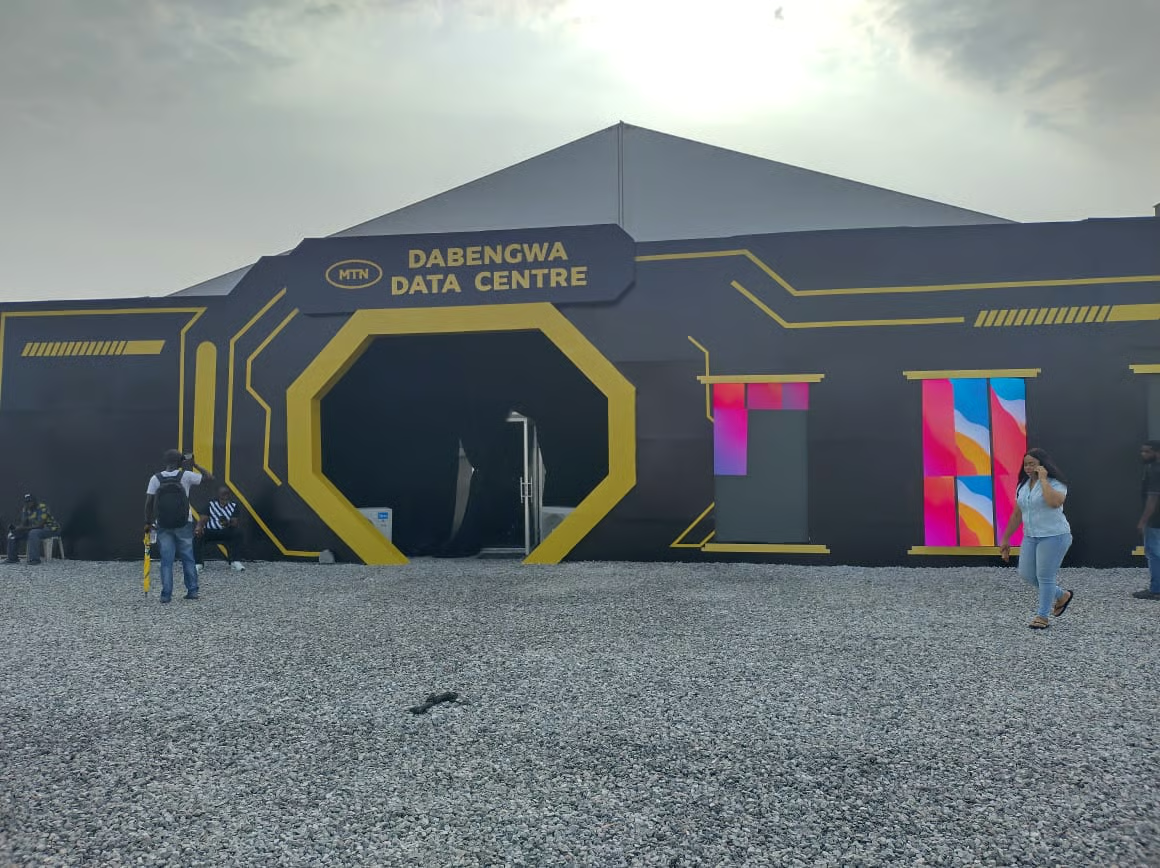
Nigeria already has a significant facility in the form of the Sifiso Dabengwa Data Centre in Lagos, where MTN launched the first phase in 2025. At launch, the facility was described as the largest data centre in West Africa.
South Africa provides a different advantage. MTN has an established enterprise and network footprint, with data centre and switching infrastructure in several locations, including Gauteng, Cape Town and KwaZulu-Natal.
The two markets also offer the scale that MTN needs if it wants to build a commercial AI infrastructure business. Both have large enterprise sectors, significant digital activity and growing demand for cloud and computing capacity.
MTN will, however, face established competition. Hyperscalers, specialist data-centre operators and infrastructure investors are putting substantial capital into African facilities, particularly in markets where fibre connectivity, enterprise demand and access to international cable systems make large-scale deployments viable.
MTN’s advantage is the combination of those digital infrastructure assets with its own customer base and network footprint.
AI data centres bring a tougher infrastructure challenge
The opportunity comes with a difficult physical constraint: AI needs a lot of power.
High-density AI servers consume considerably more electricity than conventional enterprise equipment and generate more heat, which puts pressure on cooling systems. Facilities designed around traditional server densities cannot simply be filled with AI accelerators and expected to perform in the same way.
This makes electricity supply, cooling and connectivity central to the economics of AI infrastructure in Africa.
The issue is particularly relevant because African markets are trying to expand data-centre capacity while dealing with constraints in power generation and transmission. Data-centre developers therefore have to consider grid reliability, backup systems, renewable energy, site selection and cooling technology alongside the usual questions of fibre connectivity and customer demand.
MTN’s telecom footprint gives it an advantage on connectivity, but it does not remove the power challenge. Building AI infrastructure will require access to suitable sites and reliable electricity at a cost that makes the resulting capacity commercially viable.
That is one reason the UAE-backed investment partnership matters. A well-capitalised partner with data-centre expertise can help MTN tackle the capital and operational demands associated with facilities that are far more infrastructure-intensive than conventional telecom sites.
Kenya offers an attractive market, but with conditions
Kenya has not been named as one of MTN’s current priority markets, so there is no basis for saying Africa Data Hub is preparing to build a facility here. The country is nevertheless relevant to the wider African data-centre race, particularly because Nairobi is developing into an important connectivity and cloud infrastructure hub.
Kenya now has a defined regulatory framework for commercial data centres. Under the revised Telecommunications Market Structure published by the Communications Authority of Kenya in June 2026, data centres fall within the Network Facilities Provider Tier 1 and Tier 2 licensing structure.
The framework gives the industry a clearer regulatory route while also treating data centres as important network infrastructure. NFP-T1 permits commercial data-centre establishment under a nationwide infrastructure licence, while NFP-T2 provides a more incremental structure for operators deploying infrastructure across the country.
The initial licence fee for both categories is KSh15 million, although the licence terms, spectrum arrangements and annual operating fees differ substantially between the two tiers. For a large AI data-centre project, the fee itself is unlikely to determine whether an investment proceeds. The more important issue is that operators must now account for the regulatory framework as part of their infrastructure planning.
Kenya also illustrates the other major challenge facing the continent: electricity.
The country has submarine cable landing points, established fibre routes and a growing data-centre market, but power availability remains a constraint on very large facilities. Concerns over electricity capacity have already featured in the stalled Microsoft-G42 data-centre project, demonstrating that strong digital demand alone does not guarantee that a major AI facility can be built quickly.
That makes Kenya a useful test case for MTN’s future expansion. If Africa Data Hub moves beyond South Africa and Nigeria, the company will have to assess markets on a combination of connectivity, enterprise demand, regulation, electricity and investment economics.
MTN is building more of the infrastructure behind Africa’s digital economy
The broader strategy becomes clearer when the different pieces are considered together.
MTN is operating one of Africa’s largest mobile networks, expanding cloud capabilities, developing cloud-native fintech infrastructure, investing in distributed computing and now creating a dedicated vehicle for data-centre expansion. Each initiative addresses a different layer of the digital economy, but they can also reinforce one another.
A large data centre can host enterprise applications and AI workloads. Fibre can connect it to customers and other facilities. Telecom sites can provide locations for distributed computing. Cloud platforms can supply additional capacity where a dedicated facility is not necessary. MTN’s fintech and enterprise businesses can provide customers for those services.
That gives the company a potential infrastructure stack rather than a collection of unrelated technology projects.
There is also a growing sovereignty question. As African governments and enterprises adopt AI, the location of the infrastructure processing sensitive information becomes more important. Local or regional computing capacity can reduce latency, support data-residency requirements and give organisations alternatives to processing every workload outside the continent.
For MTN, that could create opportunities beyond conventional colocation. The company could eventually offer combinations of connectivity, data-centre capacity, cloud connectivity, edge computing and AI infrastructure to enterprises and public-sector organisations.
The next details will matter. MTN has yet to disclose the identity of its UAE-backed partner, the capital committed to Africa Data Hub, the precise ownership structure and the facilities or markets that will follow South Africa and Nigeria.
Those disclosures will show whether Africa Data Hub becomes another infrastructure holding company within MTN or the foundation of a much larger African AI computing business.
For now, the direction is clear: MTN is moving deeper into the physical infrastructure required to run Africa’s next generation of cloud and AI services, and data centres are becoming a central part of that strategy.
Download the FREE Kaspersky Next Enterprise Security Guide here to explore the complete framework for simplifying security operations and building cyber resilience.
Go to TECHTRENDSKE.co.ke for more tech and business news from the African continent and across the world.
Follow us on WhatsApp, Telegram, Twitter, and Facebook, or subscribe to our weekly newsletter to ensure you don’t miss out on any future updates. Send tips to editorial@techtrendsmedia.co.ke


