

Spotify draws a line around AI artist identities as streaming platforms debate discovery, royalties and trust

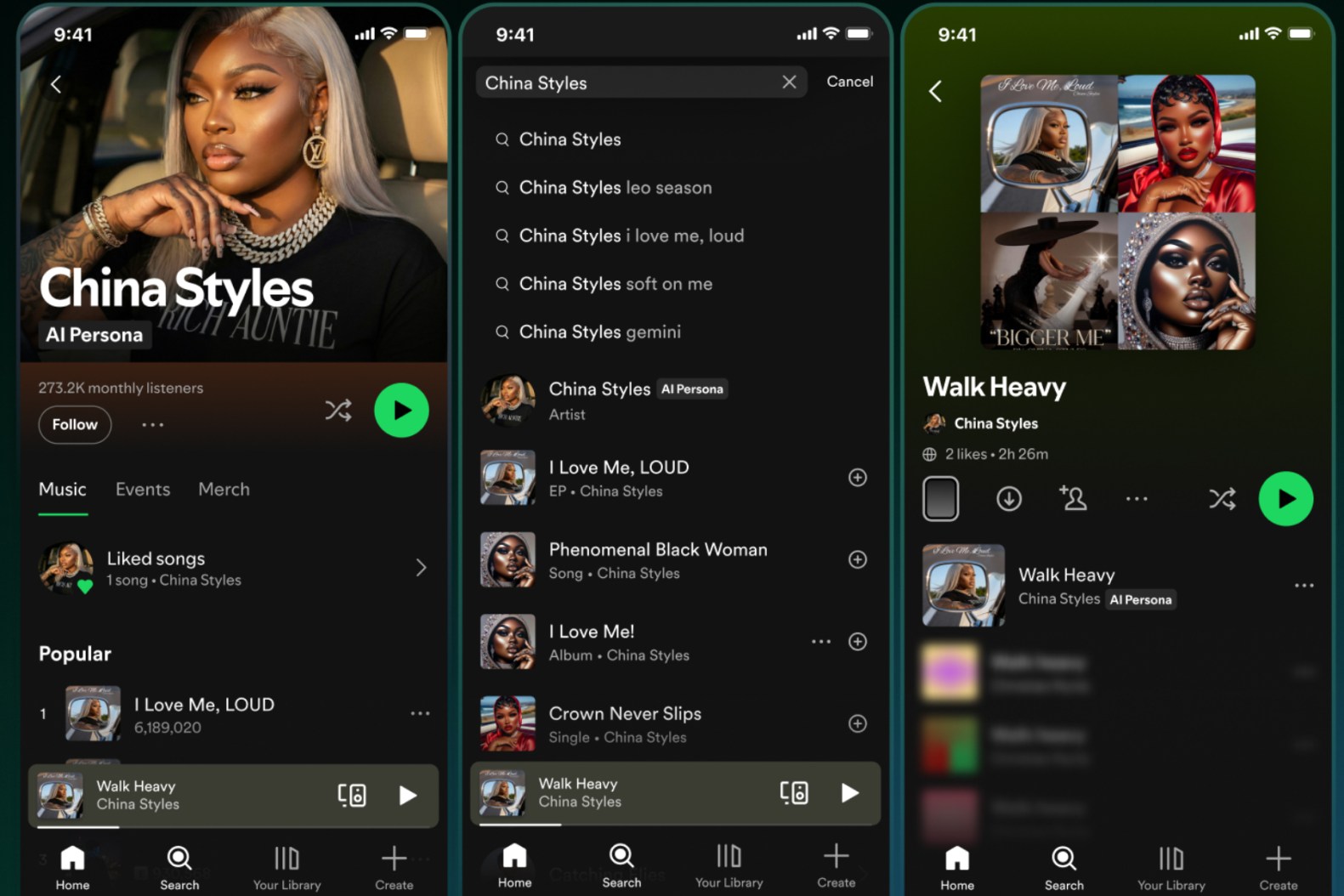
Spotify is introducing an AI Persona label for artist profiles that do not represent a real person, putting a new boundary around how synthetic artists appear on the streaming service.
From mid-September, selected profiles will carry an “AI Persona” badge, while Spotify will also apply a “Likely AI Persona” designation when its own review determines that an identity may be AI-generated. Music from those profiles will be excluded from personalised and editorial recommendations by default, although listeners who actively follow an AI Persona can still encounter its music.
The distinction matters because Spotify is not announcing a ban on AI-generated music. Its new policy is aimed at the identity behind the artist profile, rather than establishing whether artificial intelligence was used somewhere in the recording process. That places Spotify in a different position from other streaming services that are tackling the issue through detection, royalty rules or labels applied directly to recordings.
Spotify will label AI-generated artist identities
Spotify says artists can begin disclosing an AI Persona through Spotify for Artists, but the company will not depend entirely on self-reporting. It plans to combine human review with AI tools to examine profiles, including artist names and images that appear to represent photorealistic AI-generated people. Profiles meeting defined audience thresholds will be reviewed first, allowing Spotify to focus on artists already attracting significant listener attention.


The company is presenting the move as part of a broader Artist Identity & Trust programme that also includes Verified by Spotify, SongDNA, AI Credits and Artist Profile Protection. That context is important because the new badge is less about identifying whether a particular song was produced by a machine and more about making the relationship between an artist and a listener easier to understand.
Spotify’s policy also creates two levels of disclosure. An artist can voluntarily identify as an AI Persona, while Spotify can independently attach a “Likely AI Persona” label when its systems and reviewers reach that conclusion. That second category introduces an appeal question, particularly for artists who use fictional characters, avatars or unconventional identities without intending to deceive listeners.
The recommendation system is where the policy matters
The most consequential part of the announcement may not be the badge itself. It is what happens to music carrying that label.
Spotify says music from AI Personas will not be included in editorial or personalised recommendations by default. The music can still be available when listeners seek it out, including when they actively follow an AI Persona.
That creates a distinction between being available on Spotify and being promoted by Spotify. An AI artist can remain in the catalogue, but losing access to recommendation systems can make it much harder to reach listeners who have never encountered the artist before.
That matters because recommendation is one of the principal ways streaming services connect unfamiliar music with listeners. Spotify’s decision therefore affects the distribution opportunity around an AI Persona without formally preventing the artist from publishing music on the platform.
Deezer provides a useful comparison. The French streaming service says it receives nearly 90,000 fully AI-generated tracks a day, representing more than half of new music deliveries at peak levels recorded in June 2026. It has already excluded detected AI music from algorithmic recommendations and editorial playlists, and says fully AI-generated tracks account for only 1–3% of listening despite their enormous upload volume.
The figures illustrate the importance of discovery controls. A platform can receive huge amounts of synthetic music without giving that material equivalent access to its recommendation machinery.
Spotify is targeting identity, not AI-assisted music
Spotify’s approach becomes clearer when AI-assisted production is separated from an AI-generated artist identity.
A human musician could use artificial intelligence for elements of composition, vocal processing, arrangement, mastering or other production tasks while continuing to operate as a real artist. That does not automatically make the profile an AI Persona.
The reverse can also be true. An artist profile can be constructed around a fictional, photorealistic AI-generated identity, creating the kind of persona Spotify says it intends to label even if the precise production method behind its recordings is not the issue.
This makes “AI artist” an imprecise description of the policy. Spotify is specifically addressing AI-generated artist identities.
That is a more manageable problem for a platform than trying to determine how much artificial intelligence contributed to every recording. Modern music production can involve a mixture of human performance, AI-assisted editing and generative tools, making a simple human-versus-AI classification increasingly difficult.
Deezer and TIDAL are taking different routes
The emerging streaming landscape is not developing a single rule for AI music.
Deezer is focused heavily on detecting the recording itself. Its AI detection system identifies fully synthetic music, removes detected tracks from algorithmic recommendations and editorial playlists, and is being used to tackle fraudulent streaming. Deezer says up to 85% of streams generated by fully AI-generated tracks were fraudulent in 2025, compared with 8% across its catalogue overall.
TIDAL has taken the debate into another area: payment. Its current AI policy allows AI-generated music on the service, but recordings it determines are wholly generated using generative AI are not eligible for royalty attribution. TIDAL also labels those recordings and allows listeners to turn off AI-labelled music in their settings.
TIDAL’s policy is deliberately narrower than a blanket rule covering any use of AI. The company says it is taking action against wholly AI-generated recordings because current detection technology has limitations and because it wants to avoid false positives. It also leaves open the possibility of expanding the policy as detection becomes more reliable.
The three approaches therefore operate at different points in the streaming economy. Spotify is putting the emphasis on identity and discovery; Deezer is targeting synthetic recordings, recommendations and fraudulent streams; TIDAL has added royalty eligibility to the equation.
The bigger fight is over discovery and royalties
Taken together, these policies show why the AI music debate is becoming a business problem for streaming platforms rather than simply a question of whether machines can make convincing songs.
AI makes it possible to create music at a volume that conventional production workflows could not match. Deezer’s upload figures demonstrate the scale: more than 50% of new deliveries at peak were fully AI-generated, yet those recordings still represented only a small share of listening.
That gap matters because streaming platforms operate with finite attention. If automated systems can produce tens of thousands of recordings every day, the important question is not merely whether those recordings can be uploaded. It is whether they can gain access to recommendation systems, attract genuine listeners and participate in the same financial pool as human-created music.
TIDAL has answered part of that question by excluding wholly AI-generated recordings from royalty attribution. Spotify is taking a different route by restricting recommendation exposure for AI Personas. Neither approach completely resolves the issue, but both acknowledge that platform rules can determine the economic value of synthetic music even when the music itself remains available.
There is also a fraud problem underneath the debate. Deezer says AI-generated music represented only 1–3% of its listening, despite the huge volume of uploads, but found that as much as 85% of streams on fully AI-generated tracks were fraudulent in 2025. That makes detection and recommendation controls relevant not just to questions of artistic authenticity but to the integrity of the royalty system.
The difficult question of what counts as a real artist
Spotify’s policy will inevitably raise difficult cases.
A fictional band has always been possible. Musicians have performed behind characters, masks and stage personas, while virtual performers have existed in popular culture without necessarily being deceptive. The challenge for Spotify is distinguishing a creative fictional identity from an AI-generated profile that gives listeners a false impression that a real person exists behind it.
The company’s decision to use human review alongside AI tools acknowledges some of that complexity, but the “Likely AI Persona” designation means classification disputes are likely to arise. Spotify will need credible ways for artists to challenge incorrect labels, particularly where an artist uses an avatar, pseudonym or heavily constructed visual identity without attempting to mislead listeners.
There is another unresolved question: what happens when a real human artist uses AI extensively but does not have an AI-generated identity? Spotify’s new policy does not appear to answer that question because its focus is the identity represented by the profile.
That leaves a sizeable area between human and synthetic creation. A song can have a human artist, AI-generated vocals, machine-produced instrumentation and human editing, while another release might be generated entirely by an AI system and attached to a fictional persona. Treating those two cases as the same would miss the distinction that Spotify is now trying to establish.
Spotify’s AI Persona label therefore represents one part of a broader attempt to decide how synthetic creativity fits into a music business built around human artists, human audiences and royalty systems. Deezer is already confronting the sheer volume of AI uploads, while TIDAL has put a direct question around whether wholly machine-generated recordings should earn royalties.
Spotify is taking a different route. It is leaving AI Personas on the platform while making them less likely to enter the recommendation stream that introduces listeners to unfamiliar music. The important consequence is not that synthetic artists disappear, but that Spotify will have greater control over how easily they can be discovered.
That may prove to be the most consequential part of the new label. As AI-generated music becomes easier to produce and distribute, streaming platforms are acquiring more responsibility for deciding which identities are credible, which recordings reach audiences and, ultimately, which forms of music participate fully in the economics of streaming.
Download the FREE Kaspersky Next Enterprise Security Guide here to explore the complete framework for simplifying security operations and building cyber resilience.
Go to TECHTRENDSKE.co.ke for more tech and business news from the African continent and across the world.
Follow us on WhatsApp, Telegram, Twitter, and Facebook, or subscribe to our weekly newsletter to ensure you don’t miss out on any future updates. Send tips to editorial@techtrendsmedia.co.ke


