

Samsung Galaxy Z Fold8 Leads Samsung's New Foldable Strategy as Fold8 Ultra and Z Flip8 Debut

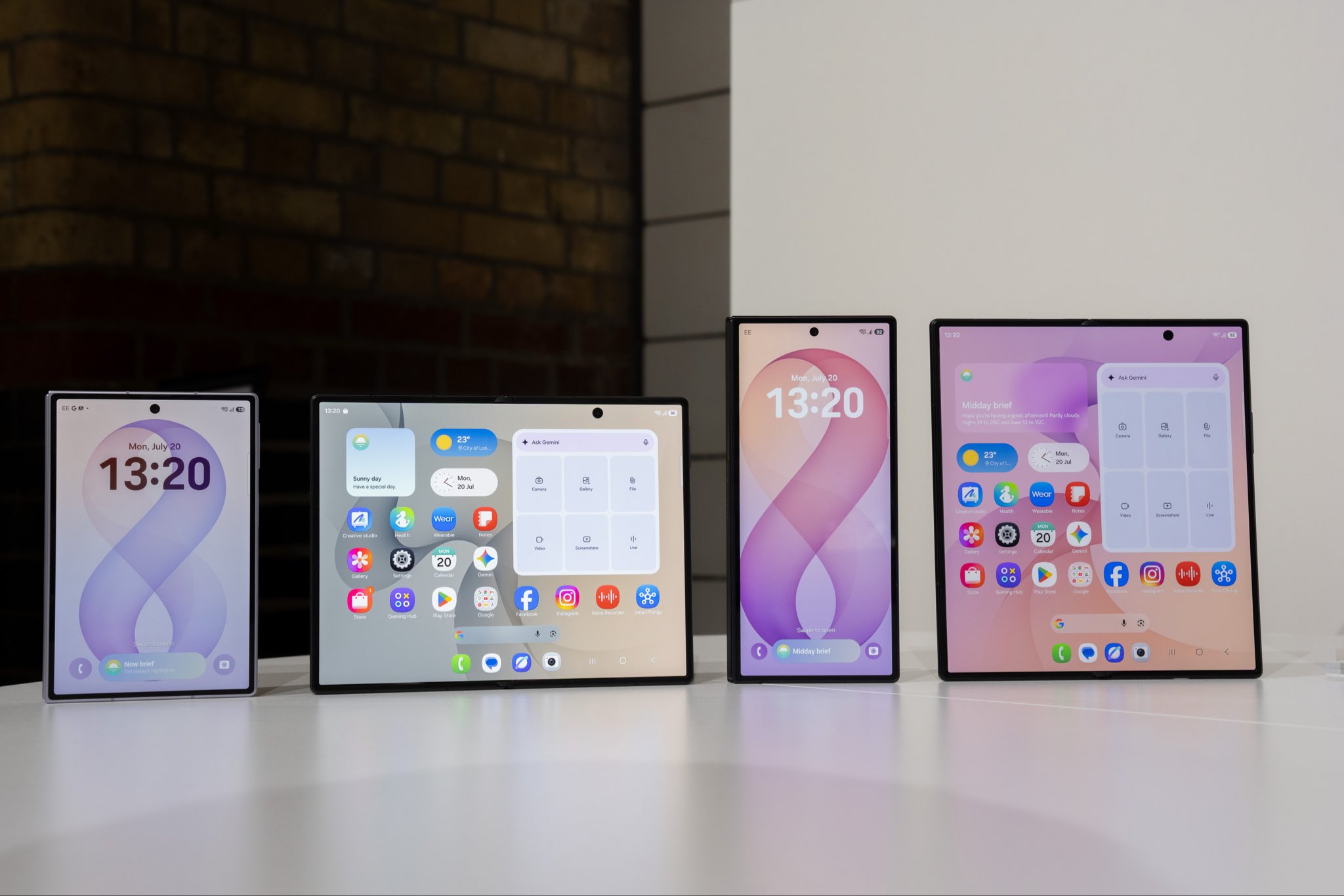
Samsung has redrawn the roadmap for foldable smartphones with the launch of the Galaxy Z Fold8, Galaxy Z Fold8 Ultra and Galaxy Z Flip8, replacing a product strategy it had followed since the original Galaxy Fold debuted in 2019. Rather than refining a two-device lineup, the company has introduced three distinct foldables aimed at different types of premium smartphone buyers while expanding Galaxy AI and debuting One UI 9 based on Android 17.
The biggest change is not simply the arrival of another Fold or Flip. It is Samsung’s decision to split its flagship Fold series into two separate devices. The new Galaxy Z Fold8 is built around a wider form factor intended to feel more natural for everyday use, while the Galaxy Z Fold8 Ultra pushes hardware further with a thinner profile, a larger display, a more advanced camera system and a bigger battery.
The move comes as competition in foldable smartphones continues to intensify. Chinese manufacturers including Huawei, Honor, Xiaomi and Vivo have steadily reduced the size and weight of their premium foldables while introducing larger batteries and faster charging technologies. Apple is also widely expected to enter the category with its first foldable iPhone next year, raising the stakes in the premium smartphone market. Samsung’s latest lineup broadens its reach before that competitive landscape shifts again.
For years, Samsung’s foldable strategy remained straightforward. Buyers chose between the Galaxy Z Fold for productivity or the Galaxy Z Flip for portability. That formula helped establish Samsung as the leading name in foldable smartphones, but it also meant one Fold design had to satisfy a broad range of users.
With the Galaxy Z Fold8 series, Samsung has taken a different approach. Instead of asking one Fold to satisfy every buyer, it has divided the lineup into two distinct experiences. Early hands-on impressions suggest the split is more meaningful than the specifications alone imply. The Galaxy Z Fold8 is designed around a wider layout that feels closer to a conventional smartphone in daily use, while the Galaxy Z Fold8 Ultra remains the flagship option for buyers who prioritise multitasking, photography and premium hardware.
That distinction addresses one of the most common criticisms of previous Fold devices. Their tall, narrow cover screens often felt cramped for typing, messaging and browsing, prompting many users to unfold the phone for routine tasks.
Samsung’s answer is a wider Galaxy Z Fold8. By adopting a broader 10:16 cover display and a 4:3 inner display, the Fold8 is designed to deliver a more familiar smartphone experience when folded while providing a tablet-like workspace once opened. The wider proportions also make reading, document editing and multitasking feel more natural than on earlier generations, and early reviewers say the broader layout is noticeably better suited to web browsing, streaming video and everyday typing than Samsung’s previous Fold designs.
The Fold8 Ultra, meanwhile, remains focused on users who want maximum performance, photography capabilities and the largest possible workspace in Samsung’s foldable portfolio.
Together, the two devices represent Samsung’s biggest rethink of the Fold series since the category was introduced, signalling a shift from a one-size-fits-all approach to a portfolio built around different user priorities.
The Galaxy Z Fold8 is the most significant addition to Samsung’s foldable lineup because it introduces a new design philosophy rather than simply refreshing existing hardware.
When folded, the device measures just 9.7mm thick and weighs 201 grams, making it the lightest Galaxy Z Fold Samsung has released. Once unfolded, its thickness drops to 4.5mm, giving it a profile that rivals many premium slab smartphones.
Its defining feature is the display. Samsung has equipped the Fold8 with a 5.5-inch Full HD+ Dynamic AMOLED 2X cover display featuring a wider 10:16 aspect ratio. Unlike earlier Fold models that prioritised height, the new proportions provide more space for typing, messaging and navigating apps without opening the phone.
Opening the device reveals a 7.6-inch QXGA+ Dynamic AMOLED 2X display with a 4:3 aspect ratio and adaptive refresh rates of up to 120Hz. The layout gives documents, spreadsheets, websites and videos a more balanced presentation while improving split-screen multitasking. Early reviewers have also highlighted refinements that are harder to appreciate from a specification sheet alone. The wider display better reflects the way people use smartphones today, making web browsing, streaming video and on-screen typing feel more comfortable than on previous Galaxy Fold models.
Samsung has also introduced new durability improvements. The Fold8 combines Armour Aluminium with a Flex Titanium architecture that incorporates a titanium-alloy layer beneath the foldable display alongside a structural titanium plate. According to Samsung, the redesign reduces the visibility of the display crease while increasing rigidity across the folding panel. Early hands-on impressions broadly support those claims, with reviewers describing a shallower crease that becomes less distracting during everyday use, while the new anti-reflective inner display helps reduce glare and makes the large screen feel closer to a conventional tablet in bright environments.
Performance comes from Qualcomm’s Snapdragon 8 Elite Gen 5 for Galaxy processor paired with up to 16GB of RAM and as much as 1TB of storage.
Battery technology also takes a step forward. The Fold8 introduces a 4,800mAh silicon-carbon battery capable of delivering higher energy density than conventional lithium-ion designs. Samsung says the technology allows it to increase battery capacity without significantly increasing thickness or weight. The move also marks Samsung’s first adoption of silicon-carbon batteries in a foldable smartphone, bringing it in line with a technology that several Chinese manufacturers have already embraced for slimmer flagship devices. The phone supports 45W wired charging and 20W wireless charging.
Samsung has taken a different approach to cameras. Rather than fitting three rear cameras, the Fold8 carries a dual-camera system consisting of a 50-megapixel primary sensor with optical image stabilisation and a 50-megapixel ultra-wide camera. Samsung relies on high-resolution sensor cropping and image processing to deliver optical-quality zoom while preserving the phone’s slimmer design. Early camera impressions suggest that Samsung intentionally accepted some imaging compromises on the standard Fold8 in exchange for a lighter body and its new form factor, leaving the Ultra to carry the company’s flagship camera credentials.
Video recording extends to 8K at 30 frames per second, while a new Dual-Screen Split Camera mode allows creators to record using both the rear and front cameras simultaneously.
More than any previous Galaxy Fold, the Fold8 appears to have been designed around everyday usability rather than headline specifications. Samsung has prioritised ergonomics, screen proportions, portability and battery efficiency while preserving the multitasking experience that has defined the Fold series, creating what many early reviewers describe as the company’s most approachable book-style foldable to date.
If the Galaxy Z Fold8 broadens Samsung’s appeal, the Galaxy Z Fold8 Ultra serves as the company’s technology showcase, targeting buyers who want the most advanced foldable Samsung has built.
At 4.1mm when unfolded and 215 grams, it is Samsung’s thinnest and most powerful book-style foldable to date. The refinements go beyond industrial design. Samsung has paired the slimmer chassis with an 8.0-inch Dynamic AMOLED 2X display offering a sharper 422ppi pixel density, peak brightness of up to 3,600 nits and improved anti-reflective coatings that make the screen easier to use outdoors.
Samsung has also redesigned the display stack and hinge. Early hands-on impressions from reviewers consistently point to a noticeably shallower crease than previous generations, while the updated hinge allows the panel to return closer to its original flat shape after repeated folding. Those engineering improvements make the Fold8 Ultra feel closer to a conventional flagship smartphone than earlier foldables.
The cover display grows to 6.5 inches, providing a familiar smartphone experience without opening the device.
Performance is driven by Qualcomm’s Snapdragon 8 Elite Gen 5 for Galaxy, paired with up to 16GB of RAM and 1TB of storage.
The camera system is Samsung’s most advanced on any foldable.
Leading the setup is a 200-megapixel primary sensor joined by a 50-megapixel ultra-wide camera, a 10-megapixel 3x telephoto lens and a dedicated 50-megapixel periscope telephoto camera offering 5x optical zoom. Together, the four-camera system gives the Ultra far greater flexibility than the standard Fold8, particularly for zoom photography and low-light shooting.
That distinction becomes increasingly important because early camera testing suggests the standard Fold8 deliberately prioritises portability over imaging performance. While reviewers have praised its daylight photos and colour reproduction, they also report that image quality softens at higher zoom levels and in low-light conditions due to its smaller main sensor and the absence of dedicated telephoto hardware. The Fold8 Ultra addresses those compromises with larger imaging hardware and a more versatile camera system aimed at users who expect flagship photography from a foldable.
Battery capacity also increases to 5,000mAh through Samsung’s new silicon-carbon battery technology. Combined with 45W wired charging, the larger battery gives the Ultra a clear endurance advantage.
Early hands-on battery testing suggests the combination of silicon-carbon cells, software optimisation and the Snapdragon platform comfortably delivers a full day of heavy use despite the thinner chassis. Reviewers have reported finishing demanding workdays with battery remaining, placing the Ultra much closer to traditional flagship phones than previous Fold generations.
Samsung has also enlarged the vapour chamber cooling system, allowing the device to better sustain demanding workloads including gaming, AI processing and prolonged multitasking.
Although both Fold models share One UI 9 and Galaxy AI, their priorities are clearly separated.
The Fold8 is built around portability, comfort and a wider everyday experience.
The Fold8 Ultra is designed for users who want Samsung’s best display, longest battery life and most capable camera system regardless of price.
That distinction extends to pricing.
Globally, the Galaxy Z Fold8 starts at $1,899.99, translating to an estimated KSh285,000 to KSh295,000 through official Kenyan retail channels depending on taxes and distribution costs. The 1TB model is expected to retail between KSh380,000 and KSh395,000.
The Galaxy Z Fold8 Ultra starts at $2,099.99, or approximately KSh325,000 to KSh335,000 in Kenya. Buyers choosing the 1TB configuration should expect pricing in the region of KSh415,000 to KSh430,000.
While the Fold series represents Samsung’s biggest strategic shift, the Galaxy Z Flip8 continues to target buyers who value portability above all else.
Rather than radically redesigning the Flip formula, Samsung has focused on refining the experience around the cover display, battery life and artificial intelligence.
The most visible upgrade is the new 4.1-inch FlexWindow. Extending almost edge to edge around the dual rear cameras, it allows users to reply to messages with a full keyboard, manage music playback, view navigation, access widgets and interact with Galaxy AI without opening the phone.
Inside is a 6.8-inch Dynamic AMOLED 2X display with an adaptive refresh rate of up to 120Hz.
Depending on the market, Samsung ships the Flip8 with either its 2nm Exynos 2600 processor or Qualcomm’s Snapdragon 8 Elite Gen 5, both designed to improve efficiency while supporting the latest Galaxy AI experiences.
Battery capacity increases to 4,300mAh while retaining 25W wired and 15W wireless charging.
Samsung also continues to position Flex Mode as one of the Flip’s defining strengths. Users can partially fold the phone to capture hands-free photos, join video calls without a stand or use the lower half of the display as a control panel while viewing content on the upper screen.
Photography remains familiar, with a 50-megapixel primary camera joined by a 12-megapixel ultra-wide sensor. The larger FlexWindow also makes it easier to frame selfies using the rear cameras, allowing users to capture higher-quality self-portraits than the front-facing camera alone.
For Kenyan buyers looking to enter Samsung’s foldable ecosystem without paying Fold-series prices, the Galaxy Z Flip8 remains the most affordable option.
The 256GB model starts at $1,199.99, translating to an estimated retail price of KSh185,000 to KSh195,000. The 512GB version is expected to retail between KSh205,000 and KSh215,000 through authorised Samsung partners.
Hardware is only part of Samsung’s strategy.
All three foldables launch with One UI 9 based on Android 17, with Samsung positioning Galaxy AI as a core part of the experience rather than a standalone feature.
Among the headline additions is Now Brief, which generates personalised summaries combining appointments, weather, travel information, reminders and wellness data throughout the day.
Now Nudge builds on that by recognising on-screen activity and recommending contextual actions. If users discuss arranging a meeting, for example, the software can suggest opening Calendar or Maps without manually switching applications.
Google’s Gemini integration has also expanded significantly.
Samsung now includes Gemini Notebook, allowing users to upload PDFs, presentations, handwritten notes, recordings and documents before generating summaries, study guides or presentations using AI. Buyers also receive six months of Google AI Pro at no additional cost.
Photography receives new AI-powered editing tools through Photo Assist, while document scanning has been upgraded with automatic page detection, perspective correction and shadow removal.
On larger foldable displays, Samsung says these AI features become more practical because users can interact with multiple applications simultaneously without constantly switching screens.
Although Samsung Kenya has yet to announce official retail pricing, global launch prices provide a strong indication of local positioning.
The Galaxy Z Flip8 starts at $1,199.99, translating to an estimated Kenyan retail price of KSh185,000 to KSh195,000 for the 256GB model and KSh205,000 to KSh215,000 for the 512GB version.
The Galaxy Z Fold8 begins at $1,899.99, placing the entry model at approximately KSh285,000 to KSh295,000. The 512GB version is expected to retail between KSh310,000 and KSh320,000, while the 1TB model could reach KSh380,000 to KSh395,000.
The Galaxy Z Fold8 Ultra starts at $2,099.99, translating to roughly KSh325,000 to KSh335,000. Higher-capacity models are expected to retail between KSh350,000 and KSh360,000, while the flagship 1TB version could reach KSh415,000 to KSh430,000 through authorised Samsung retailers.
Samsung has opened global pre-orders ahead of general availability on August 7. Kenyan buyers purchasing through Samsung Experience Stores and authorised retail partners are expected to receive launch incentives including complimentary storage upgrades, Samsung Care+ benefits and enhanced trade-in offers for eligible Galaxy devices.
The Galaxy Z Fold8 series represents far more than Samsung’s annual hardware refresh. It signals a structural change in how the company approaches the premium smartphone market.
For the first time, Samsung is no longer asking a single Fold model to satisfy every type of buyer.
Instead, each device has a clearly defined role.
The Galaxy Z Fold8 prioritises portability, wider screen proportions and everyday usability. The Galaxy Z Fold8 Ultra becomes Samsung’s flagship engineering showcase with the company’s best cameras, brightest display and longest battery life. The Galaxy Z Flip8 continues serving users who want flagship performance in a compact foldable form factor.
That diversification arrives as competition accelerates.
Chinese manufacturers continue to narrow the hardware gap through thinner designs, larger batteries and faster charging technologies, while Apple’s expected entry into foldables is widely anticipated to expand consumer interest in the category.
Samsung’s response is not simply better specifications. It is broader segmentation.
Rather than competing with one Fold against every rival, Samsung now offers multiple premium foldables built around different priorities. That gives buyers more meaningful choice while allowing the company to compete across a wider range of premium use cases.
Early reactions from reviewers suggest that strategy is already resonating. Much of the conversation has shifted away from whether foldables are practical toward which Fold model best matches individual needs. The wider Fold8 has drawn praise for making the closed-phone experience feel more natural, while the Ultra has been recognised for pushing display technology, battery life and camera hardware closer to flagship slab-phone standards.
The strategy is not without trade-offs. Some reviewers argue Samsung still trails certain Chinese competitors in areas such as battery capacity, charging speeds, stylus support and camera hardware, particularly on the standard Fold8. Those comparisons underline how competitive the foldable market has become and suggest Samsung’s latest generation is focused as much on refining the overall user experience as winning every specifications battle.
For consumers, the result is Samsung’s most complete foldable portfolio since entering the category in 2019.
For the wider smartphone industry, it signals that the next phase of foldables will be shaped less by proving the concept works and more by offering specialised devices tailored to different ways people use their phones.
Download the free Kaspersky SMB Cybersecurity Guide here to learn how businesses can move beyond traditional antivirus and build a more resilient approach to cybersecurity.


