
Kenya signs DCO Charter, opening a new front in its push to shape AI, data and digital trade policy

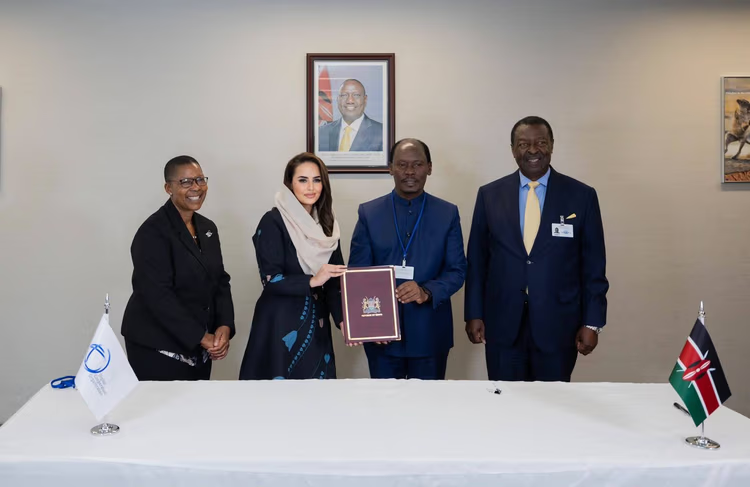
Kenya has signed the Charter of the Digital Cooperation Organization (DCO), taking another step toward full membership in the 24-country digital cooperation bloc as governments grapple with rules around artificial intelligence, cross-border data and digital trade.
Cabinet Secretary for Information, Communications and the Digital Economy William Kabogo Gitau signed the Charter and handed it to DCO Secretary-General Deemah AlYahya during a ceremony on the sidelines of the 81st United Nations General Assembly in New York. The DCO describes Kenya as a Signatory Member at this stage, with the remaining accession procedures still to be completed.
Kenya completes the next step toward DCO membership
The development follows the DCO Council’s August approval of Kenya’s candidature alongside Albania, Azerbaijan, Kazakhstan, Lebanon, Palestine, Syria and Zambia. The expansion is expected to take the organisation from 16 to 24 countries, representing approximately 980 million people once the accession processes are completed. Kenya’s signing therefore completes an important part of a process already under way rather than representing a sudden entry into international digital policy.
The distinction between signing the Charter and becoming a full DCO Member State is worth keeping clear. Each prospective member must complete its national internal procedures and deposit the required instrument before membership takes effect, meaning claims that Kenya has already become a full DCO member should be treated cautiously until the organisation confirms completion of the process.
The wider expansion gives Kenya a larger diplomatic setting in which to pursue its digital interests. Once the eight accessions are complete, the DCO expects its membership to represent about 980 million people across 24 countries. The organisation has presented that scale as a basis for countries to coordinate their positions rather than approach emerging digital rules entirely on their own.
Why the DCO matters to Kenya’s digital policy
The areas identified by the DCO are already familiar territory for Kenya. The country is working on AI governance, data protection, digital public infrastructure, digital identity, connectivity and digital services, while Kenyan companies operate in markets where data movement and digital trade rules can directly affect their ability to expand.

Cross-border data is particularly important. A digital economy can have strong domestic data-protection rules and still face difficult questions when information is processed by cloud platforms, AI providers or other technology companies outside the country. That makes international arrangements around trusted data flows relevant to Kenyan businesses and public institutions, particularly as AI services become more dependent on international infrastructure.
Kenya’s engagement with the European Union provides another example. The country has been working with the EU on digital transformation issues that include trusted data flows, digital trade and wider digital cooperation. DCO membership adds a multilateral dimension to that work, giving Kenya another institutional setting in which to discuss how data, technology and digital commerce should operate across borders.
The same applies to AI. Kenya’s AI Strategy 2025–2030 and its wider regulatory work are concerned with how artificial intelligence can be deployed while addressing governance, infrastructure, skills and trust. The government has also identified AI infrastructure and cross-border collaboration as part of its digital transformation agenda.
The DCO has its own programmes around AI readiness, digital policy and practical tools for governments, including the Digital Economy Navigator, which is intended to help countries assess digital maturity, prioritise reforms and identify areas for investment.
That gives Kenya access to a policy network focused specifically on the digital economy, although the value of those tools will depend on whether they translate into policies, investment and cooperation that produce measurable results in Kenya.
Kenya brings more than mobile money experience
Kenya’s appeal to the DCO is also tied to what it can contribute.
The country’s experience with M-Pesa is the obvious example, but the deeper lesson is broader than mobile money. Kenya has spent more than a decade building digital services around mobile payments, APIs, fintech platforms and increasingly connected public and private systems. That experience gives the country practical knowledge of what happens when digital infrastructure reaches millions of users and becomes part of ordinary economic activity.
The DCO has highlighted Kenya’s mobile financial services sector and broader technology ecosystem as part of the country’s digital-economy foundation. Kenya’s ICT sector contributed 9.2% of GDP in 2024, while the country’s digital economy was valued at about $4.2 billion, according to figures cited by the organisation.
That experience is useful to other countries trying to build digital payment systems, expand financial inclusion or develop technology businesses. It also gives Kenya an opportunity to bring lessons from its own successes and failures into discussions on digital policy rather than participating only as a recipient of technical assistance.
Kenya’s digital public infrastructure ambitions add another dimension. Government agencies are working toward more connected systems, secure data exchange and interoperability, while the country’s technology sector is also preparing for greater use of AI. Those efforts raise practical questions around identity, APIs, data governance, cybersecurity and the infrastructure needed to run AI-enabled services at scale.
The result is a more complicated picture of digital sovereignty than simply controlling where data is stored. A country’s ability to influence its digital future also depends on whether its systems can communicate with one another, whether it has the infrastructure and skills to operate them, and whether local companies can participate in the markets created around them.
The practical question is what membership delivers
The DCO’s argument is that countries gain more influence by coordinating with other digital economies. Its recent expansion gives that argument a larger numerical base, but the size of the bloc alone does not establish how much influence Kenya will gain.
The more important questions will emerge after accession is completed. Will Kenya coordinate positions with other DCO members on AI governance? Can the organisation help reduce regulatory barriers for Kenyan digital companies entering other member markets? Will its work on cross-border data produce arrangements that businesses can actually use? Can cooperation lead to investment in digital infrastructure, skills and innovation?
Those outcomes would give the membership a much more concrete meaning than diplomatic representation.
The DCO has been developing mechanisms intended to move beyond policy discussions, including the Digital Economy Navigator, a Digital Economy Calculator, policy harmonisation initiatives and programmes focused on AI and digital infrastructure. It has also launched programmes bringing together startups, researchers and technology teams from member countries around practical AI applications.
For Kenya, that could create opportunities for companies, researchers and government agencies to work with counterparts across a larger network. But those opportunities will depend on how actively Kenya participates and whether domestic institutions connect DCO programmes to local priorities.
DCO membership adds another layer to Kenya’s digital strategy
Kenya’s accession comes as the country is already balancing several external and domestic digital relationships. It has its bilateral digital partnership with the EU, its obligations and opportunities under African continental integration frameworks, domestic AI and data-policy initiatives, and a technology industry that depends on international cloud, infrastructure and investment.
The DCO therefore gives Kenya another platform rather than replacing the institutions it already works through.
That matters because many of the questions facing Kenya cannot be resolved entirely within its borders. A Kenyan company selling digital services abroad encounters another country’s tax and data rules. A Kenyan organisation using an overseas AI provider has to consider cross-border data obligations. A government building AI-enabled services depends on infrastructure, skills and technology that may span several jurisdictions.
The DCO’s focus on AI, digital policy, investment, skills and cross-border cooperation is designed around precisely those connections. Its August expansion and Kenya’s subsequent Charter signing also show that the organisation is trying to build a broader coalition of countries at different stages of digital development.
For Kenya, the immediate significance is straightforward: it has gained another institutional platform at a time when the rules governing data, AI and digital commerce are becoming central to how economies participate in technology markets. Whether that platform gives Kenya greater influence will depend on what it does with the membership, how it coordinates with other African and international institutions, and whether cooperation produces practical benefits for the country’s government, businesses and digital economy.
Real ESG impact doesn’t happen in panels alone, it happens in the rooms where financiers, operators, and policymakers actually align. Our GreenShift Forum 2026 cuts the noise, bringing together the people rewiring Africa’s sustainability and energy frameworks for one focused day in Nairobi. Secure your seat.
Go to TECHTRENDSKE.co.ke for more tech and business news from the African continent and across the world.
Follow us on WhatsApp, Telegram, Twitter, and Facebook, or subscribe to our weekly newsletter to ensure you don’t miss out on any future updates. Send tips to info@techtrendsmedia.co.ke


