
Kenya’s agentic AI ambitions expose the infrastructure gap between digital services and connected government

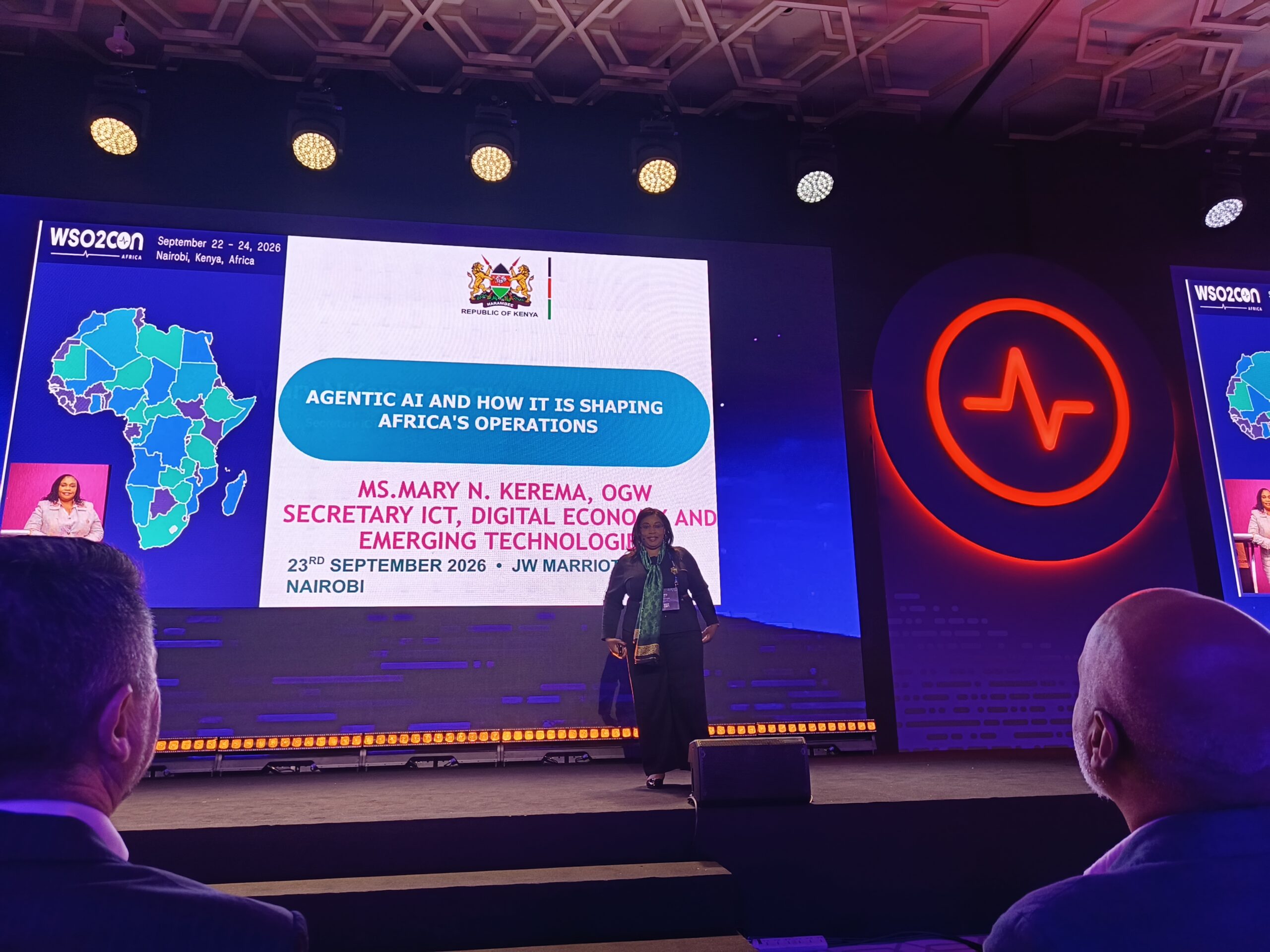
Kenya’s government has spent years putting services online. The harder part now is getting the systems behind those services to work together. That problem takes on a different weight as AI agents move from answering questions to carrying out tasks across multiple systems.
At WSO2Con Africa 2026 in Nairobi, Mary N. Kerema put that integration gap at the centre of her argument about how Kenya and the rest of Africa should approach agentic AI.
Kerema, who delivered the presentation on behalf of Principal Secretary Eng. John Tanui, framed the issue around a simple observation: Africa has digitised the front door, but the next challenge is the operating layer behind it. A government portal can be digital while the processes supporting it still depend on fragmented systems, manual hand-offs and disconnected data.
Kenya’s AI agents challenge starts with integration
Kerema said Kenya still faces limitations in integration, with government systems needing stronger connections so that agencies can exchange information and work together. She pointed specifically to APIs as part of the infrastructure required to make those systems communicate.


That becomes more important as AI moves from generating information to executing work. A generative AI system can answer a question without changing anything in an underlying government system. An AI agent given an operational goal may need to establish identity, retrieve information, interact with several systems, perform authorised actions and escalate an exception to a human.
The architecture therefore has to support more than an AI model. It needs reliable data, system access, verified identity, defined boundaries and monitoring.

The WSO2Con programme itself has put the same architecture questions at the centre of its enterprise AI agenda, with sessions covering agent-ready APIs, identity, integration, governance and digital government.
Digital government cannot stop at the portal
Kerema’s presentation drew a distinction between the digital front door and the operating core. Apps, portals, chatbots, online forms and digital payments can make a service appear digital to the citizen while data silos, legacy systems and manual hand-offs continue underneath.
That gap becomes visible when a service requires several government institutions to coordinate.
Her proposed mental model is centred on the citizen rather than the structure of government. A person requesting a service should not have to understand which ministry owns each system, which office needs to approve something or where information has to be submitted again. The systems should coordinate the authorised work behind the scenes.
Kerema described the desired outcome as “one citizen, one journey, many governments.”
That idea gives agentic AI a practical public-sector use case. An agent could potentially coordinate steps across government capabilities, provided it has the identity, permissions, data access and system connections required to do so.
The emphasis is therefore on the operating model behind the service. An agent cannot coordinate systems that cannot communicate, access data that has no usable interface or safely execute actions without clearly defined authority.
Agentic does not mean unrestricted autonomy
One of the more important distinctions in Kerema’s presentation was between agentic capability and unrestricted autonomy.
The slides described the shift from automation, where software executes a defined rule, through assistance and agency to orchestration, where systems coordinate work across multiple environments. The accompanying principle was that agentic systems should be outcome-oriented while remaining bounded and permissioned.
That distinction matters particularly in government.
An AI agent acting on behalf of a citizen or public institution would need to have a defined identity and authority. It would need to be clear what information it can access, which actions it can perform, which decisions always require human involvement and how its actions can be monitored.
Kerema said human escalation remains necessary, particularly for high-level decisions, exceptions and appeals. She also argued that agent activity needs to be auditable so that institutions can establish what happened and review the outcome.
This shifts the governance question from whether government should use AI to how government can establish accountable boundaries around systems that act.
Kenya already has the policy foundation
Kenya is not starting its AI agenda from scratch. The government launched the National AI Strategy 2025–2030 in March 2025, built around AI digital infrastructure, data and AI governance, and AI research, innovation and commercialisation. Its implementation roadmap also identifies public service delivery among the priority areas for AI use.
Separately, the Ministry of Information, Communications and the Digital Economy has been developing an AI and Emerging Technologies Policy. The ministry opened a draft of that policy for public comments in 2026, with the framework intended to address responsible governance, development and deployment of AI and other emerging technologies.
That policy work gives context to Kerema’s argument. The question is increasingly about how the country’s AI ambitions translate into functioning systems and public services.
The government’s own recent messaging has also placed greater emphasis on outcomes from digital and AI investments. In September 2026, the Ministry said digital transformation should ultimately be measured through productivity, jobs, enterprise growth, public-service efficiency and quality of life rather than simply the number of policies or platforms created.
That is closely aligned with Kerema’s call to stop treating integration as an afterthought and to design digital capabilities around citizen and business outcomes.
The infrastructure underneath AI matters
Kerema’s presentation placed AI within a wider set of dependencies that includes connectivity, energy, compute, data, skills, governance and finance. The argument is that these foundations have to develop together because an AI system cannot compensate for weak infrastructure underneath it.
Data quality is particularly important. An agent coordinating a government service needs access to information that can be trusted, interpreted in context and exchanged between systems under defined rules.
Interoperability becomes the bridge between that data and the services that use it. Kerema spoke of a model in which agencies retain ownership of their data while enabling controlled, federated sharing, with standards and governance around how information is published, exchanged and used.
This also changes how government technology projects should be designed. Instead of creating another isolated application for each problem, reusable capabilities can provide common building blocks that different services and institutions can use.
Africa’s operating environment requires local design
Kerema also argued that African operating conditions should shape how agentic systems are designed. Public and private ecosystems, informal economies, cross-border trade, uneven connectivity, multiple languages and mobile-first usage create conditions that differ from those in many mature digital markets.
That makes localisation more than a question of language or interface design. An agent coordinating a service across African institutions has to work within the connectivity, identity, data and institutional structures that actually exist.
Her presentation therefore positioned Africa’s complexity as a design problem that can also create opportunities for locally relevant systems. The emphasis was on building capabilities that can connect many services and eventually scale across institutions and borders.
The question is what happens behind the AI interface
The most significant shift in Kerema’s argument is that agentic AI changes the unit of digital transformation.
For years, governments could digitise a form, create a portal or put a payment process online and call that progress. Agentic systems raise a different requirement because software that acts on an outcome needs access to the systems, data and permissions that make the outcome possible.
That puts integration at the centre of Kenya’s AI agents government conversation.
Kerema’s prescription is to build reusable digital capabilities, treat data as strategic infrastructure, design systems for interoperability and embed governance from the beginning. Her closing framework also calls for stronger cooperation between government, industry and academia rather than isolated technology projects.
For Kenya, the immediate AI question is therefore larger than which model or agent platform to deploy. The more fundamental question is whether the digital systems behind public services can become connected enough, trusted enough and governed enough for AI agents to perform useful work on behalf of citizens.
Africa’s agentic AI opportunity, in Kerema’s framing, will ultimately depend on what happens in that operating layer.
Real ESG impact doesn’t happen in panels alone, it happens in the rooms where financiers, operators, and policymakers actually align. Our GreenShift Forum 2026 cuts the noise, bringing together the people rewiring Africa’s sustainability and energy frameworks for one focused day in Nairobi. Secure your seat.
Go to TECHTRENDSKE.co.ke for more tech and business news from the African continent and across the world.
Follow us on WhatsApp, Telegram, Twitter, and Facebook, or subscribe to our weekly newsletter to ensure you don’t miss out on any future updates. Send tips to info@techtrendsmedia.co.ke


