
Safaricom’s expanding merchant network creates new opportunities for digital credit

The scale of activity on M-PESA’s merchant network is becoming an important part of Safaricom’s financial services business. In the six months to September 2026, merchant transactions reached 4.7 billion, a 52.6% increase from the corresponding period a year earlier. Revenue from merchant services rose 34.6% to KSh8.18 billion, according to Safaricom’s HY27 results.
The figures point to a substantial commercial network built around payments between customers and businesses. For small traders, these transactions also generate a record of business activity that can support financial services beyond the original payment. Safaricom is developing its credit offering around this wider digital ecosystem, with Pochi, merchant lending products and behavioural scoring forming part of the strategy.
Pochi la Biashara provides a useful view of how this network is being used. The service allows informal traders to receive business payments separately from their personal M-PESA funds, giving them a dedicated wallet for transactions. Safaricom reported 3.2 million Pochi customers during the HY27 period, while the wider M-PESA merchant network had reached 4.5 million merchants.
Pochi transaction value rose 95.6% year on year to KSh300.05 billion. Transaction volume increased 65.8% to approximately 1.8 billion, while revenue from the service grew 77.7% to KSh2.99 billion. The growth in both value and volume indicates that Pochi is handling a substantial amount of commercial activity, although the figures alone do not establish how much of that activity represents new business for participating traders.



The distinction is relevant to Safaricom’s plans for merchant credit. A payment wallet can give a business a digital transaction record, but access to a loan depends on additional considerations, including how lenders assess cash flow, repayment capacity and the risk associated with each borrower.
Merchant credit is developing across separate products
Safaricom has several lending products within its financial services ecosystem, and their performance needs to be considered separately. The HY27 results list Merchant Overdraft, Pochi Term Loan, Fuliza, KCB M-PESA and M-Shwari as distinct lending activities. Their customer bases, loan sizes and performance figures should not be treated as interchangeable.
Merchant Overdraft disbursements reached KSh24.4 billion during the six months, increasing 13.6% year on year. The product recorded 7.1 million disbursement transactions, up 31.1%, while its customer count rose 41% to 61,600. Revenue increased 8.7% to KSh200 million.
Pochi Term Loan recorded a different performance pattern. Disbursements fell 60.9% to KSh200 million, while the number of transactions declined 73.5% to approximately 10,000. Revenue dropped 24.1% to KSh8 million, and the reported customer count fell 59.1% to 1,000.
Those figures show why merchant lending should not be discussed as a single product category. Merchant Overdraft expanded across disbursements, transactions and customers, while Pochi Term Loan contracted over the same reporting period. The results do not provide enough detail to attribute the difference to a particular change in demand, product design or lending policy.
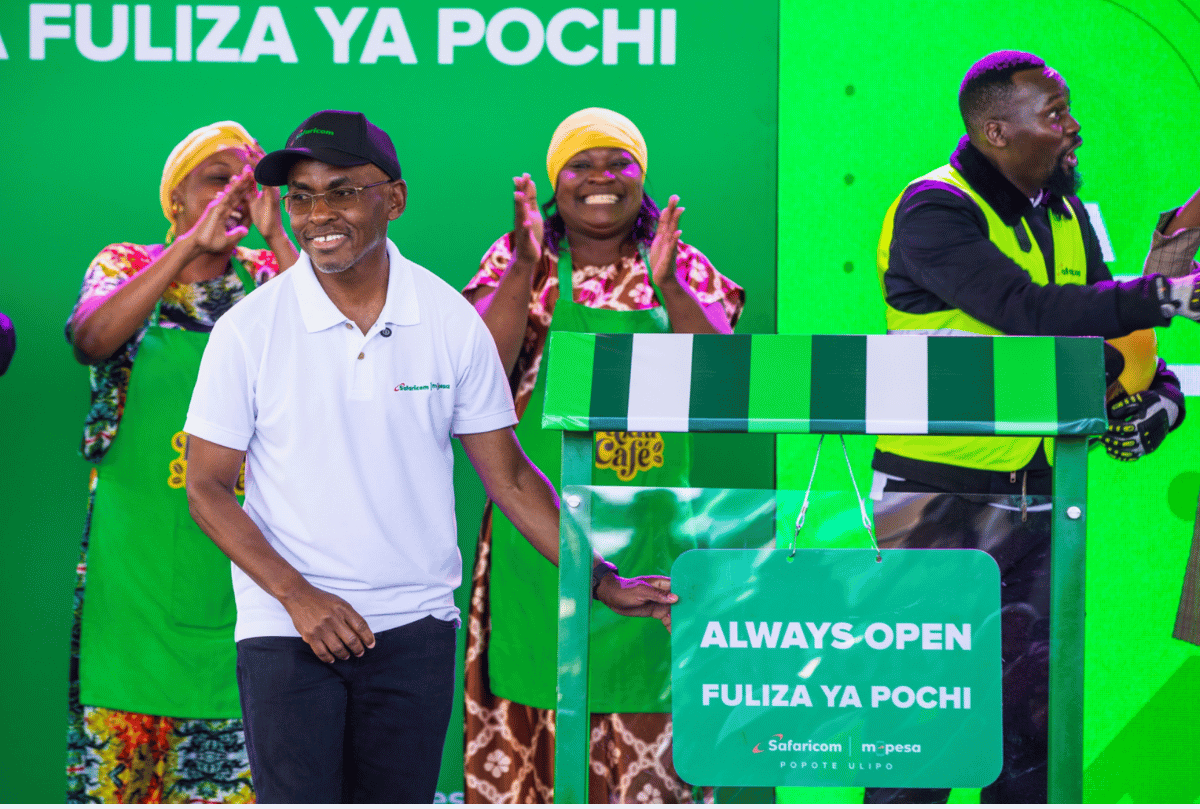
Safaricom also announced the expansion of Fuliza Ya Pochi, described as an overdraft facility for qualifying micro-merchants. The October announcement said the service had been extended to more than one million eligible merchants. This is a separate development from the Pochi Term Loan reported in the HY27 results, and the company’s financial statements do not provide a standalone performance line for Fuliza Ya Pochi.
That separation is important when interpreting the scale of merchant credit. The number of merchants eligible for an overdraft is not the same as the number who have borrowed, while the performance of an existing loan product cannot be used as a proxy for a newer facility.
Credit growth also brings questions of affordability and repayment
Safaricom’s consumer lending figures offer another indication of the scale of its credit operations, although they should not be mistaken for merchant lending results. Fuliza disbursements reached KSh1.1575 trillion in the six months to September 2026, an 84% increase year on year. Repayments stood at KSh1.1533 trillion, up 79.1%, while the number of distinct customers rose 88.9% to 17.2 million.
The repayment-to-disbursement ratio was 99.6%, compared with 102.4% in the corresponding period. This is a comparison of total repayments and disbursements during the reporting period. It does not mean that 99.6% of individual borrowers repaid their loans in full.
The average Fuliza loan fell 24.6% to KSh192.10 from KSh254.60, even as revenue increased 86% to KSh4.9 billion. The combination of higher disbursements and a lower average ticket suggests that the service is handling a larger volume of relatively small advances. It does not, on its own, establish whether individual borrowers are becoming more or less financially secure.
The other consumer lending products also recorded substantial activity. KCB M-PESA disbursements reached KSh39.8 billion, up 13.3%, while M-Shwari disbursements rose 8.2% to KSh52 billion. Their reported repayment ratios were 96.7% and 105.3%, respectively.
For merchant lending, the commercial case depends on whether credit can help businesses manage short-term cash requirements without creating repayment obligations that exceed their ability to generate income. A trader may need funds to replenish stock, meet supplier payments or manage a temporary gap between sales and expenses. The value of an overdraft therefore depends on its pricing, repayment terms and the reliability of the business activity used to assess eligibility.
Safaricom has identified behavioural scoring and multiple funding partners as part of its approach to expanding credit access and managing portfolio risk. The company says these capabilities are supported by its M-PESA Fintech 2.0 platform, which is designed to improve the speed and capacity of its financial services infrastructure.
Fintech 2.0 is designed to support higher transaction volumes
The new M-PESA platform can support up to 6,000 transactions per second, according to Safaricom’s HY27 results booklet. The company says this represents three times the previous Fuliza transaction throughput. Its modular architecture is intended to improve system reliability, fraud management, customer protection and the pace at which new products can be developed.
The platform is relevant to merchant services because payment and lending products rely on systems capable of handling large volumes of transactions. Higher processing capacity can support more activity across the network, although it does not by itself guarantee that businesses will receive credit or that loans will be affordable.
Safaricom has also adjusted merchant payment charges. Its results booklet reports that Lipa na M-PESA transactions of up to KSh500 are zero-rated, Transacting Till charges were cut by 50%, and the free-transaction threshold for Pochi was increased to KSh200 under a promotional tariff. The company also reported that approximately 81% of Lipa na M-PESA and Pochi merchant transactions were free during the period.
These changes sit alongside the growth in merchant payment volumes. They suggest that Safaricom is using pricing as one way to encourage digital payments across its business network, while developing financial products that can draw on the activity taking place there.
The commercial opportunity extends beyond processing payments. A merchant network with millions of participants gives Safaricom a distribution channel for financial products, while transaction histories can contribute to how lenders understand business activity. The challenge is ensuring that those records are used to assess genuine repayment capacity, rather than treating transaction volume as a substitute for a business’s financial health.
For micro-merchants, the value of this ecosystem will ultimately be measured by the usefulness of the services they can access: affordable payments, reliable transaction records and credit that supports business activity without placing undue pressure on cash flow.
Go to TECHTRENDSKE.co.ke for more tech and business news from the African continent and across the world.
Follow us on WhatsApp, Telegram, Twitter, and Facebook, or subscribe to our weekly newsletter to ensure you don’t miss out on any future updates. Send tips to info@techtrendsmedia.co.ke

