
Ziidi Trader's growing footprint at the NSE coincides with a boom in major share transactions

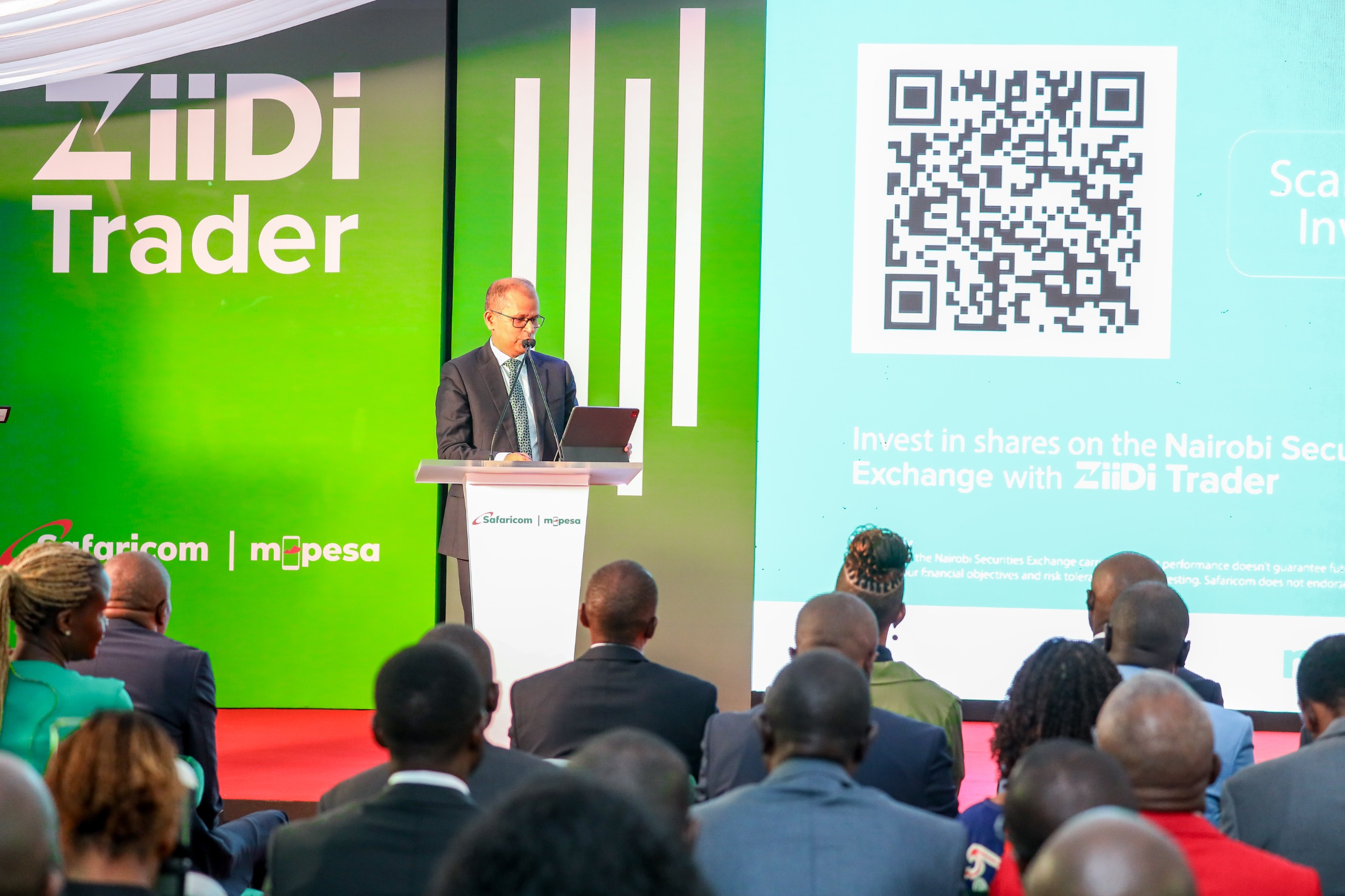
Ziidi Trader accounted for 54.21% of equity transactions recorded by the Nairobi Securities Exchange (NSE) between its launch in March and October 31, giving Safaricom’s mobile share-trading platform a substantial role in the market’s day-to-day activity.
The platform processed 1,318,851 transactions out of 2,432,819 equity deals recorded by the exchange during the period. Yet only 176,477 of its 1.1 million registered users had bought at least one share, leaving roughly 84% of those who signed up without a recorded purchase.
The figures show how mobile distribution has become an important route into the stock market, even as a relatively small proportion of Ziidi’s registered audience has progressed to buying securities. Its contribution to transaction volumes is significant, but the number of people who have actually invested remains a separate measure of the platform’s reach.
The figures also come as the NSE handles a growing volume of large institutional transactions. Recent share transfers involving Safaricom, NCBA Group and Kenya Pipeline Company (KPC) have generated substantial commissions for investment banks and stockbrokers, adding another dimension to the business being conducted through the exchange.


Mobile trading accounts for more than half of NSE equity deals
Ziidi’s 1.32 million transactions included 866,405 purchases and 452,416 sales, according to the latest figures. Its average ticket size stood at KSh3,349.65 on October 30, down from KSh4,818 in August.
The platform’s activity is spread across ordinary exchange trading and public share offers. During the KPC initial public offering in March 2026, Ziidi facilitated approximately 36,000 of the 73,000 retail orders. It also received 12,426 applications in the Quickmart IPO, covering 22.73 million shares valued at KSh170.54 million.
Renaissance Capital has also used the platform to market global depositary receipts representing shares in Dangote Refinery.
These transactions have demonstrated Ziidi’s ability to distribute investment opportunities to M-Pesa customers. The platform is jointly offered by Safaricom, the NSE and Kestrel Capital, allowing users to buy and sell listed shares through their phones without opening a conventional brokerage account. Existing M-Pesa customer identification details are used for onboarding, while Kestrel manages the omnibus account through which the shares are held.
Registrations have grown faster than active participation
The number of people signing up for Ziidi has increased substantially since its launch, but the proportion making a first share purchase has remained broadly unchanged.
Earlier figures reported by TechTrendsKE put registrations at approximately 511,000, with 84,000 active buyers. The latest disclosure puts registrations at 1.1 million and active buyers at 176,477. Both populations have more than doubled, while the conversion rate has stayed close to 16%.
The gap points to a challenge beyond attracting customers to a digital trading service. A registered user still needs to select a listed company, assess the investment and decide how much money to commit.
Market participants have identified limited investor awareness and uncertainty over which shares to buy as barriers to wider participation. Eric Ruenji, founder and chairman of Theo Capital Holdings, has said that many prospective investors are interested in joining the platform but do not know what to purchase.
He has also cautioned against allowing Ziidi to become associated only with IPO participation, given the need to sustain activity in the secondary market.
The NSE is preparing to list the Wall Street Africa Banking Index exchange-traded fund, which is expected to provide exposure to 12 banking stocks through a single investment product. The fund could offer an alternative to investors who are unsure which individual bank shares to select, although its listing alone does not establish whether more registered Ziidi users will begin trading.
The exchange is targeting nine million active retail investors by the end of 2029. Ziidi’s ability to bring more M-Pesa customers into the market will be relevant to that ambition, but the current figures show that registrations and active participation are still moving at different rates.
Institutional transactions bring substantial business to brokers
The retail activity recorded through Ziidi is taking place alongside large transactions involving institutional investors, companies and the government. Three major share deals involving Safaricom, NCBA and KPC were valued at a combined KSh356.5 billion, forming the bulk of the KSh367 billion in block trades cited in recent market reporting.
The largest was the government’s transfer of a 15% stake in Safaricom to South Africa’s Vodacom for KSh204 billion on June 30. SBG Securities represented Vodacom, while KCB Investment Bank acted for the Treasury. At a reported commission rate of about 1%, each intermediary stood to earn an estimated KSh2 billion.
Nedbank’s acquisition of a 66% stake in NCBA for KSh110 billion was concluded on November 3. Dyer & Blair Investment Bank handled the transaction for Nedbank, while NCBA Investment Bank represented most of the sellers. Reported commission rates of between 1% and 1.1% could translate into at least KSh1 billion for each side.
On October 21, Nigerian businessman Aliko Dangote acquired a 24.76% stake in KPC for KSh42.5 billion from a group of state-linked shareholders. Rock Investment Bank represented Dangote, while KCB Investment Bank acted for the sellers. At a reported rate of approximately 1%, each side stood to earn about KSh425 million.
The fees are estimates based on reported commission rates rather than confirmed final payments. Together, the transactions illustrate the scale of institutional business being handled by the exchange’s intermediaries. They are separate from Ziidi’s reported transaction count and should not be treated as activity generated by the mobile platform.
The NSE introduced its block trading board in 2023 for transactions exceeding KSh3 billion and representing at least 5% of an issuer’s total issued shares. The facility provides an exchange channel for significant ownership changes, making these transactions visible to the investing public.
Brokerage earnings reflect a wider market recovery
The increase in large transactions has coincided with a sharp improvement in the financial performance of Kenya’s stockbrokers and investment banks.
The industry reported combined revenue of KSh9.88 billion in the first half of 2026, up from KSh3.7 billion in the corresponding period a year earlier. Net profit rose to KSh3.59 billion from KSh1.15 billion.
Brokerage commissions more than doubled to KSh2.8 billion from KSh1.6 billion, while advisory fees increased to KSh2.54 billion from KSh292,031. These earnings reflect activity across the wider industry, including trading, corporate transactions and advisory mandates. They cannot be attributed to Ziidi or the three block trades alone.
Faida Investment Bank recorded revenue of KSh2.69 billion, while Standard Investment Bank reported KSh2.07 billion. The two firms accounted for nearly half of the industry’s reported revenue. Fund management has also become an important source of income for several intermediaries.
The figures mark a recovery from the first half of 2023, when the industry recorded revenue of KSh2 billion and net profit of KSh365 million following a prolonged period of weak market activity.
Safaricom’s investment figures cover a wider business
Safaricom’s HY27 results provide further context on the growth of its investment and financial-services operations, but the figures do not offer a separate performance breakdown for Ziidi Trader.
For the six months ended September 30, 2026, the company reported 3.4 million active wealth-management customers and total wealth-management assets under management of KSh25.56 billion. It separately reported Ziidi assets under management of KSh23.36 billion, up 82.9%.
Safaricom also recorded KSh7.12 billion in financial-services revenue, an increase of 55.3%. These results cover a broader business that includes savings, lending and insurance. The 3.4 million wealth-management customers should not be confused with Ziidi Trader registrations, while the KSh23.36 billion in Ziidi assets should not be presented as assets held specifically through the share-trading product.
The results show the scale of Safaricom’s investment business, while the separate Ziidi Trader figures reveal how many registered customers have entered the equity market. For the NSE, the next measure of progress will be whether the expanding mobile audience translates into a larger number of people buying and selling listed securities.
Visit TECHTRENDSKE.co.ke for more tech and business news from across Africa and the world.
Follow us on WhatsApp, Telegram, Twitter, and Facebook, or subscribe to our weekly newsletter so you don’t miss future updates. Send tips to info@techtrendsmedia.co.ke

