
Safaricom wants mobile users to become participants in Kenya’s investment market

Safaricom’s financial services business is developing a role in investment products that goes beyond the payment and short-term credit services traditionally associated with M-PESA. The company reported 3.4 million active wealth management customers in the six months to September 2026, compared with 1.3 million in the same period a year earlier. Assets under management reached KSh25.6 billion, up from KSh15.1 billion, representing growth of 69.7%.
The figures place investment services among the areas contributing to Safaricom’s expanding financial services portfolio. The company reported wealth management revenue of KSh100 million during the period, an increase of 69.8%. The revenue remains modest relative to the assets managed, but the customer and asset figures indicate that mobile investment products have gained a substantial distribution base.
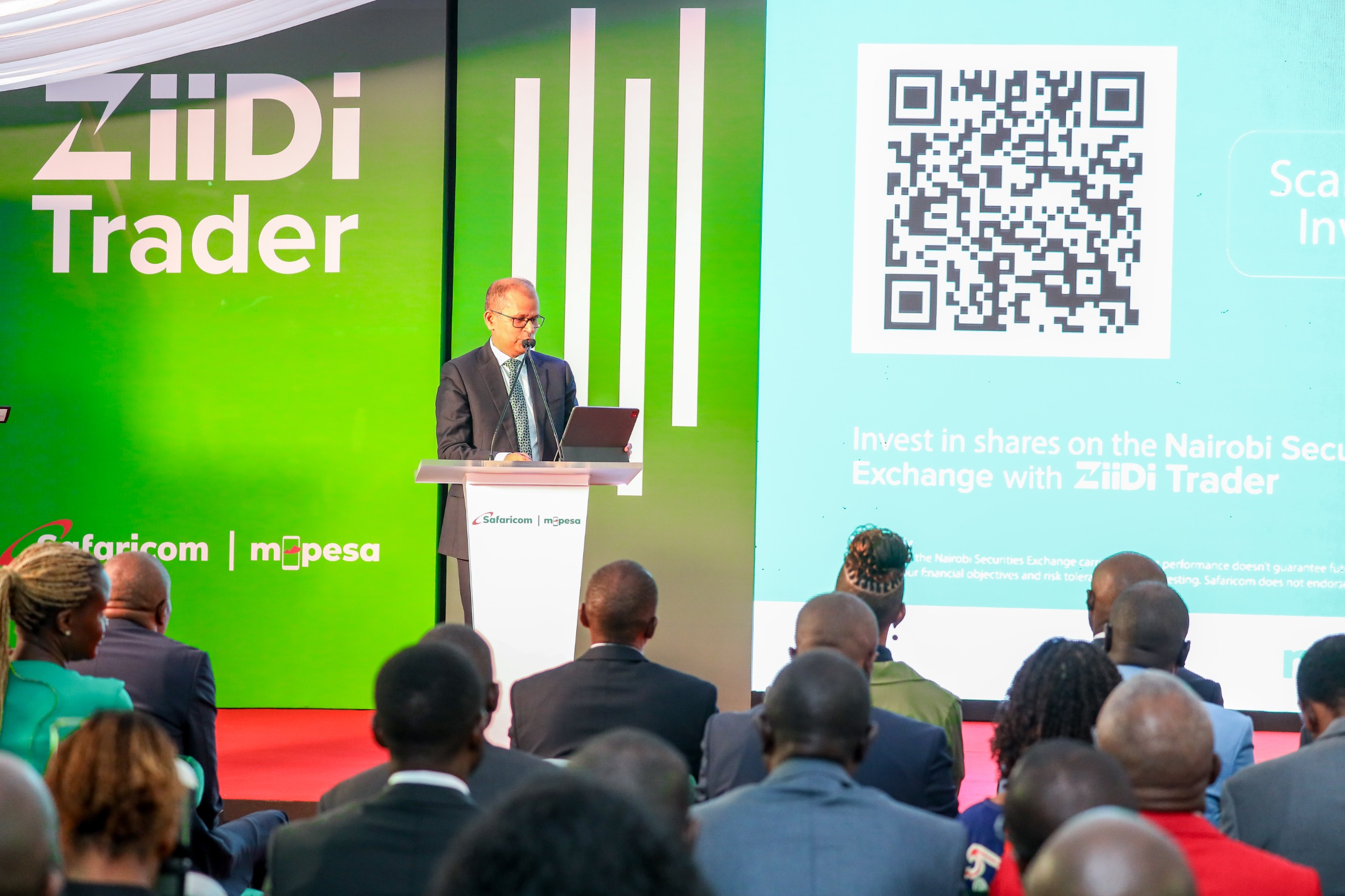
Safaricom’s Ziidi offering covers different forms of investment activity. Ziidi Money Market Fund gives M-PESA users access to a managed investment product through their mobile phones, while Ziidi Trader connects customers to securities listed on the Nairobi Securities Exchange. These services address different financial needs, and their adoption should not be measured as though they are the same product.
A mobile wallet is becoming an investment distribution channel
The Ziidi Money Market Fund allows customers to invest through M-PESA rather than relying exclusively on conventional investment channels. The product is offered by Safaricom in partnership with Standard Investment Bank and ALA Capital, with the fund operating under Capital Markets Authority regulation.



Customers can access the service through the M-PESA app or USSD. The fund accrues interest daily, according to the product information, while deposits and withdrawals are conducted through the mobile money platform. Although the fund does not impose a maximum investment amount, applicable M-PESA transaction limits still govern how customers move money through the service.
This arrangement gives an existing payments network a route into investment distribution. Customers who already use M-PESA to receive income, pay bills and transfer funds can access a money market fund without having to begin their investment journey through a separate banking or brokerage relationship.
The scale of Safaricom’s wider M-PESA business provides the distribution infrastructure. During HY27, M-PESA processed 12.9 billion chargeable transactions, a 48.2% increase year on year. Total transaction volumes across the service grew 25.2% to 27.4 billion, while M-PESA revenue rose 13.6% to KSh100.1 billion.
Those figures do not represent investment activity. They show the scale of the payment network through which Safaricom can distribute financial products, including savings and investment services. The company’s opportunity lies in converting some of that existing digital engagement into longer-term financial participation.
Ziidi Shari’ah adds another option within the money market fund category. It is designed to provide a Sharia-compliant investment route for customers seeking an alternative structure. Its presence broadens the product range, although its performance should be assessed separately from the overall wealth management figures unless Safaricom provides a specific breakdown.
Ziidi Trader brings the stock market into the mobile ecosystem
The investment proposition extends beyond money market funds. Ziidi Trader allows customers to buy and sell shares listed on the Nairobi Securities Exchange through the M-PESA app. The service is offered through a partnership involving Safaricom, the NSE and Kestrel Capital.
Customers can start investing with one share, monitor their portfolios and access market information through the platform. The service also supports access to corporate bonds, giving users a route to more than one category of listed security.
For the NSE, mobile access offers another channel through which retail investors can participate in the market. For Safaricom, it extends M-PESA into securities trading, a business with different requirements from processing payments or providing a money market fund.
The involvement of the NSE and Kestrel Capital is part of the service’s operating structure, while the Capital Markets Authority provides the regulatory framework for the relevant investment activities. The platform therefore sits within an established capital markets system, rather than operating as a standalone mobile savings feature.
The HY27 results do not separately disclose Ziidi Trader’s active users, trading volumes or value of transactions. Safaricom’s reported 3.4 million active wealth management customers and KSh25.6 billion in assets under management should therefore not be interpreted as figures for the share-trading service alone. They represent the broader wealth management business.
That distinction is important when assessing how much mobile access is changing participation in the stock market. A customer investing in a money market fund is not necessarily an active equities investor, while someone who has registered for a trading platform may not be placing regular orders.
Access is only the first measure of investment participation
Mobile investment services can reduce some of the practical barriers associated with opening and managing investment accounts. A customer can access a product through a familiar mobile interface, move funds through an existing payments account and monitor holdings without relying on a physical branch or brokerage office.
But convenience does not remove the financial decisions involved in investing. Customers still need to understand investment risk, liquidity, fees, the nature of the underlying assets and the possibility that returns can change. A money market fund and a listed share also carry different risk profiles and serve different investment objectives.
The commercial case for digital wealth management will depend on whether customers continue to invest after opening an account. Regular contributions, investment duration, withdrawals and the distribution of assets across products would provide a fuller picture of how mobile services are influencing financial behaviour.
The wider financial services figures provide some context for Safaricom’s investment ambitions. The company reported financial services revenue of KSh7.1 billion in HY27, up 55.3%, while M-PESA’s overall revenue reached KSh100.1 billion. These are separate reporting measures: the financial services figure relates to the relevant segment, while M-PESA revenue covers the wider mobile money business.
Safaricom’s investment offering also sits within a market where retail access to capital markets remains an important policy and industry objective. Digital platforms can make the mechanics of investing more accessible, but they cannot substitute for investor education or an understanding of the products being purchased.
For the company, the opportunity is to develop a relationship with customers that extends beyond payments and short-term borrowing. For investors, the practical measure will be whether mobile access helps them build and maintain portfolios suited to their financial goals.
Safaricom’s HY27 results show that the wealth management business has already attracted millions of active customers and tens of billions of shillings in assets. The next stage of its development will be judged by how those customers use the available products, and how much of that activity translates into sustained participation in Kenya’s investment market.
Go to TECHTRENDSKE.co.ke for more tech and business news from the African continent and across the world.
Follow us on WhatsApp, Telegram, Twitter, and Facebook, or subscribe to our weekly newsletter to ensure you don’t miss out on any future updates. Send tips to info@techtrendsmedia.co.ke

