

African Banks Lean Into Digital Transformation as Margins Tighten

Africa’s banking sector is heading into the second half of 2026 in a state industry analysts describe as cautiously optimistic: resilient on the surface, but navigating real macroeconomic pressure underneath. Inflation remains sticky in several markets, interest rates stay elevated, and currency volatility continues to complicate balance-sheet planning for lenders across the continent.
Despite those headwinds, banks are not standing still. Across multiple markets, lenders are restructuring balance sheets, investing in technology and rethinking branch models in an effort to reposition for long-term relevance rather than simply weather the cycle.
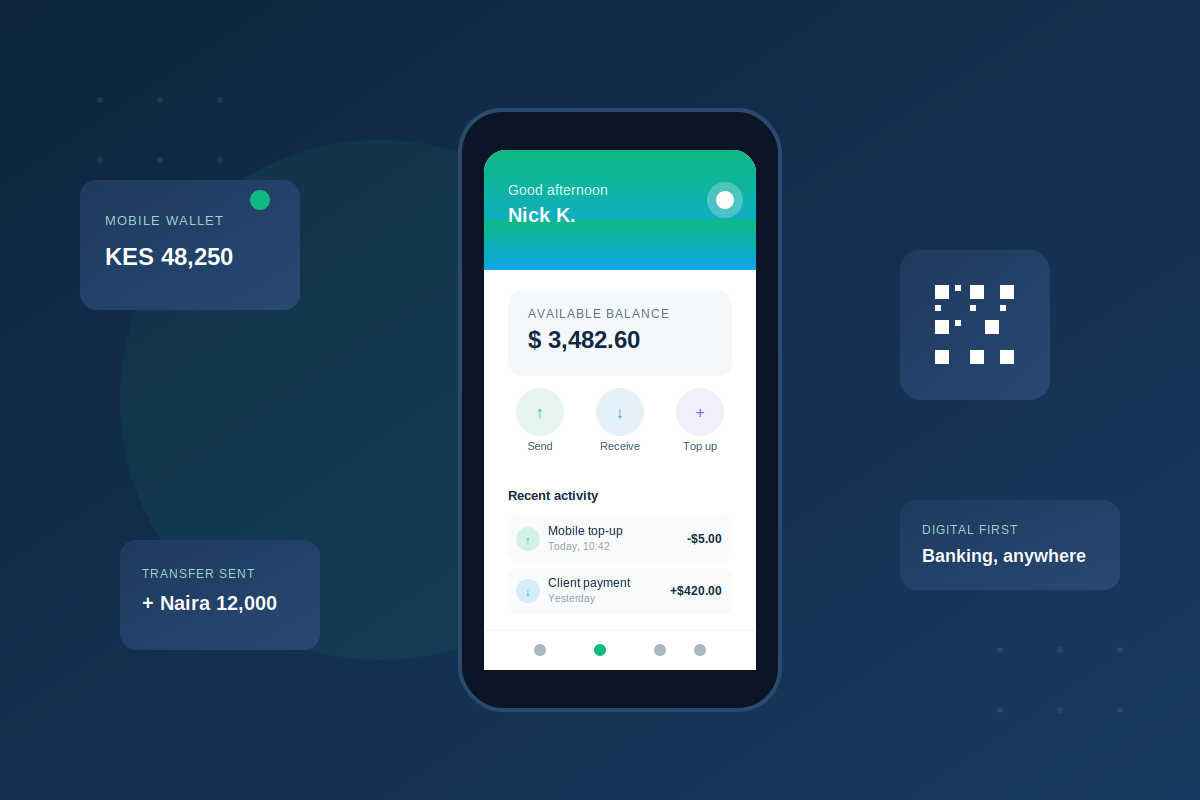
Digital transformation tops the list of catalysts reshaping the sector. Mobile banking, USSD platforms and app-based services now dominate customer interactions across much of the continent, driven by rising smartphone penetration, urbanisation and a young, digitally native population. According to the European Investment Bank’s 2024 Banking in Africa survey, transferring money domestically, receiving payments from customers, and paying bills or suppliers are the three most common services that banks now provide digitally, with half of surveyed banks also offering international transfers or remote account opening, and roughly a third planning to introduce these services.
Industry researchers note that digital channels are not just lowering costs for banks, they are also improving risk assessment and enabling new products tailored to previously underserved populations. The continent’s fintech sector continues to expand rapidly, with the number of active fintech companies reaching 1,263 in 2024, up from 1,049 in 2022 and just 450 in 2020, with Nigeria and South Africa together hosting nearly half of all fintech firms. Payments remain the dominant fintech product, offered by a third of fintech firms, followed by lending services at roughly a fifth.


Banks themselves appear increasingly convinced that partnership, rather than pure competition, with fintechs is the more profitable path. Survey data shows that when traditional banks partner with non-bank fintech companies, virtually all cite improving the customer experience as a strategic motivation, with the vast majority also pointing to access to innovative technology and an expanded customer base. Close to nine in ten banks surveyed across sub-Saharan Africa are now investing in upgrading the digital skills of staff and management through specialised training programmes, alongside continued investment in digital infrastructure and tools.
Cross-border payments, SME financing and ESG-linked finance are emerging as the clearest growth opportunities, alongside underserved retail segments that traditional branch-based banking has struggled to reach profitably. At the same time, credit deterioration, cyber threats, rising regulatory compliance costs and skills shortages feature prominently among the risks lenders are being urged to manage closely.
Profitability dynamics are shifting beneath the surface. Sub-Saharan African banks have seen profits grow in the high interest rate environment, even as the spread between deposit rates and private sector lending rates has narrowed in many countries, partly because banks have increased their holdings of government bonds and benefited from sharply higher yields on those bonds. That tailwind may not last. As sovereign bond yields begin to fall, the report warns, this is likely to weigh on bank profitability going forward, sharpening the urgency around diversifying income through digital and fee-based services.
“African lenders are no longer waiting out macroeconomic headwinds; they are actively reengineering their operating models around digital delivery. High interest rates have temporarily padded margins, but as sovereign bond yields eventually compress, banks know they must diversify into fee-based, digitally scaled services. According to the European Investment Bank’s 2024 Finance in Africa report, based on a survey of 51 sub-Saharan banks, the sector is aggressively pivoting toward digitalization and climate finance. With fintech partnerships accelerating, the traditional branch-heavy model is rapidly giving way to mobile-first ecosystems that lower operational costs while effectively reaching previously underserved retail and SME segments,” said Agustina Maria Patti, Financial Markets Strategist at Exness.
Performance is not uniform across the continent. Markets with deeper capital markets and more advanced fintech ecosystems are pulling ahead, while others remain constrained by thinner financial intermediation and higher sovereign risk premiums. Financial conditions across the continent have been loosening following a severe tightening from mid-2021 to mid-2023, a period the report describes as the most severe peak-to-trough tightening episode since 2009, triggered largely by the war in Ukraine. The EIB’s financial conditions index for Africa has been expanded in the latest edition to cover ten countries, namely South Africa, Egypt, Nigeria, Kenya, Morocco, Côte d’Ivoire, Ghana, Tunisia, Senegal and Zambia.
Climate exposure adds another layer of complexity to risk management. Africa is acutely exposed to the physical risks of climate change, yet many banks report limited impact on their asset quality, often because they remain reluctant to lend to agriculture, the sector most exposed to climate risk. Banks that are more engaged with climate issues, the report finds, are more likely to offer green products to customers and less likely to identify internal constraints to green lending, a pattern that is reshaping how ESG considerations factor into lending strategy across the region.
The European Investment Bank’s long-running Finance in Africa survey series, now in its ninth year, continues to track this divergence across financial markets, digitalisation and climate finance. The latest edition draws on the EIB Banking in Africa Survey, carried out among 51 banks across sub-Saharan Africa, alongside evidence from the World Bank Enterprise Surveys and a range of other data sources. The report’s structure spans financial markets and financing conditions, economic development and access to finance, banking sector trends and regional performance, digital financial services, and climate finance and investment across the region.
Go to TECHTRENDSKE.co.ke for more tech and business news from the African continent and across the world.
Follow us on WhatsApp, Telegram, Twitter, and Facebook, or subscribe to our weekly newsletter to ensure you don’t miss out on any future updates. Send tips to editorial@techtrendsmedia.co.ke


