
Fixing Africa’s Cloud paradox: Why The Continent’s Digital Future is Still Within Reach

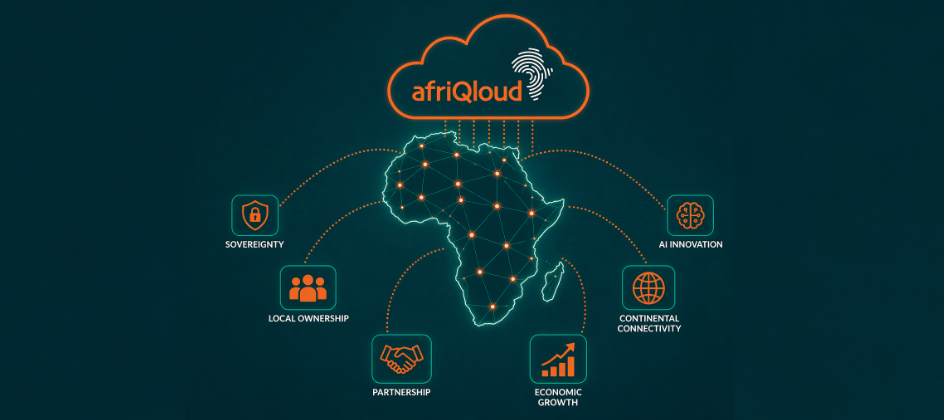
In its recent piece, ‘Africa can’t build 54 clouds – and importing one won’t fix it,’ TechCabal captures a real and pressing dilemma. The article argues that Africa faces a structural contradiction: fragmented national ambitions make it impractical to build dozens of sovereign clouds, yet reliance on foreign hyperscalers risks deepening dependency, economic leakage, and loss of control.
It is a compelling diagnosis. But it is not a dead end.
A closer examination – particularly in light of the AfriQloud framework – suggests that the problem is not unsolvable. Rather, it has been incorrectly framed. The choice is not between 54 isolated national clouds and total dependence on external providers. There is a third path emerging: coordinated, sovereign, and distributed infrastructure built at continental scale.
The false binary in Africa’s cloud debate


TechCabal’s central argument rests on a binary: either Africa attempts to replicate hyperscaler models at a national level – an inefficient and costly exercise – or it continues importing cloud services from global providers such as Amazon Web Services, Microsoft Azure, and Google Cloud.
Both options have limitations.

Fragmentation leads to duplication of costs, inconsistent standards, and limited scalability. Importation, meanwhile, entrenches external control over data, infrastructure, and economic value. As TechCabal rightly points out, neither approach adequately serves Africa’s long-term strategic interests.
However, this framing overlooks a critical alternative: infrastructure that is nationally sovereign but continentally coordinated.
AfriQloud’s core insight: Build once, scale across many
AfriQloud introduces a fundamentally different architecture – one that resolves the fragmentation problem without sacrificing sovereignty.
Instead of 54 disconnected clouds, it proposes a Pan-African, interoperable ecosystem built on distributed cloud infrastructure. This model allows each country to maintain local ownership and control of its data and systems, while participating in a shared continental framework
The distinction is subtle but transformative:
- Not one imported cloud, but a network of interconnected sovereign nodes
- Not 54 isolated systems, but a unified, interoperable architecture
- Not dependency, but coordinated self-reliance
This directly addresses TechCabal’s concern about inefficiency. Infrastructure is not duplicated unnecessarily; it is federated. Capacity can be shared, standards harmonized, and services extended across borders without centralizing control.
Distributed cloud: Designed for Africa’s realities
One of the article’s implicit assumptions is that cloud infrastructure must follow the centralized hyperscaler model. AfriQloud challenges this premise.
Distributed cloud architecture places compute and storage closer to where data is generated. In African contexts – where connectivity, power stability, and latency vary widely – this model is not just viable; it is optimal.
It delivers three critical advantages:
- Resilience: Systems remain functional even with intermittent connectivity
- Efficiency: Reduced bandwidth and latency costs
- Sovereignty: Data stays within national jurisdictions
This design aligns with Africa’s historical pattern of leapfrogging. Just as the continent bypassed fixed-line telephony in favor of mobile, it can bypass centralized cloud models in favor of distributed systems.
Solving the capability gap: Build-Operate-Transfer
Another concern raised in the broader cloud debate is capability – whether African countries possess the technical expertise and capital to build and operate advanced infrastructure.
AfriQloud’s Build-Operate-Transfer (BOT) model addresses this directly.
Rather than requiring governments to develop capabilities from scratch, infrastructure is initially deployed and managed by a consortium of experienced partners. Over time, skills, systems, and operational control are transferred to national institutions.
This ensures that:
- Sovereignty is not symbolic – it is engineered into the lifecycle
- Local capacity is built, not assumed
- Long-term dependency is systematically reduced
In effect, the model replaces the “import and rely” paradigm with “learn, own, and operate.”
Economics: Retaining value within the continent
TechCabal highlights a critical issue: Africa’s growing cloud expenditure largely flows outward to foreign providers.
AfriQloud reframes cloud infrastructure as an economic development engine, not just a technical service.
Through its ecosystem model:
- Local telecoms, data centers, internet service providers (ISP`s), managed service providers (MSp`s), system integrators (SI`s) and developers participate in deployment
- Capital is mobilized through blended financing, including development institutions
- Innovation ecosystems are funded alongside infrastructure
This approach transforms cloud spending into local investment, retaining value within African economies while stimulating job creation and skills development.
The AfCFTA multiplier effect
Perhaps the most significant gap in the “54 clouds” argument is its limited consideration of continental integration.
The African Continental Free Trade Area (AfCFTA) is creating the largest free trade zone in the world. But its success depends on digital infrastructure that can support cross-border commerce, identity, and payments.
AfriQloud positions itself as this digital backbone. By enabling interoperable systems across countries, it allows:
- Seamless digital trade processes
- Cross-border identity and payment systems
- Harmonized public services
This transforms cloud infrastructure from a national concern into a continental growth enabler – a dimension largely absent from the TechCabal critique.
Governance: Beyond technology
A final weakness in the prevailing pessimism is the assumption that infrastructure challenges are purely technical.
AfriQloud recognizes that success depends equally on governance. Its model integrates five stakeholder groups – government, academia, industry, civil society, and capital – ensuring alignment across policy, talent, execution, and financing.
This ecosystem approach reduces the risk of fragmentation not just at the infrastructure level, but across the entire digital economy.
From impossibility to strategy
TechCabal is correct in one respect: Africa cannot afford to build 54 disconnected clouds. Nor can it afford indefinite reliance on imported infrastructure.
But the conclusion that the problem is intractable does not hold.
AfriQloud demonstrates that the real solution lies in reframing the challenge:
- From fragmentation → to federation
- From dependency → to sovereignty
- From infrastructure as a service → to infrastructure as strategy
Africa’s digital future will not be built by copying existing models, nor by rejecting them outright. It will be built by adapting them – combining global expertise with local ownership, and national control with continental scale.
If executed effectively, this approach does more than resolve the cloud dilemma. It positions Africa not as a passive consumer in the global digital economy, but as an active architect of its own infrastructure – and its own destiny.
If you would like to be part of this transformative journey – whether as a government stakeholder, technology partner, investor, or ecosystem contributor – we invite you to take the next step. Engage directly with the AfriQloud team to explore collaboration opportunities or request further information. To express your interest or begin the conversation, please reach out via this email: hello@afriqloud.com.
Go to TECHTRENDSKE.co.ke for more tech and business news from the African continent and across the world.
Follow us on WhatsApp, Telegram, Twitter, and Facebook, or subscribe to our weekly newsletter to ensure you don’t miss out on any future updates. Send tips to editorial@techtrendsmedia.co.ke


