Peter Ndegwa wants Safaricom to grow beyond its dominance in telecoms and M-PESA

Safaricom’s ability to sustain its position in Kenya’s telecommunications market increasingly depends on how much business it can build around its existing customer relationships. Mobile connectivity remains the foundation, but financial services, merchant payments, fixed broadband, enterprise technology and regional expansion now account for a larger part of the company’s growth strategy.

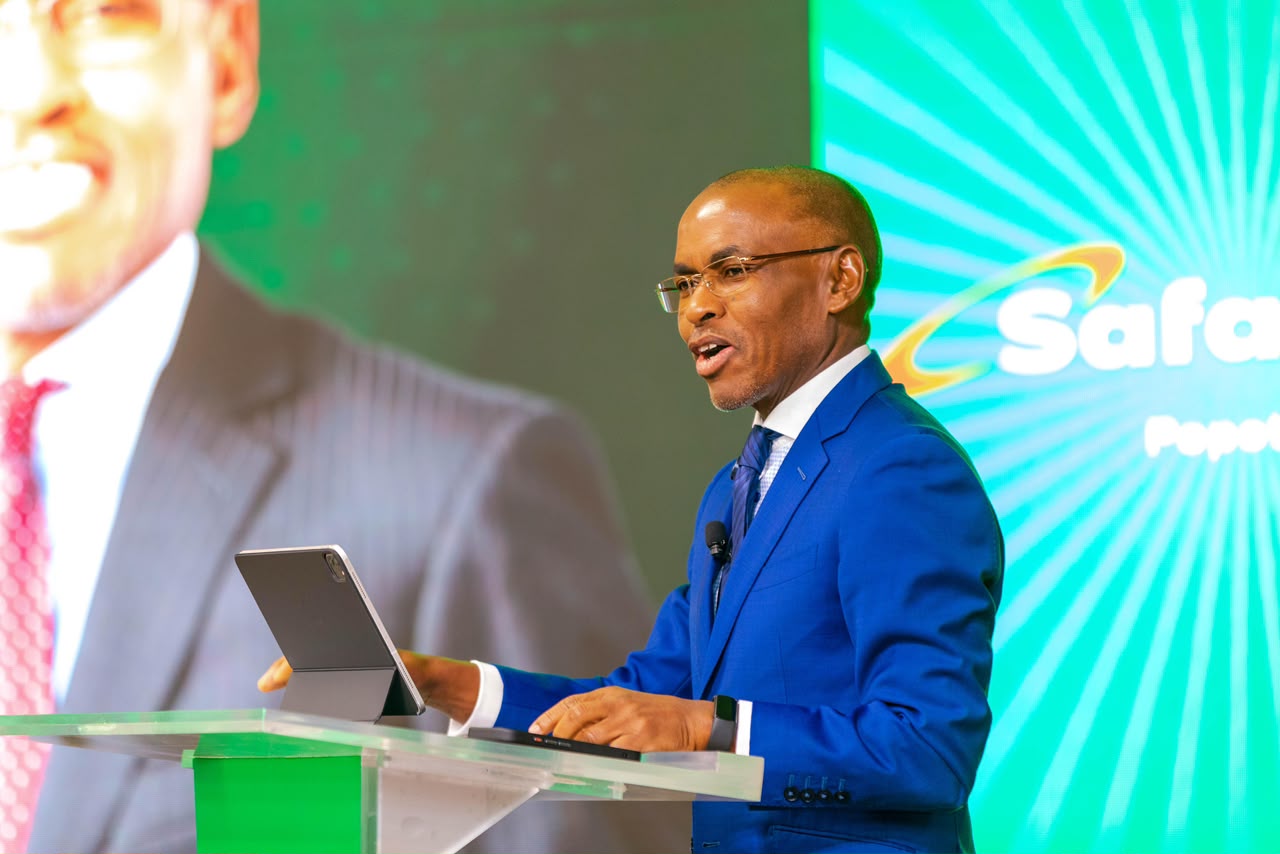
Peter Ndegwa, Safaricom’s chief executive, outlined this approach during the Lagos Business School Chief Executive Programme at Strathmore Business School in Nairobi on November 20, 2026. His discussion with executives from eight Nigerian businesses centred on defending a dominant market position through customer value creation, organisational agility and continued investment in adjacent businesses.
The financial results behind that strategy show the scale of the operation. Safaricom Group recorded KSh414.1 billion in service revenue for FY26, equivalent to approximately US$3.2 billion, with 71.6 million customers across Kenya and Ethiopia. In Kenya, the company held 69% of the mobile market and 89% of the mobile money market, according to Communications Authority figures for June 2026.
Maintaining that position requires the company to manage a business whose services have become part of everyday commercial activity. M-PESA processed more than 46 billion transactions during FY26, while its total transaction value reached KSh41.7 trillion, approximately 2.4 times Kenya’s GDP.


M-PESA’s growth depends on affordability and wider usage
One of the more consequential aspects of Ndegwa’s strategy concerns the relationship between transaction pricing and customer activity. Safaricom has been expanding access to M-PESA while increasing the frequency with which customers use chargeable services.
In his presentation, Ndegwa said 53% of M-PESA transactions were free. He also cited an increase in chargeable transactions per customer from approximately 13 a month in 2020 to 51 a month. The figures illustrate how the company is combining lower-cost access with greater transaction activity across its mobile money platform.
Safaricom’s HY27 financial performance provides additional context. Its M-PESA revenue increased 13.6% to KSh100.1 billion in the first half of FY27, while chargeable transactions rose 48.2% to 12.9 billion, according to the company’s financial results reported by TechTrendsKE on November 5.
The company has also been expanding the financial services available through M-PESA. TechTrendsKE reported on November 15 that Safaricom’s financial services revenue increased 55.3% to KSh7.1 billion during the first half of FY27. The business had 17.5 million credit customers and 3.4 million money market fund customers, alongside growth in insurance distribution.

These services extend M-PESA’s role into credit, savings, investment and insurance distribution. The platform’s transaction history and customer relationships provide a foundation for offering additional financial products through an established distribution channel.
Ndegwa’s presentation also described affordability as something that should be incorporated into product design rather than introduced through occasional discounts. Safaricom has supported access through lower-priced 4G devices, small transfers and products designed around different customer needs.
Its Shiriki Pay service provides another example. TechTrendsKE reported on November 24 that the product had attracted 3.7 million opt-ins, allowing M-PESA account holders to give up to five beneficiaries controlled spending access, subject to monthly limits of up to KSh20,000.
Building additional businesses around the customer network
Safaricom’s merchant ecosystem is another major part of its growth strategy. The company reported more than 330,000 M-PESA agents and dealers nationwide, alongside 1.28 million Lipa na M-PESA merchants and approximately 3.2 million active Pochi merchants in the presentation.
Merchant services are generating additional income while providing the company with access to business transaction activity. TechTrendsKE reported on November 17 that merchant services revenue increased 34.6% to KSh8.18 billion in H1 FY27, supported by 4.7 billion merchant transactions.
The same reporting identified opportunities to extend financial services to small businesses using their transaction histories. Digital payment activity can provide information about business performance and cash flows, supporting the development of credit products for merchants.
Safaricom is also extending its services into wealth management. Its investment products had 3.4 million active customers and KSh25.6 billion in assets under management, according to TechTrendsKE’s November 17 reporting. Assets under management increased 69.7% year-on-year.
The company’s fixed connectivity business provides another revenue stream. Ndegwa said approximately 926,000 homes were connected, while fixed and Internet of Things revenue increased 25.5%. Enterprise and digital services also cover cloud, connectivity and technology solutions for businesses and government institutions.
Safaricom has been consolidating customer access to these services through My OneApp. The application recorded 7.3 million downloads and 4.5 million monthly active users, having processed KSh2 trillion in transactions, according to TechTrendsKE’s November 5 report. Ndegwa had also acknowledged customer dissatisfaction during the initial rollout.
The expansion into these businesses is supported by a distribution network that already reaches millions of individuals and merchants. Safaricom can use its existing customer relationships to introduce additional services across payments, connectivity and financial products.
Ethiopia tests Safaricom’s expansion strategy
Safaricom’s Ethiopian operation provides a different measure of the company’s ability to extend its business model beyond Kenya.
The operator entered Ethiopia with a network and customer acquisition strategy built from scratch. Its operations have had to contend with armed conflict, currency reform and the commercial conditions of a market substantially different from Kenya.
During the Lagos Business School discussion, Ndegwa said Safaricom Ethiopia’s service revenue increased 71.6% in H1 FY27, while its EBITDA loss declined 96.5% year-on-year. The company was targeting EBITDA breakeven by the end of FY27.
TechTrendsKE’s November 5 reporting provides further detail on the operation. Safaricom Ethiopia generated KSh10.6 billion in service revenue and had 15.4 million three-month active customers during the first half of FY27. Its EBITDA loss stood at KSh434.4 million, following the 96.5% year-on-year reduction.
The operation’s revenue growth was 102.1% in Ethiopian birr. Safaricom had invested a cumulative KSh159.6 billion in the business, reflecting the capital requirements of establishing a telecommunications operation in a new market.
The improvement in financial performance follows years of network investment and customer acquisition. Safaricom has had to build local distribution, expand network coverage and develop services suited to Ethiopian customers while managing the country’s operating conditions.
Ndegwa’s position is that the company cannot simply export its Kenyan operating model into another market. Local market conditions require adjustments to products, pricing, distribution and business operations.
That approach also reflects his earlier experience in consumer goods. Before joining Safaricom in April 2020, Ndegwa held management positions at East African Breweries Limited, Guinness Ghana, Guinness Nigeria and Diageo’s continental European operations.
At EABL, he worked on reviving growth in a mature category through Senator Keg, which used affordability to reach consumers in informal markets. His subsequent roles in Ghana and Nigeria involved building brands in price-sensitive markets and managing the effects of currency depreciation and oil price shocks. At Diageo, he worked across more than 50 countries, where differentiation, innovation and productivity were important to operating in low-growth markets.
AI and organisational changes support the next phase
Safaricom’s technology strategy is also becoming more closely connected to its customer operations and financial services business.
Ndegwa identified customer care, fraud protection on M-PESA, network planning, credit assessment and personalised offers as areas where artificial intelligence could improve operations. He said the company was prioritising practical customer and business problems rather than pursuing AI pilots without defined applications.
The presentation also cited Fintech 2.0, which enables M-PESA to process up to 6,000 transactions per second. AI-supported fraud detection is part of the company’s effort to protect transactions while improving service delivery.
TechTrendsKE’s November coverage of Safaricom’s AI initiatives provides additional context. Reporting on November 17 examined the company’s engagement with employees, developers and local technology talent through programmes including Decode and Spark. A November 19 interview with Safaricom CTO James Maitai also explored how the operator is incorporating AI into its technology operations.
The security requirements are substantial for a company processing billions of financial transactions. TechTrendsKE reported on October 27 that Safaricom monitored 1.25 billion intrusion attempts during FY26 and investigated more than 130,000 security events. Its November 16 coverage examined the company’s response to digital scams and the security risks facing customers.
Ndegwa also discussed changes to the company’s management structure. He said he had reduced his direct reports from 15 to nine, giving business leaders clearer responsibilities and shortening decision-making processes. His approach relies on smaller teams, defined priorities and leaders trusted to deliver specific outcomes.
The ecosystem strategy extends to Safaricom’s relationship with regulators and commercial partners. Ndegwa said agents, dealers, developers and banks were important to the company’s operating model, while regulators needed to be engaged early on matters including interoperability and pricing.
The investment requirements of maintaining telecommunications infrastructure also remain substantial. TechTrendsKE reported on November 27 on proposed changes to Kenya’s communications law that would affect instalment payments for qualifying spectrum licences exceeding KSh1 billion. The reporting also covered Safaricom’s KSh35 billion Kenyan capital expenditure in H1 FY27 and full-year guidance of KSh58 billion to KSh61 billion.
Safaricom’s expansion into financial services, enterprise technology and new markets is taking place alongside continued investment in the connectivity infrastructure supporting its existing customers. Ndegwa’s approach places the customer proposition, operating efficiency and the development of new services within the same management strategy.
Visit TECHTRENDSKE.co.ke for more tech and business news from across Africa and the world.
Follow us on WhatsApp, Telegram, Twitter, and Facebook, or subscribe to our weekly newsletter so you don’t miss future updates. Send tips to info@techtrendsmedia.co.ke