
How This Is Digital built its AI training business before becoming Meta’s partner in Kenya

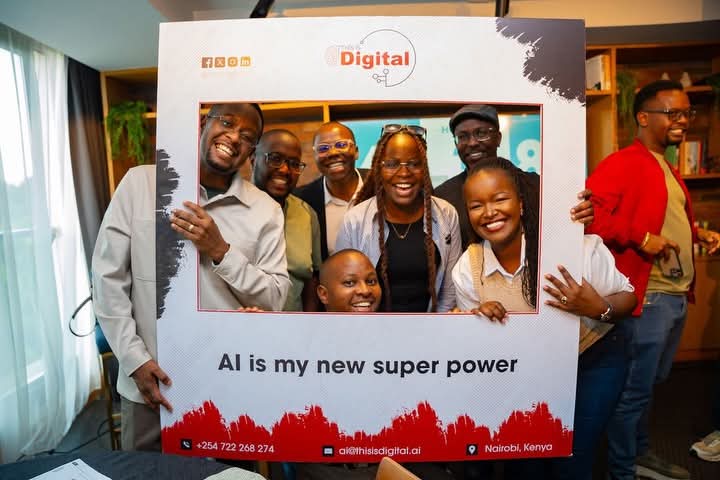
When Grace Murugi asked Claude what kind of company she should start, she was not looking for a business name or a list of startup ideas. In January 2025, she uploaded her CV and the World Economic Forum’s Future of Jobs report into the AI model and asked it to assess her qualifications and experience against the skills the report identified as important for the future, then recommend a business she could start to help prepare Kenya for that future. The answer was an AI literacy company. That exercise became part of the thinking behind This Is Digital, which has since trained more than 800 professionals and built an AI training and consultancy operation serving individuals and organisations in Kenya and beyond.
The story is useful because the company did not begin with a large training catalogue, a mature product or an established customer base. Murugi and her co-founder, Greg Wanjama, first spent time showing people what AI could do, listening to the questions they were asking and finding out whether those people would actually pay to learn how to use the technology. They were already seeing friends, colleagues and acquaintances turn to them for help with ChatGPT and other AI tools, and those informal consultations gave them an early indication that there was a market for practical AI training.
By the time the company launched publicly, the founders had decided to make a deliberate commitment to the business. They held a public launch before the full curriculum was finished, with some prospective clients already lined up, then built the training programme around what they were learning from the market. That decision has since produced a company that says it has trained more than 800 professionals, served more than 40 organisations and reached professionals across 11 countries.
An AI prompt helped shape the business idea
Murugi’s own background helps explain why the idea came together quickly. She studied computer science, moved into digital marketing, worked at Scan Group and Safaricom, and later became global head of digital strategy at Oxfam International. While at Oxfam, she was exposed to AI through training and collaborative projects involving organisations including Meta and Microsoft, which prompted her to think more seriously about where the technology could create opportunities in Kenya.


The Claude exercise provided a more structured way to test that thinking. Murugi fed the model her professional history alongside the World Economic Forum report and asked it to identify a business opportunity that matched her experience while addressing the skills Kenya would need. Its recommendation was an AI literacy company, a result she describes as the moment when AI helped form the company’s initial thesis. The founders then subjected that idea to a much less glamorous but more important process: conversations with potential customers, demonstrations and informal consultations to establish whether there was genuine demand.
Wanjama came at the business from a different direction. A software developer by training, he had already incorporated AI into his own technical workflow, using it for coding, debugging and other development tasks. His challenge was translating that technical familiarity into language that professionals outside software development could understand and apply to their own work. That combination of technical experience and Murugi’s digital strategy background became the basis for the company’s training approach.
That approach is reflected in the company’s current training model. This Is Digital says its curriculum covers 15 AI tools and offers online, in-person and one-on-one formats, with training built around practical workflows rather than simply introducing people to individual applications. The company currently says it has trained more than 800 professionals, served more than 40 organisations and reached professionals across 11 countries.
From informal demonstrations to 800+ professionals
The founders’ early validation process was highly hands-on. They describe meeting people for coffee, opening laptops and demonstrating how AI could solve specific problems, then repeating the exercise with different professionals and organisations. Those sessions became an informal laboratory for the eventual curriculum because the founders could see which questions kept coming up and which use cases people were prepared to pursue.
The result was a training business that gradually moved from general AI awareness toward workflow design. The founders say many people arrive knowing how to ask ChatGPT or another model a question, but have less experience giving an AI system the context, instructions and constraints needed to perform useful recurring work. That gap has shaped the way they teach, particularly as interest has moved from basic prompting toward AI assistants and agents.
Their experience with trainees has also produced some striking individual stories, although these remain claims from the founders rather than independently verified employment statistics. They say five people have left their jobs after taking the company’s training, including one person who became an AI-powered researcher and another who moved into AI-powered social media automation. Those examples are presented by the founders as evidence of how deeply some participants have incorporated AI into their professional work.
The more important lesson for the company appears to have been what trainees revealed about the limits of generic AI knowledge. People can own several paid AI subscriptions and still struggle to extract meaningful value from them, while another person with a single tool can develop a much deeper workflow around it. The founders’ argument is that the differentiator lies in how well the technology is connected to someone’s actual work, expertise, processes and objectives.
Building a company that uses AI internally
That philosophy also applies to This Is Digital itself. The founders describe the company as AI-native, with AI embedded across curriculum development, preparation for presentations and training sessions, research, administration and other back-office processes. They have also built specialised agents to handle recurring tasks, allowing the founders to spend more time delivering training and working with customers.
This internal use is important because the company is using the systems it teaches. Rather than treating AI as a separate product that gets demonstrated during a workshop and then forgotten, the founders have incorporated it into the company’s operating processes. Their stated approach is to do the substantial setup work first, including defining skills and building agents, then allow those systems to handle repeatable tasks.
Wanjama compares this process with implementing an enterprise resource planning system. A platform can offer the same underlying capabilities to two organisations while producing very different results depending on how each organisation configures its processes, reporting structures, data and standard operating procedures. He argues that AI works in much the same way: the technology becomes more useful when it is given access to the specific context in which a person or business operates.
That also explains why the founders are sceptical of the idea that AI automatically fixes weak businesses. Wanjama argues that companies still need a viable business model, clear processes and people who understand the underlying work. AI can help identify weaknesses, analyse a business model and accelerate execution, but it does not remove the need for human judgement.
What hundreds of trainees taught This Is Digital
After reaching the 800-person mark, the founders used their own AI tools to analyse what they had learned from the people they had trained. One recurring observation was that the Kenyan AI conversation contains a large amount of enthusiasm alongside considerable uncertainty about how to turn that enthusiasm into useful systems.
They see this particularly clearly in the interest around AI agents. The founders say many people now want an agent for almost every task, but underestimate the work required to make one genuinely useful. Their analogy is a personal assistant: an effective agent needs a defined role, access to the right information and tools, rules, parameters and a clear understanding of the work it is expected to perform.
That distinction has influenced the company’s training. Rather than building a generic agent that attempts to do everything, the founders advocate specialised systems with narrowly defined jobs. A simple example discussed in the interview is an agent whose sole responsibility is creating Zoom meetings through the relevant API. Once such an agent has been properly configured and trained, it can handle a repetitive workflow without requiring a person to repeat the same instructions every time.
The same thinking extends to professional development. Wanjama argues that as more people become competent at basic prompting, simply knowing how to communicate with an AI model will become less distinctive. He recommends using AI as a critical reviewer or sparring partner, asking it to examine reports, emails, client interactions or other work and identify areas where the person can improve. Murugi makes a related argument through what she calls adaptability, encouraging professionals to think about how AI can make them better marketers, researchers, HR practitioners, journalists and other specialists rather than treating AI skills as a standalone occupation.
How the Meta partnership fits the journey
That experience now sits behind This Is Digital’s partnership with Meta on AI Academy Kenya. The partnership was announced in September, with the programme designed to provide AI training to Kenyan students, professionals, small business owners and startups. The programme is expected to upskill up to 300 participants.
The programme has two principal components. The Pitchathon is aimed at Kenyan startups and developers building solutions with Meta’s AI technologies, while the eight-week AI Masterclass is designed to build broader practical AI skills. The Masterclass is scheduled to begin on November 3, while Pitchathon applications close on September 30.
The formal partnership came after discussions that, according to Murugi, began in June and progressed through due diligence, a proposal and meetings with Meta’s team. In the interview, she described the selection as particularly striking because the business was only about a year old at the time.
For This Is Digital, the partnership therefore expands an existing model rather than creating one from scratch. The company already had a curriculum, a community of trainees, experience working with organisations and a training operation that it says had reached more than 800 professionals. Meta provides a larger platform through which that experience can be applied to a new group of Kenyan students, developers, professionals and startups.
The bigger ambition for AI skills in Africa
The founders’ ambitions extend beyond the Meta programme. Murugi says the company’s longer-term goal is to help empower one million Africans with practical AI skills, while acknowledging that a target of that scale cannot be achieved by one training company alone. She argues for an ecosystem of organisations working across different parts of AI education, technical development and practical implementation.
That ambition is consistent with the way the company describes its own role. This Is Digital positions the business around practical AI literacy for professionals and organisations, while its corporate training offering spans sectors including universities, banks, government, churches and other organisations.
The founders’ central lesson from their first year is simpler than much of the language surrounding AI. They argue that businesses and professionals should start with the work they need to improve, then determine where AI can create measurable value. The technology matters, but so do the underlying processes, expertise and judgement that determine whether an AI system actually helps.
That is also what makes the company’s origin story unusual. AI helped Murugi formulate the initial business thesis, the founders then validated that thesis through conversations and demonstrations, and the company subsequently built AI into its own operations while training hundreds of other people to do the same. A year into that journey, the business has moved from asking whether there was a market for AI literacy to helping deliver Meta’s AI capacity-building programme in Kenya.
The next measure of that journey will be what those trained professionals and businesses actually build with the skills they have acquired. For This Is Digital, the stated goal is to make that pool much larger, with the founders arguing that Kenya and the wider African technology ecosystem need more people who can move from experimenting with AI tools to applying them to real work and real problems.
Real ESG impact doesn’t happen in panels alone, it happens in the rooms where financiers, operators, and policymakers actually align. Our GreenShift Forum 2026 cuts the noise, bringing together the people rewiring Africa’s sustainability and energy frameworks for one focused day in Nairobi. Secure your seat.
Go to TECHTRENDSKE.co.ke for more tech and business news from the African continent and across the world.
Follow us on WhatsApp, Telegram, Twitter, and Facebook, or subscribe to our weekly newsletter to ensure you don’t miss out on any future updates. Send tips to info@techtrendsmedia.co.ke