The Silent Backbone of Africa’s Internet Boom Is Now a Battleground for Global Power
What began as a race for faster connections is turning into a contest over influence, access, and the unseen arteries of the digital age.

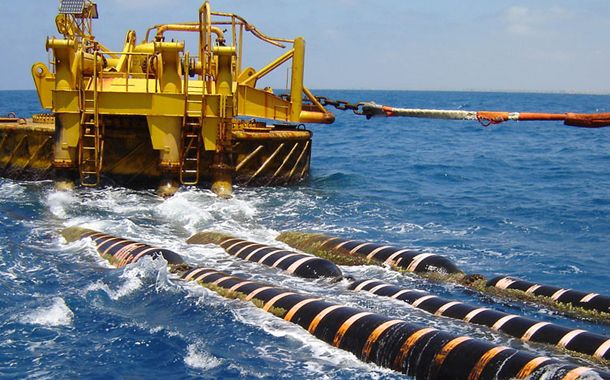
The shore outside Mombasa looks ordinary enough — tide-churned, sun-glared, restless with trade wind. But just offshore, beneath the surface, runs one of the most consequential systems on Earth. Armored fiber-optic lines — thin as a garden hose, buried beneath the sand — carry most of the continent’s digital life. They land quietly in sealed compounds, where engineers manage the pulse of billions of packets every second.
Each cable begins as a feat of marine engineering and ends as a line of geopolitical tension. And Africa, long treated as a consumer end-point of global connectivity, is now at the center of its renewal. The continent’s subsea map has thickened over the past decade — from a sparse network skirting coastlines into a dense lattice of overlapping routes. What once looked like a digital periphery now resembles an emerging crossroads.
A Continent in the Currents
In 2009, only a handful of undersea cables linked Africa to the rest of the world. Today, more than thirty routes encircle it, connecting Lagos to Lisbon, Mombasa to Mumbai, and Cape Town to London. The increase is dramatic — not only in capacity but in control. What used to be the domain of state-backed telecom consortia has become a competition between technology giants.
Meta’s 2Africa cable, looping more than 45,000 kilometers around the continent, is among the largest ever built. Google’s Equiano, running from Portugal to South Africa, promises bandwidth leaps that could alter regional economies. Each new project announces faster speeds and cheaper access, but the real story lies beneath the corporate slogans. These cables are not just pipes for data — they are arteries of influence, shaping who controls the digital future of 1.4 billion people.


Africa’s internet demand is surging, driven by mobile banking, streaming, and now artificial intelligence. The continent’s population is young, its developers prolific, and its cloud infrastructure still forming. Yet the path to digital self-sufficiency runs through hardware that few Africans own and oceans they cannot patrol.
The AI Undercurrent
Every conversation about AI infrastructure eventually loops back to bandwidth. Large language models, image generators, and cloud-based tools depend on massive data flows between data centers — and most of that traffic still moves through undersea fiber. For Africa, the stakes are structural: whoever builds and manages these cables will shape who trains, stores, and monetizes the continent’s digital intelligence.
AI companies rarely speak of cables. They talk about compute power, data sets, and models. But each of those layers depends on this unseen lattice. Meta, Google, and Microsoft are racing to expand their submarine reach not only to serve users but to feed their own AI ecosystems. Training data needs to travel; inference results need to return; latency shapes what’s possible. Africa’s subsea cables make that circulation viable — and, by extension, make the continent a critical node in the AI economy.
For governments, this raises an uncomfortable question: can Africa’s digital sovereignty exist if its neural infrastructure is foreign-built and ocean-borne? Some officials frame the issue as opportunity — a chance to leapfrog terrestrial gaps and attract cloud investment. Others see dependence disguised as development.
Bandwidth and Leverage
Cable routes follow markets, not coastlines. They connect data centers to cloud regions, fintech hubs to global exchanges, content delivery networks to consumers. But those same routes can reveal the hierarchy of the digital world. The biggest cables often serve the biggest players, and their design reflects their ambitions.
Meta’s 2Africa is not just a ring — it’s a strategic bypass around congested European corridors. Google’s Equiano reduces latency between West Africa and Europe, an advantage for AI processing and content distribution. Amazon and Microsoft have signaled interest in deeper connectivity for their cloud regions. The pattern resembles old trade routes reborn in fiber, where data replaces spice and bandwidth replaces gold.
For African governments, the calculus is uneasy. More cables mean more access, but also more dependence on external systems. Local telecoms lease capacity rather than own it. Policy frameworks lag behind physical buildouts. And as AI workloads rise, the continent risks becoming a throughput zone rather than a producer of value.
The Security Question
A single cable cut can disrupt financial transactions, disable streaming platforms, and even slow down AI operations across continents. In March 2024, damage to multiple West African cables left several countries partially disconnected for days. The incident, traced to undersea landslides, underscored how fragile this infrastructure remains — and how little control coastal states have over its protection.
Security analysts warn that the cables’ strategic role makes them potential targets in future conflicts. The same invisibility that makes them efficient also makes them vulnerable. Surveillance, sabotage, or espionage along these routes would be difficult to detect and harder to attribute. Some nations have begun mapping the ocean floor with military precision, treating cables as both infrastructure and intelligence pathways.
Africa’s coastal nations, by contrast, often rely on international maintenance contracts and aging regulatory frameworks. The imbalance is stark: the continent’s digital lifelines lie mostly beyond its jurisdiction, even as its dependence deepens.
The Illusion of Connectivity
The promise of subsea expansion is that faster cables will close the digital divide. In practice, the benefits are uneven. Coastal capitals thrive; inland regions remain underconnected. Wholesale bandwidth prices have dropped, but last-mile access and data affordability lag behind.
The map looks dense, but density doesn’t equal distribution. Each landing point marks not equality but potential — one that depends on terrestrial fiber, reliable power, and coherent policy. Without those, the cables remain what one engineer called “a highway with no on-ramps.”
Still, the narrative of progress persists. Investment announcements use the language of transformation, as if capacity alone could democratize access. What’s missing is a conversation about ownership: who profits when data moves faster, and who governs the intelligence that follows it?
The New Infrastructure of Power
AI has revived an old idea — that information itself is infrastructure. The pipelines that once carried oil now have digital counterparts. Bandwidth determines competitiveness; latency shapes innovation. And in that economy, Africa’s seabed has become contested real estate.
The global race for AI supremacy requires vast computational backbones. Subsea cables form the connective tissue between data farms, chip clusters, and user markets. As models scale, they require stable, high-capacity routes. That makes Africa’s network both opportunity and leverage point.
Some analysts describe this as the “second wave” of digital colonization — not through extraction, but through dependency. Big Tech doesn’t need to occupy territory when it can own the pathways that define it. Yet the reality is more complex. Many African engineers, entrepreneurs, and policymakers are now asserting agency, seeking to localize cloud regions, push for data residency laws, and negotiate more balanced partnerships. The next stage of the story may depend on how effectively those efforts materialize.
Reading the Map Anew
To trace the routes of Africa’s subsea cables is to read a living atlas of ambition. Each line represents not just a technical route but a political choice — about who connects whom, and on what terms. The ocean floor has become a kind of quiet archive of the world’s priorities, encoded in glass and light.
The cables that land on Africa’s shores link it to the future of artificial intelligence, global finance, and social networks — but they also expose the limits of digital globalization. Speed without autonomy, capacity without governance, growth without control. The continent’s digital promise depends on whether it can turn that web of connectivity into a network of agency.
The next chapter won’t be written in code or contracts alone. It will unfold in how nations treat their cables as infrastructure worth protecting, not just renting. The routes are already laid. The question now is who gets to draw the bandwidth of power — and who merely travels through it.
Go to TECHTRENDSKE.co.ke for more tech and business news from the African continent.
Follow us on WhatsApp, Telegram, Twitter, and Facebook, or subscribe to our weekly newsletter to ensure you don’t miss out on any future updates. Send tips to editorial@techtrendsmedia.co.ke