
M-PESA transactions surge 48% as Safaricom accepts lower yields to grow usage

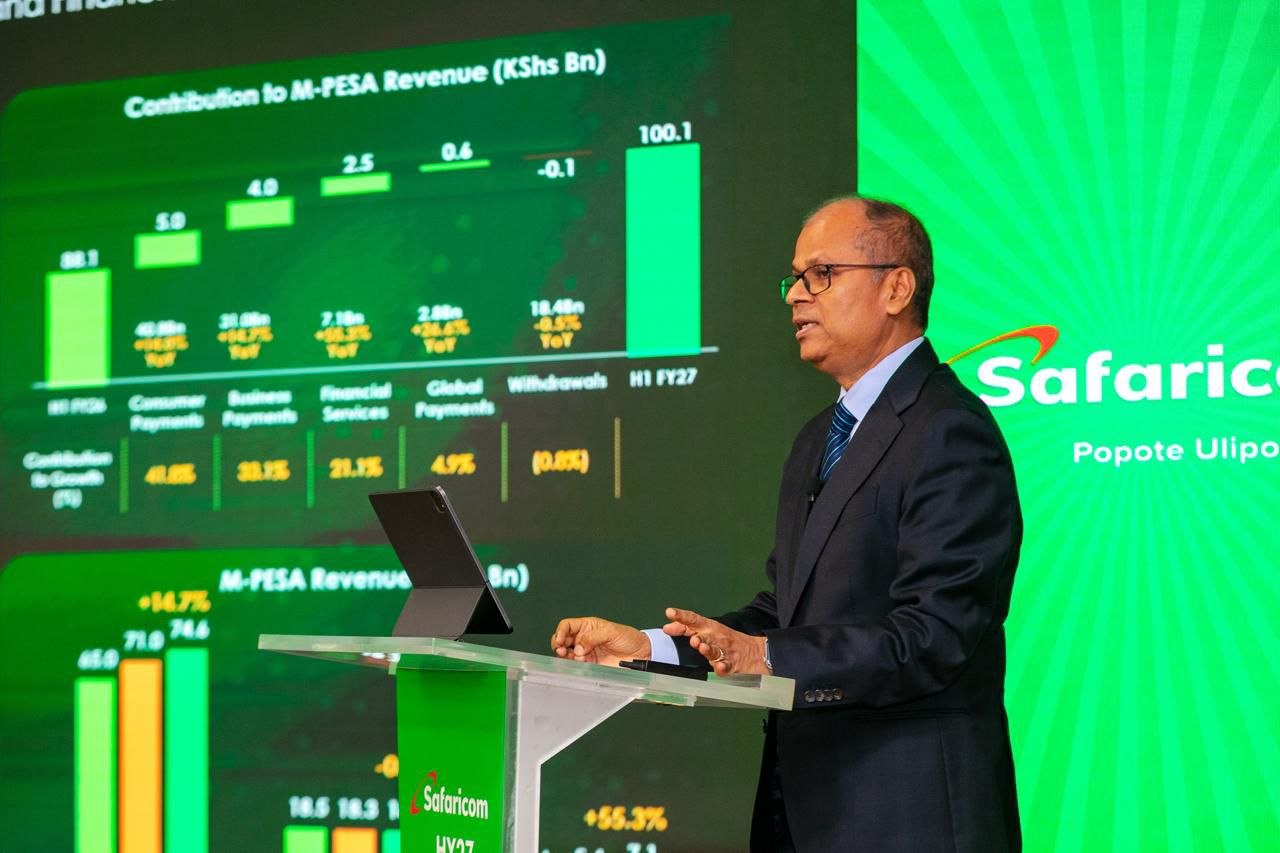
M-PESA processed 12.9 billion chargeable transactions in the first half of FY27, an increase of 48.2%, while revenue from the mobile money business grew 13.6% to KSh100.1 billion. The gap between transaction activity and revenue growth captures a central part of Safaricom’s current M-PESA strategy: encourage more people and businesses to use the platform, even where that means accepting lower average revenue from individual transactions.
Safaricom Group Chief Financial Officer Dilip Pal told analysts and journalists that the company was deliberately pursuing affordability as it expanded M-PESA’s reach. He said the business had accepted lower take rates on some transactions, with higher volumes and the expansion of other services expected to support growth across the wider ecosystem. The approach reflects a commercial calculation in which the value of a customer relationship extends beyond the fee collected when money changes hands.
The company reported that 63% of consumer payment transaction volumes were zero-rated during the period. Approximately 81% of Lipa na M-PESA and Pochi la Biashara merchant transactions were also free to customers. Safaricom said the average number of chargeable transactions per customer each month had risen from approximately 13 to 13.5 in 2020 to 51 currently, showing how much more frequently customers use the service.
The increase in transaction activity has also been accompanied by a change in the types of payments moving through the platform. Safaricom said business payments, global payments and financial services recorded 56% volume growth. Merchant transaction volumes increased 52.6% to 4.7 billion, while merchant revenue rose 34.6% to KSh8.18 billion. The figures point to a business whose activity extends beyond person-to-person transfers and conventional consumer payments.



M-PESA’s financial services business recorded revenue growth of 55.3% to KSh7.1 billion during the half-year. Safaricom reported 17.5 million credit customers, 3.4 million money market fund customers and KSh25.6 billion in Ziidi assets under management. The company also issued 67,500 insurance policies during the period, an increase of 852.2%. These services give Safaricom additional ways to earn revenue from customers who already use M-PESA for everyday transactions.
The merchant business is another part of that strategy. Safaricom reported a headline merchant population of 4.5 million, up 90.3%, while Pochi la Biashara reached 3.2 million customers, an increase of 115.3%. Lipa na M-PESA had 1.3 million merchants. Management said the company was working to deepen merchant engagement through financial products, credit and tools that help businesses manage payments and daily operations.
For Safaricom, the commercial opportunity lies in the relationship between payment activity and the services built around it. A merchant using M-PESA may also need working capital, reconciliation tools, invoicing and other business services. A consumer making regular payments may also use savings, investment, insurance and credit products. The platform can therefore generate value through several customer interactions, even when a large proportion of individual payments do not attract a fee.
This approach also places greater importance on the cost of operating and maintaining the payment network. Chief Executive Peter Ndegwa said M-PESA’s processing throughput had grown from approximately 1,500 transactions per second around the introduction of FinTech 2.0 to more than 6,000 transactions per second. He said the platform could support up to 12,000 transactions per second, providing capacity for further growth in payments and related services.
The financial results show that M-PESA remains a major contributor to Safaricom’s earnings, with half-year revenue passing KSh100 billion for the first time. Its next stage of growth will depend on how effectively the company converts higher platform activity into income from financial services, merchant solutions and business payments. Safaricom is pursuing a larger payments ecosystem in which transaction affordability supports customer activity and a broader range of services provides additional sources of revenue.
Go to TECHTRENDSKE.co.ke for more tech and business news from the African continent and across the world.
Follow us on WhatsApp, Telegram, Twitter, and Facebook, or subscribe to our weekly newsletter to ensure you don’t miss out on any future updates. Send tips to info@techtrendsmedia.co.ke

