
Apple Adopts SynthID to Label AI-Generated Photos in iOS 27
Apple wants people to know when artificial intelligence helped create a photo


Apple wants people to know when artificial intelligence played a role in creating a photo.
As the company rolls out new generative editing features across iOS 27, Apple says images produced through those tools will carry SynthID markers designed to preserve information about AI involvement. Details shared by John McCormack, Apple’s Vice President of Camera and Photos Software Engineering, and Dela Huff, Apple’s Senior Manager of Camera and Photos Product Marketing, offer the clearest picture yet of how that system will work.
The initiative places Apple SynthID AI photo watermarking at the center of the company’s broader effort to address image provenance as generative tools become more common across Apple Intelligence.
The move addresses a growing challenge facing the technology industry as AI image generation becomes more common: how should users know when a photograph has been materially altered by software?


Apple announced iOS 27 at WWDC 2026, extending support back to the iPhone 11 lineup while continuing to expand Apple Intelligence features across the iPhone ecosystem. As those capabilities become more deeply integrated into everyday photography, Apple is also introducing new mechanisms designed to identify AI-generated content.
Apple wants people to know when artificial intelligence helped create a photo
Apple plans to adopt SynthID, an invisible watermarking technology developed by Google, to identify generative content produced through Apple’s photo tools.

According to McCormack, the marker is embedded directly into an image rather than relying solely on metadata. The watermark is designed to remain invisible to users while still being detectable by systems capable of identifying AI-generated content.
As Apple expands Apple Intelligence across iOS 27, the company is placing increasing emphasis on transparency around generative content.
“Anything that is generative coming out of Apple, the generative content will be marked with this thing called SynthID,” McCormack said.
The disclosure is notable because it positions provenance as part of Apple’s broader AI strategy rather than a standalone feature attached to Photos.
The company sees SynthID as a more durable record than traditional metadata
Metadata has traditionally been used to store information about photographs, including editing history, file origins and camera settings. The challenge is that metadata can disappear when images are exported, converted or shared across platforms.
McCormack said SynthID offers a more durable solution because the marker becomes part of the image itself rather than existing only as attached file information.
Apple sees the technology as complementary to metadata rather than a replacement for it. Together, the two systems create a stronger record of AI involvement in a photograph.
The issue is becoming increasingly important as computational photography tools blur the distinction between photo enhancement and image generation.
Keeping AI labels attached to images becomes harder once they start moving online
One of Apple’s most significant claims concerns durability.
McCormack said the embedded watermark remains detectable even when an image is resized, converted into another format or captured through a screenshot. Those are the situations where traditional metadata is most likely to disappear.
“All this watermarking stays inside the image,” McCormack said while explaining how the technology survives file conversions and screenshots.
If the technology performs as Apple describes, it would allow AI provenance information to remain attached to content even as images move across apps, services and social platforms.
Apple has not yet detailed how verification tools will be presented to end users.
New Photos features arrive as Apple Intelligence expands across iOS 27
The announcement comes alongside several Apple Intelligence-powered photography features arriving in iOS 27.
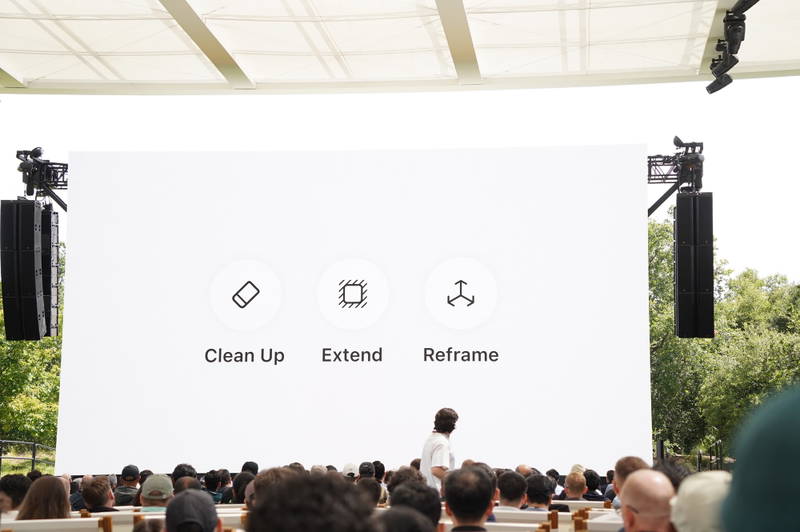
Cleanup has been expanded to remove larger and more complex objects from images. Extend allows users to expand a photo beyond its original frame. Spatial Reframing uses machine learning and three-dimensional scene understanding to reposition subjects after a photograph has already been captured.
Throughout Apple’s presentation of the features, Huff emphasized preserving the original moment rather than creating an entirely new image.
“We want everybody to be able to do that. And at the same time, we preserve the integrity of the moment,” Huff said.
That language reflects a deliberate distinction in Apple’s positioning. Rather than presenting the tools as unrestricted image generators, Apple describes them as tools designed to improve photographs while remaining faithful to the original scene.
Apple is treating photo editing as part of a much larger intelligence platform
McCormack and Huff also provided additional technical details about how the new editing tools operate.
Spatial Reframing creates a depth-aware representation of a scene from a single image, allowing users to adjust composition after capture. Extend can add up to 25 percent additional image area around a photograph. Cleanup now offers a choice between fast on-device processing and a more powerful cloud-based model running through Apple’s infrastructure.
The same philosophy guiding Apple’s AI efforts elsewhere in iOS 27 appears throughout the Photos experience. Rather than positioning artificial intelligence as a separate destination, Apple is embedding it directly into existing workflows.
That approach mirrors the broader direction Apple outlined for Apple Intelligence, where contextual understanding, search, automation and generative tools increasingly operate as part of the operating system itself.
The broader significance extends beyond photography. Apple has described Apple Intelligence as a shared layer that connects search, automation, Siri, writing tools and photo editing through a combination of on-device models and Private Cloud Compute. The new Photos capabilities offer another example of how the company is embedding intelligence directly into existing software experiences rather than treating AI as a standalone product.
The Google connection helps explain how Apple is approaching the next phase of AI
The discussion also sheds light on Apple’s evolving relationship with Google in artificial intelligence.
McCormack said Apple worked with Google on foundational technologies used to develop some of its image-generation systems, while emphasizing that the models powering the company’s photo features are Apple models operating within Apple’s own privacy and computing framework.
That distinction has become increasingly important as questions emerge about the technologies underpinning Apple’s AI efforts.
Apple has separately described Apple Intelligence as a system that combines on-device processing with Private Cloud Compute, allowing AI features to operate across supported devices while maintaining the company’s privacy architecture.
SynthID may be the clearest example of Apple’s balancing act. The watermarking technology originated at Google, yet Apple is integrating it into a wider trust and transparency framework designed to support generative features across iOS 27.
As AI editing becomes a standard part of photography, the ability to verify how an image was created may become just as important as the tools used to create it.
Go to TECHTRENDSKE.co.ke for more tech and business news from the African continent and across the world.
Follow us on WhatsApp, Telegram, Twitter, and Facebook, or subscribe to our weekly newsletter to ensure you don’t miss out on any future updates. Send tips to editorial@techtrendsmedia.co.ke


