
Apple Intelligence Gets a New Foundation as Siri Takes On a Larger Role
What emerged from WWDC was not simply a smarter Siri but a different vision for how Apple's software will operate

For years, Apple approached artificial intelligence with unusual caution.
While rivals raced to release increasingly capable chatbots, Apple focused on on-device processing, privacy protections and tightly controlled software experiences. That strategy often left the company looking late to the industry’s most important technology shift.
At WWDC 2026, Apple signaled that a different phase has begun.
The company unveiled a rebuilt Apple Intelligence platform, a dramatically expanded Siri and a new AI architecture developed in collaboration with Google. Together, the announcements marked Apple’s clearest attempt yet to reposition itself in a market increasingly shaped by artificial intelligence.


The new system is built around Apple Foundation Models that Apple says were co-developed using technology from Google’s Gemini family of models. The architecture spans both on-device processing and Apple’s Private Cloud Compute infrastructure, allowing Apple Intelligence to operate across iPhone, iPad, Mac, Apple Watch and Vision Pro.
The announcement was notable not only because of what Apple introduced, but because of what it revealed about the company’s changing approach to AI.

Apple’s AI strategy is no longer entirely its own
The decision to build a core part of Apple Intelligence alongside Google represents a significant shift for a company that has historically preferred to control its most important technologies internally.
Apple has long differentiated itself through vertical integration. From custom silicon to operating systems and services, the company has generally sought ownership of the underlying technologies powering its products.
Artificial intelligence appears to be changing that calculation.
The scale of modern AI development increasingly favors companies with access to enormous computing resources, research teams and training infrastructure. By incorporating technology derived from Google’s Gemini models into Apple Foundation Models, Apple is acknowledging the realities of a rapidly consolidating AI landscape.
Apple executives have since sought to draw a clearer distinction between collaboration and dependency. Following WWDC, Apple said Google’s consumer AI products are not embedded inside Siri and that user requests are not being routed through a Gemini assistant. Instead, Apple operates its own family of Apple Foundation Models while using Google technologies, infrastructure and model research to help develop and refine parts of the underlying system.
The company insists user requests remain protected through on-device processing and Private Cloud Compute. User information, Apple says, is used only to fulfill requests and is not accessible to Apple or third parties.
Yet the broader message is difficult to miss. Apple is no longer presenting AI as a purely Apple-built effort. Instead, it is positioning itself as the company that can combine external advances in artificial intelligence with its own strengths in hardware, software integration and privacy.
The arrangement also reveals how much AI development has changed. Apple remains responsible for the models users interact with, but post-WWDC disclosures indicate Google’s involvement extends beyond model research. Apple has used Google’s cloud infrastructure during development, while some of its most demanding cloud-based AI workloads operate within an extended Private Cloud Compute framework built on Google Cloud resources. The result is an Apple-designed system built with significant assistance from one of its largest competitors.
The new Siri is designed to do more than answer questions
The most visible expression of that strategy is Siri.
Apple’s virtual assistant has spent years trailing competitors in both capability and public perception. WWDC 2026 was effectively a relaunch.
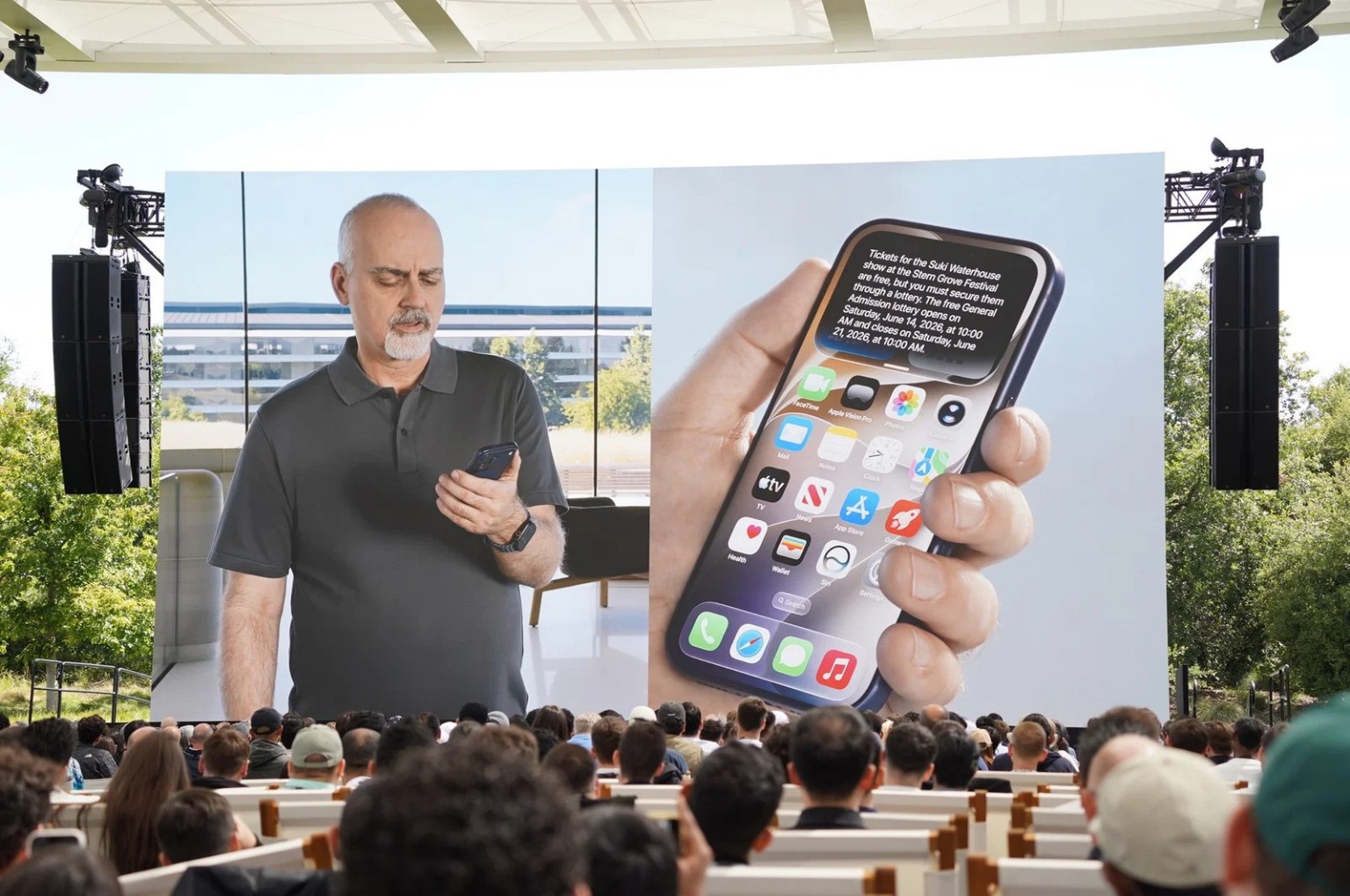
The new Siri can understand personal context, maintain awareness of what users are doing on their devices, analyze on-screen content, search the web, continue conversations across multiple Apple products and perform actions on behalf of users.
A task started on an iPhone can continue on an iPad and finish on a Mac while preserving context throughout the interaction.
The demonstrations showed Siri helping users manage plans, retrieve information, interact with apps and navigate tasks across devices. Apple also introduced a dedicated Siri app that will exist across its platforms, further reinforcing the assistant’s central role.
Many of these capabilities will look familiar to anyone following developments in artificial intelligence over the past two years. Apple is embedding those capabilities directly into the operating system and connecting them to the apps, services and personal information users already rely on.
Because it sits inside the operating system, Siri has access to system-level tools, personal data and application context that standalone AI services often cannot reach directly.
Apple’s argument is that intelligence becomes a built-in layer of the software experience rather than a separate destination.
The bigger shift may be happening beneath Siri
Apple spent much of WWDC talking about Siri, but the more consequential story may be the infrastructure being built underneath it.
Across its platforms, Apple announced improvements that initially appeared unrelated. Spotlight gained deeper understanding of user intent. Search was rebuilt across Photos and Mail. Safari can organize tabs into AI-generated topics. Home can analyze connected camera footage, generate descriptions and retrieve clips using natural-language searches.
Taken individually, they appear to be isolated features.
Viewed together, they suggest something larger.
Apple is constructing a semantic layer across its ecosystem that can understand information regardless of where it exists on a device.
The company revealed that search infrastructure has been rearchitected, allowing content to be indexed almost immediately and understood more deeply across applications. Apple Intelligence builds on this foundation to understand context, retrieve information and surface relevant actions.
Siri increasingly functions as the interface to that system.
The same foundation is beginning to appear across other Apple Intelligence features. Apple executives have since confirmed that new AI-powered photo tools, including Cleanup, Extend and Spatial Reframing, rely on the same broader intelligence infrastructure that combines on-device processing with Private Cloud Compute. The architecture is increasingly being used as a shared layer across Apple’s software rather than a collection of isolated features.
Rather than acting as a standalone assistant, Siri becomes a gateway to software that understands messages, photos, files, apps and activity across devices.
That may ultimately prove more important than any individual Siri feature announced on stage.
Apple wants AI to move from answers to actions
One of the clearest signals of Apple’s ambitions came through features that received relatively little attention during the keynote.
Among them is a new capability that can automatically replace compromised passwords.
When Apple Intelligence detects a password that may have been exposed or weakened, the system can navigate account settings, generate a replacement credential and store it securely in the Passwords app.
The user still authorizes the process, but much of the work happens automatically.
The feature reflects a broader direction emerging across Apple’s AI strategy.
The goal is to complete tasks.
That same philosophy appears in AI-generated Shortcuts, contextual actions and system-wide automation capabilities introduced across Apple’s software ecosystem.
Apple is also pairing those capabilities with systems designed to identify AI involvement when content is generated or significantly altered. The company plans to adopt Google’s SynthID watermarking technology for generative photo features, embedding markers directly into images to help preserve provenance as AI-generated content becomes more common across its platforms.
The transition from conversational AI to action-oriented software has become one of the industry’s defining shifts. Apple is positioning Siri as one of the primary interfaces through which those actions are initiated.
The future Apple described depends on newer hardware
The rollout also exposes one of Apple’s biggest challenges.
While iOS 27 will support devices dating back to the iPhone 11, access to the most advanced Apple Intelligence capabilities will be considerably more limited.
Apple says its highest-performance on-device model requires substantially more memory than previous generations. As a result, the most powerful version of Apple Intelligence will only run on the iPhone 17 Pro, iPhone 17 Pro Max and iPhone Air, alongside newer iPads and Macs that meet memory requirements.
Many other devices will still gain access to Apple Intelligence features, but those capabilities will increasingly rely on Apple’s Private Cloud Compute infrastructure rather than running entirely on-device.
The distinction creates a growing divide between software support and AI support.
Millions of users will receive iOS 27. A much smaller group will experience the full version of Apple’s newest intelligence platform.
For a company that spent years promoting Apple Intelligence as a defining platform feature, the hardware requirements introduce fresh questions about how quickly advanced AI can scale across its ecosystem.
Europe’s absence hangs over the launch
Another major limitation involves geography.
Apple confirmed that Siri AI will not launch on iPhone and iPad in the European Union later this year.
The company says disagreements with European regulators over platform access and interoperability requirements have prevented approval of its proposed implementation.
According to Apple, regulators rejected multiple proposals designed to allow competing assistants access to system capabilities while preserving privacy and security safeguards.
The result is that many of the headline features announced at WWDC will be unavailable to European users on iPhone and iPad at launch.
The dispute highlights a growing reality for technology companies.
Artificial intelligence is increasingly shaped by regulatory frameworks that influence where products launch, how they operate and which capabilities ultimately reach consumers.
Apple’s next chapter in AI begins with Siri
WWDC 2026 was presented as the arrival of a new Siri, but the conference revealed something larger.
Apple is reorganizing its software around intelligence.
Search, automation, security, contextual understanding and application interactions are being connected through a common AI framework that stretches across the company’s ecosystem.
Siri happens to be the most visible expression of that effort.
The deeper story is that Apple is attempting to transform intelligence into an operating-system layer, one capable of understanding context, retrieving information and taking action on behalf of users.
Whether that strategy is enough to reshape Apple’s position in the AI race remains uncertain.
What WWDC made clear is that Apple no longer treats artificial intelligence as a standalone feature category.
It increasingly views intelligence as a foundational layer of the software experience that will shape the next generation of its products.
Go to TECHTRENDSKE.co.ke for more tech and business news from the African continent and across the world.
Follow us on WhatsApp, Telegram, Twitter, and Facebook, or subscribe to our weekly newsletter to ensure you don’t miss out on any future updates. Send tips to editorial@techtrendsmedia.co.ke


