
From MSME lending to healthcare, where Equity Group's KSh99.5bn sustainability investment went

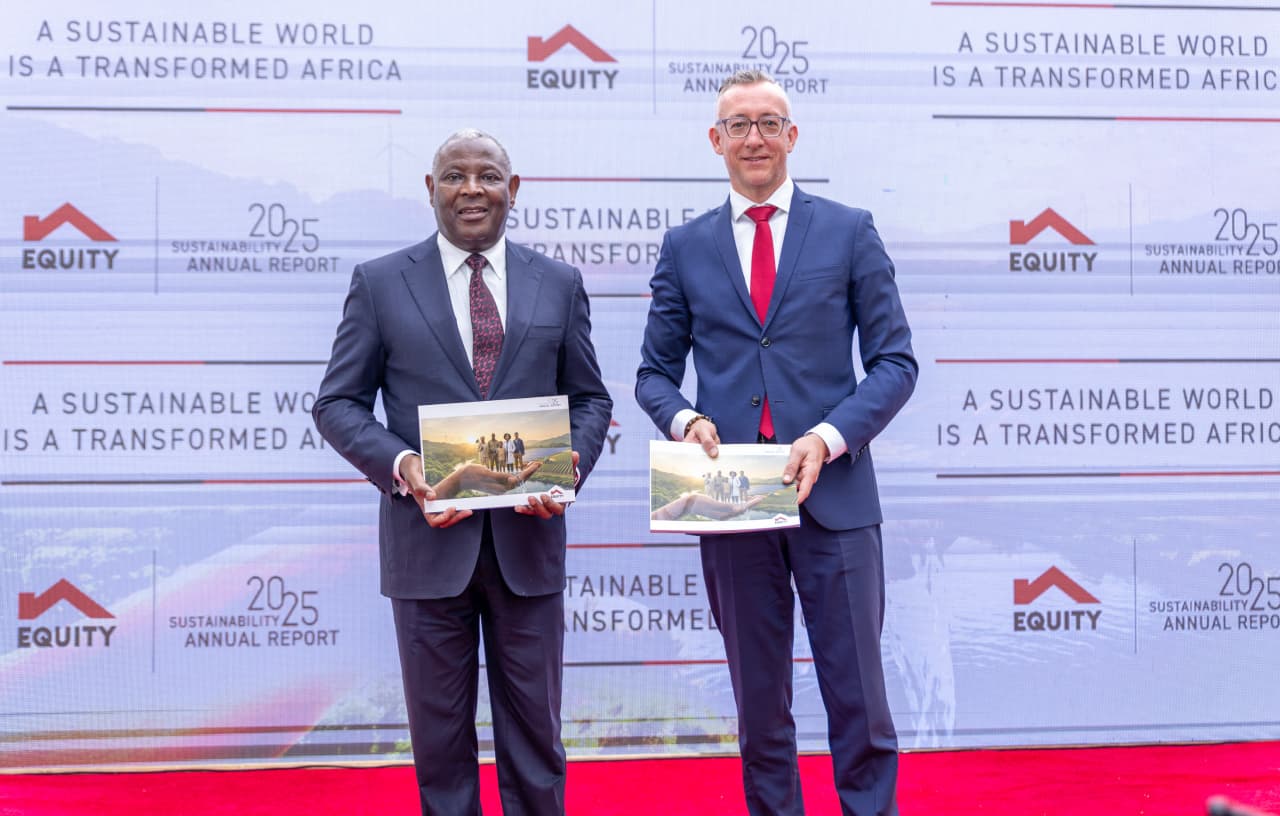
Equity Group Holdings invested KSh99.5 billion (US$771 million) in social impact and sustainability initiatives in 2025, with its latest report detailing support for businesses, farmers, students, healthcare and vulnerable households across its regional markets.
The investment, which Equity describes as the largest annual allocation of its kind in the Group’s history, covers programmes implemented through its banking operations, subsidiaries and the Equity Group Foundation. The report, themed A Sustainable World is a Transformed Africa, sets out how the financial services group is incorporating economic performance, social impact and environmental sustainability into its business strategy.
A substantial part of the reported activity involved expanding access to finance for businesses and supporting economic participation. Equity said it disbursed KSh404 billion (US$3.11 billion) to micro, small and medium-sized enterprises (MSMEs) through its Enterprise Development and Financial Inclusion programme during the year.
The Group also reported that 90 per cent of its procurement spending went to local suppliers, representing KSh47.59 billion. Through the Equity Group Foundation, it has cumulatively trained 962,924 entrepreneurs in entrepreneurship, while financial education programmes have reached 2.49 million women and young people.



Equity Group expands financing and support for businesses
The MSME figures place enterprise development alongside social protection, education and environmental programmes as major components of Equity’s sustainability agenda. The Group has previously outlined a broader SME financing strategy that includes working-capital facilities, asset finance and lending structured around agricultural production cycles.
Its September 2026 announcement of the African Rural and Agricultural Credit Facility for Inclusive Markets (ARCAFIM), developed with the International Fund for Agricultural Development, also set out plans to expand financing for smallholder farmers and rural businesses in East Africa. The programme is designed around lending and technical assistance for agricultural and climate-resilient investments.
Agriculture remains a significant part of Equity’s development work. The 2025 Sustainability Report records 622,525 small and medium-sized farmers reached through the Group’s agricultural programmes, which form part of its wider efforts to support livelihoods and production across the markets it serves.
The Group’s procurement activity also connects its own operations to local enterprise. Equity said local suppliers accounted for 90 per cent of procurement spending in 2025, with expenditure on those businesses reaching KSh47.59 billion.
Social protection programmes reach 5.94 million people
Equity’s social protection programmes reached 5.94 million people in 2025, with KSh173.5 billion disbursed through cash transfers, according to the report. The programmes also included access to credit and training for refugees, extending the Group’s work beyond direct financial assistance.
The report records KSh57.9 million in loans extended to 115 refugees, while 772 refugees received training. These interventions form part of the Group’s efforts to support financial inclusion and economic participation among vulnerable populations.
Equity Group Managing Director and Chief Executive Officer Dr James Mwangi said the Group’s performance demonstrated the relationship between commercial success and sustainable development.
“Our 2025 performance demonstrates that commercial success and sustainable development are not competing priorities, but mutually reinforcing drivers of long-term prosperity,” Mwangi said.
He added that a stronger business gives the Group greater capacity to invest in people, enterprises and communities while building resilience across the markets where it operates.
Education and healthcare remain major investment areas
Education programmes accounted for another significant part of the Group’s social investment. Equity reported 60,009 scholarships across its education initiatives, including 29,515 university scholars, 4,039 students in technical and vocational education and training institutions, and 1,115 global scholars.
The Group also facilitated 9,772 paid internships, while 415 innovators secured employment after completing a 12-month technology apprenticeship programme under the Equity Leaders Programme. Its skills development work includes partnerships with organisations such as Huawei ICT Academy, Amazon Web Services, Moringa School and WorldQuant University.
In healthcare, Equity Afya expanded its network to 150 outpatient medical centres across Kenya and the Democratic Republic of Congo. The medical franchise recorded more than 4.62 million cumulative patient visits, according to the report.
The network’s expansion builds on Equity’s use of a franchise model to extend outpatient healthcare services across different communities. The Group’s 2024 sustainability reporting had recorded 132 Equity Afya centres, comprising 127 in Kenya and five in the Democratic Republic of Congo.
Sustainability becomes part of the Group’s operating model
Equity’s latest report places sustainability alongside commercial and social performance in its Tri-Engine Model. The framework brings economic performance, social impact and sustainability together in the Group’s approach to strategy, governance, risk management and operations.
Environmental initiatives included KSh26 billion in sustainable and climate-aligned financing during 2025, more than 47,000 climate-related transactions under the International Finance Corporation’s Climate Adaptation Finance Initiative, and the distribution of 75,855 clean-energy products.
The Group also planted 9.1 million trees during the year, taking its cumulative total to 44.6 million. Equity’s previous sustainability reporting had highlighted a 35 million-tree target, which the Group says it has now exceeded.
German Ambassador to Kenya Sebastian Groth said partnerships between governments, private businesses and development institutions were essential to financing sustainable development. He described development cooperation as moving towards investment partnerships that use public funds to mobilise private capital.
Nasra Nanda, Built Environment Lead at the Executive Office of the President, also highlighted the financial sector’s role in sustainable construction, support for small and medium-sized enterprises in the built environment, and the integration of nature-based resilience into investment decisions.
Equity prepares for new sustainability disclosure standards
The Group said it is incorporating environmental, social, governance, climate and nature-related considerations into credit decisions, operations and risk management. Its approach includes environmental and social risk screening, enhanced due diligence for high-risk sectors, climate scenario analysis and stress testing.
Equity also published a Sustainable Development Impact Disclosure Report and said it was preparing for the adoption of the IFRS S1 and IFRS S2 sustainability disclosure standards. The work forms part of its efforts to strengthen the way sustainability considerations are reflected in business decisions and reported to stakeholders.
The 2025 report presents the Group’s sustainability agenda across enterprise development, financial inclusion, social protection, education, healthcare and environmental stewardship. For Equity, the KSh99.5 billion investment brings those programmes together under a business model that links financial performance with the economic and social conditions of the markets in which it operates.
Go to TECHTRENDSKE.co.ke for more tech and business news from the African continent and across the world.
Follow us on WhatsApp, Telegram, Twitter, and Facebook, or subscribe to our weekly newsletter to ensure you don’t miss out on any future updates. Send tips to info@techtrendsmedia.co.ke

