
Safaricom and Airtel’s 5G Routers Promise the Future, but Not on the Same Terms
For every home that plugs in a new 5G router, there’s a test of loyalty unfolding between the country’s two biggest networks.


If you pay the Kenyan average for home internet, this matters. Most households spend roughly 2,500 KES a month for a basic Wi-Fi connection. The entry 5G plans from Safaricom and Airtel start above that level. Safaricom lists a 10 Mbps unlimited tier around 3,000 KES. Airtel advertises a 15 Mbps entry plan at a similar price. On paper those numbers are close. In a real home they point in different directions.

This 5G router comparison draws on observed user experiences and publicly available performance data covering three devices — Safaricom’s former Nokia router, the current BiCell unit, and Airtel’s 5G router. The findings reflect how these devices perform in real-world settings, shaped by installation hurdles, varying signal strength, and the everyday frustrations that define home connectivity. The aim is straightforward: to help readers understand which option best suits different kinds of households.
Why Someone Would Buy a 5G Router Today
Look at the wiring on some streets and the argument makes itself. Neighnorhoods featuring a tangle of copper shared across blocks, patched weekly by technicians. For a little more than the average monthly bill, a 5G router can replace that fragility with a wireless link that — when coverage is strong — brings both higher speeds and lower latency.
But there are limits. The popular packages serve individuals, not families. Safaricom’s 400 GB bundle costs about 3,500 KES. Airtel’s 300 GB plan is roughly 3,000 KES. Both are fine for one heavy user, less so for multiple simultaneous video streams.
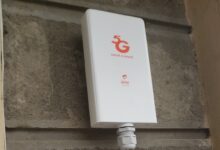

Safaricom has recently made its routers easier to find. A new partnership with Naivas Supermarket, announced in late last month, placed Safaricom 4G and 5G routers on retail shelves nationwide at KES 2,999 each. This move, part of Safaricom’s 25th-anniversary initiatives, puts the devices within reach for households that prefer buying tech alongside groceries.
The Hardware That Actually Matters in a Home
Small design choices become daily tradeoffs. The BiCell unit includes three LAN ports and a USB slot that can be used for local storage — practical for CCTV backups. The Nokia router, smaller and cleaner, offers only one LAN port. That works for fully wireless homes, but not for setups with consoles or set-top boxes.

Form factor also affects performance. Nokia’s compact shape blends into a TV console; Airtel’s rectangular cube hides in a corner; BiCell’s wedge design stands out but provides better airflow. These aren’t cosmetic notes — placement affects signal quality and throughput in real spaces.
Setup and Payments: One Is Friendlier Than the Other
The Nokia router remains the easiest to configure. Its app supports multiple SSIDs — personal, guest, and console — all within minutes. That app interface saves users from IP hunting and login screens.
Airtel’s setup leans on a web interface that asks for an IP address and manual credentials. It works, but adds friction. One recurring problem: Airtel’s app sometimes looped at verification, forcing manual resets. Safaricom’s My Safaricom app worked smoothly for both activation and renewals, though online delivery via Masoko wasn’t always reliable — one order never arrived and had to be collected in-store.
What the Numbers Showed in Real Rooms
Tests across different rooms — living, kitchen, hallway, bedroom — revealed clear patterns. Three metrics tell the story: download, upload, and ping.
Airtel’s router averaged mid-30 Mbps for downloads, low-20 Mbps for uploads, and pings between 25 and 45 ms. One consistent read showed 36 Mbps down, 23 Mbps up, and 29 ms latency.
Safaricom’s Nokia unit performed more evenly. A living room test logged around 48 Mbps down and 50 Mbps up, with 26 ms ping. Late-night bedroom runs hit over 50 Mbps both ways, enabling smooth streaming and uploads.
The BiCell version’s battery aged fast — the promised three hours dropped to about two after several cycles under heavy use.
Band Behaviour, Night Peaks and Surprises
Longer testing showed an edge for Safaricom’s 5 GHz band. Over twenty separate sessions, average downloads hovered near 345 Mbps, with night peaks around 416 Mbps and a top burst above 470 Mbps. Those aren’t everyday speeds for all users, but they show the network’s headroom.
Airtel’s 5 GHz band often underperformed, behaving closer to 2.4 GHz. When signal quality slipped from “excellent” to “good,” uploads could fall from 30 Mbps to below 5 Mbps. That kind of swing made real-time backups unreliable.
Safaricom’s 2.4 GHz band, usually slower, held up well. It maintained strong pings and frequent runs above 100 Mbps, making it a better everyday option in homes with thicker walls or lower signal strength.
Portability and Power
Airtel includes a 5,000 mAh power bank, a small but significant feature. It kept the router running for about eight hours — enough for road trips or sites with unreliable electricity.
Safaricom’s BiCell router has an internal battery, but heavy use drained it in under two hours. The Nokia model lacks any battery, though the Airtel power bank can power it — a cross-brand workaround that proved useful.
Comparing to Fibre and the Question of Value
Fibre still wins on stability. In side-by-side tests, a 2,500 KES fibre plan maintained steady speeds between 15 and 19 Mbps with 4 ms ping — smooth and predictable.
Safaricom’s 5G 100 Mbps plan, priced near 5,000 KES, blew past those numbers in bursts but showed variable latency depending on router placement.
The verdict depends on lifestyle. For heavy uploaders, content creators, or users needing symmetrical speeds, Safaricom’s performance justifies the cost. For portability and budget flexibility, Airtel’s router — with its bundled power bank — is the better deal, even with some upload inconsistency.
Availability now tilts the balance too: Safaricom no longer sells the Nokia router directly, meaning users often have to rely on remaining stock through third-party outlets.
Who Should Buy Which Kit
If you stream, upload, or host live sessions often, Safaricom’s routers — particularly the BiCell and higher-tier bands — will fit you best. If you travel, work remotely, or live in an area with frequent power cuts, Airtel’s portable setup makes more sense.
For families, both entry-level bundles (300 GB or 400 GB) may fall short. They are designed for singles or small households with moderate daily use.
A Practical Epilogue
This 5G router comparison doesn’t name a universal winner. It shows a trade between speed and flexibility. Safaricom’s strength lies in bandwidth and stability. Airtel’s lies in portability and price.
The small details — app design, ports, signal bands, delivery reliability — matter as much as speed tests. Before you buy, check which router model is in stock and which network best matches how you actually live.
That’s the real measure of 5G in Kenyan homes today.
Go to TECHTRENDSKE.co.ke for more tech and business news from the African continent.
Follow us on WhatsApp, Telegram, Twitter, and Facebook, or subscribe to our weekly newsletter to ensure you don’t miss out on any future updates. Send tips to editorial@techtrendsmedia.co.ke

