
Sony A7 V Emerges in Midrange Mirrorless Market with Sensor Upgrades and Hybrid Ambitions
Sony’s A7 V balances stills and video for hybrid creators, combining improved autofocus, color fidelity, and practical sensor gains.

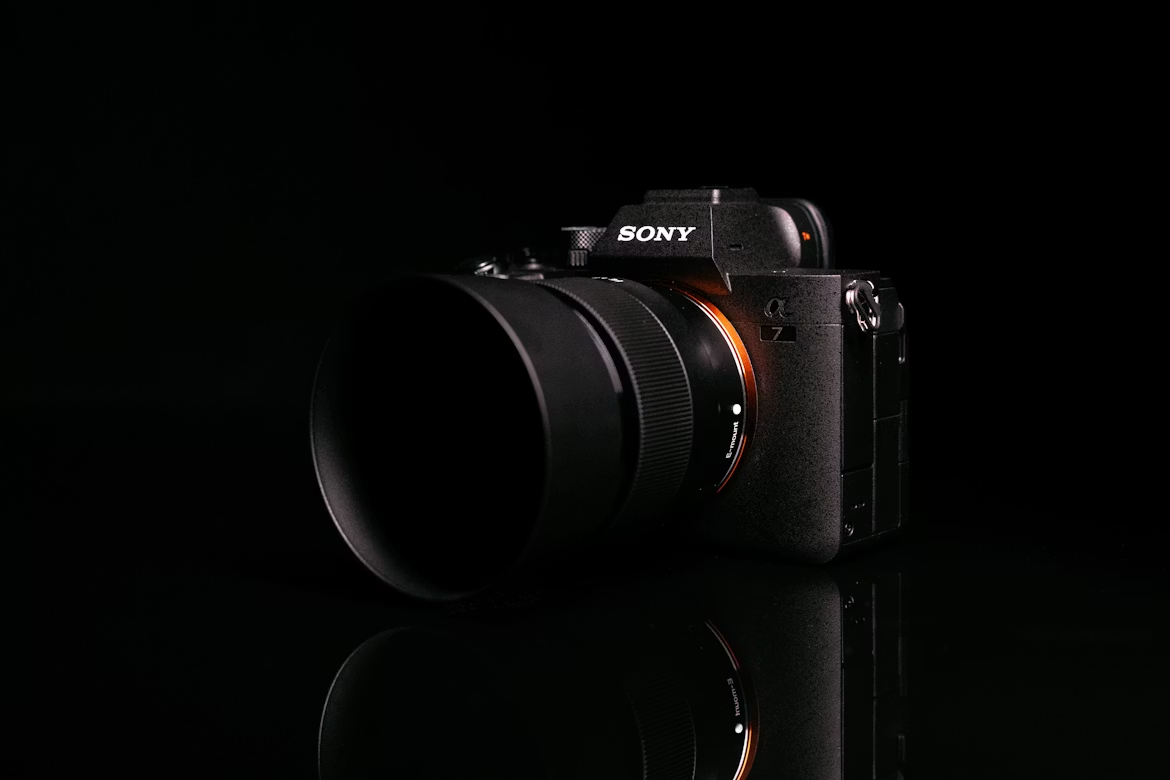
Sony’s next Alpha camera, the long-rumored A7 V, is poised to land at the intersection of ambition and pragmatism. Teased through a minimalist Instagram post, the image of a large “V” against a blurred background was enough to spark speculation about a follow-up to the A7 IV. A four-year gap separates the previous models, making a 2026 announcement a natural rhythm in Sony’s product cycle. For professionals and enthusiasts, the question is whether this camera will reshape expectations in the midrange mirrorless category or simply refine existing strengths.

Sensor Innovation Under Scrutiny
Early rumors point to a new 33MP “partially stacked” sensor, a modest leap from the A7 IV’s offering but one with potential for practical gains. Stacked sensors have altered the conversation around readout speed and rolling shutter in the past, particularly for high-frame-rate video, and Sony seems intent on applying lessons learned without pursuing headline pixel counts.
Real-world implications matter: photographers often trade megapixels for performance in low light or workflow efficiency. A sensor like this suggests an emphasis on maintaining dynamic range and ISO latitude while accommodating 4K/60 fps capture internally. The design appears to be about refinement, not spectacle, though early hands-on notes indicate minimal rolling-shutter distortion even during rapid pans.
Hybrid Performance in the Frame
Hybrid shooters—those toggling between stills and motion—are likely to notice the nuanced improvements. The A7 V is rumored to capture oversampled 4K at 60 fps and provide at least two new lenses at launch. Compared with the A7 IV, the enhancements might seem incremental, yet they respond to actual on-set pressures: continuous autofocus, color fidelity, and frame rates that align with professional workflows rather than marketing charts.

Sony’s autofocus algorithms remain an area of interest. The A7 IV was already notable for subject recognition and eye-tracking, but the new model reportedly advances AI-assisted predictive tracking. It is not an all-encompassing solution, and the system sometimes overestimates motion in irregular scenes, yet for wedding or documentary assignments, it provides a layer of certainty when capturing fleeting moments.
Body and Ergonomics: Familiar, With Small Adjustments
Sony rarely reinvents its body lines mid-series, and the A7 V appears to follow that logic. Observers note subtle refinements: a marginally deeper grip, updated button mapping, and possibly improved heat management around the sensor and card compartments. These are not headline features, but they address user frustrations accumulated over years—particularly in hybrid applications where sustained video recording can push cameras past thermal thresholds.

Battery endurance is another point of interpretation. While Sony does not typically promise marathon runtimes, real-world use indicates that high-output mirrorless cameras often operate below their advertised capacities once autofocus and video capture are combined. In practice, the A7 V’s design will likely balance performance and portability rather than aim for record-breaking stamina.
Lens Ecosystem and Optical Choices
Launching alongside the body are at least two lenses, rumored to target everyday versatility and creative latitude. Sony’s approach to optics has historically emphasized sharpness and minimal focus breathing for video. Bokeh quality and edge-to-edge clarity will determine whether this camera-lens pairing can genuinely rival higher-end models in narrative video or commercial photography.
The lens ecosystem remains a quiet but significant factor. Users weighing investment decisions often consider how many lenses offer consistent color rendition and mechanical reliability. Sony’s RF-style competitors have made incremental progress in affordability, but the Alpha system still trades on proven optics and incremental firmware improvements that extend body-lens performance.
Market Position and Competitive Context
The midrange full-frame mirrorless segment is dense and increasingly complex. Sony’s A7 V sits in direct comparison with Canon’s R6 Mark III, Nikon’s Z6 III, and Panasonic’s S5 II. Each brings a distinct approach: Canon favors internal RAW capture and color predictability, Nikon emphasizes burst performance and stacked sensors, and Panasonic trades portability for extended video features and active cooling.
Sony’s proposition is integration. The new sensor, AI tracking, and incremental lens improvements offer a balanced package rather than dominance in any single metric. For professionals assessing cost and workflow, the decision will hinge on the cumulative effect of reliability, codec options, and long-term ecosystem support rather than any single headline feature.
Speculation on Practical Implications
If Sony leans into hybrid versatility, the A7 V could consolidate workflows for creators who previously carried separate bodies for stills and video. That does not make it a replacement for high-end cinema cameras, but it would offer a credible alternative for short-form content, social media productions, or documentary work where portability, autofocus, and color consistency matter.
Conversely, the incremental nature of the update might frustrate those hoping for a more radical departure from the A7 IV. Stacked sensors offer a clear technical edge in burst photography, yet Sony’s apparent decision to pursue “partial stacking” suggests a prioritization of balanced use over record-breaking specs. The result is a camera that performs reliably across varied scenarios without dominating any one benchmark.
The Measured Continuum
Sony’s A7 series has always been a study in middle ground: advanced enough to attract professionals, approachable enough for serious enthusiasts. The A7 V seems to continue that tradition, emphasizing practical gains and workflow consistency. It is unlikely to excite fans seeking headline-grabbing improvements, yet it may earn quiet respect among those who depend on the equipment day after day.
In 2026, the question will be how the market responds. Will hybrid creators embrace a model that balances innovation with restraint, or will they gravitate toward rivals offering more radical technical leaps? Sony’s decision to calibrate rather than redefine its midrange mirrorless approach hints at a deliberate understanding of its user base—conservative in optics, assertive in software, and attentive to the rhythm of professional life.
Go to TECHTRENDSKE.co.ke for more tech and business news from the African continent.
Follow us on WhatsApp, Telegram, Twitter, and Facebook, or subscribe to our weekly newsletter to ensure you don’t miss out on any future updates. Send tips to editorial@techtrendsmedia.co.ke


