

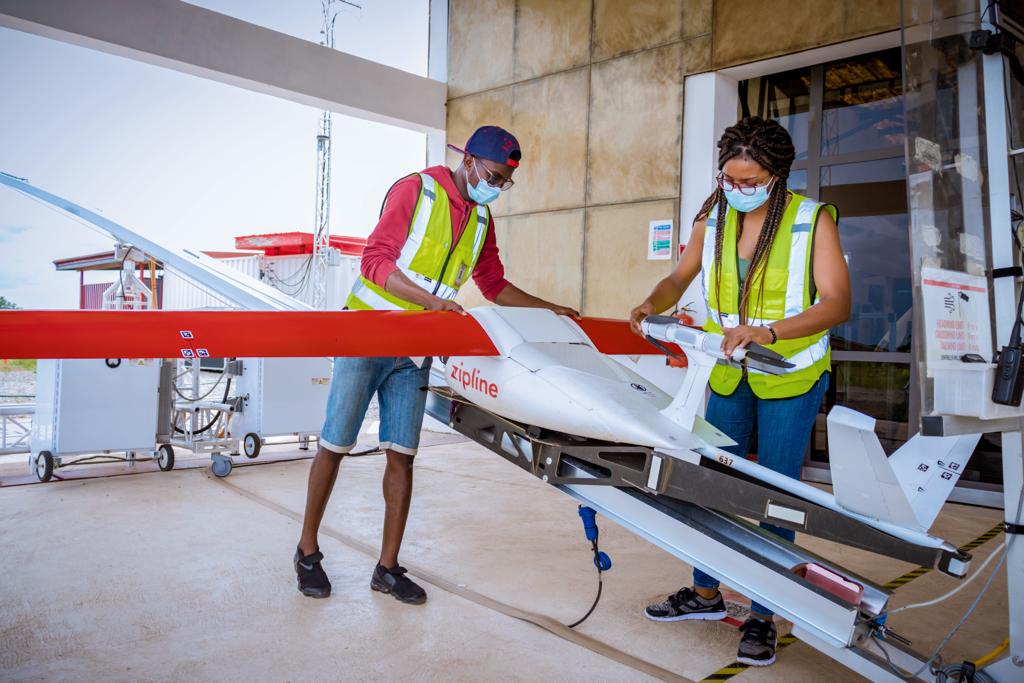
The Government of Rwanda has signed a historic expansion agreement with Zipline to achieve full nationwide autonomous logistics coverage.

The expansion is the first major milestone under Zipline’s recent $150 million pay-for-performance award from the U.S. Department of State. The deal makes Rwanda the first country in the world to be entirely covered by an autonomous delivery network, reaching more than 11 million citizens.
Since pioneering drone delivery in 2016, Rwanda has used Zipline’s fixed-wing aircraft (Platform 1) to slash maternal mortality and modernize its medical supply chain. This new phase introduces three groundbreaking developments. Rwanda will deploy Platform 2 (P2), Zipline’s next-generation VTOL (Vertical Take-Off and Landing) drones. These Zips hover quietly at high altitudes while a small droid lowers packages with “dinner plate” precision to homes and offices in dense urban areas like Kigali.
Zipline will also establish its first overseas R&D hub in Rwanda. This facility will serve as a global sandbox for testing next-generation aircraft performance, safety systems, and logistics software.

Additionally, a new long-range distribution hub in the Karongi District will join existing sites in Muhanga and Kayonza. This hub, strategically located on the border with the DRC, will serve 2.9 million people in the Western region.
“Rwanda did not ask whether it had been done before; it asked whether it could work and whether it could save lives,” said Caitlin Burton, CEO of Zipline Africa. “This is a global first, not just because the technology exists, but because the leadership exists.”
Paula Ingabire, Rwanda’s Minister of ICT and Innovation, echoed this sentiment, noting that the partnership has already demonstrated extraordinary impact. “We have witnessed the extraordinary impact of drone delivery, saving time, saving money, and saving lives,” she stated, adding that the expansion into urban delivery will bring these benefits to the 40% of healthcare demand concentrated in the capital.
The expansion is designed for long-term sustainability. While the U.S. government provides the upfront infrastructure funding, the Government of Rwanda has committed to paying for ongoing operations.
The social impact of the network has already been quantified by researchers, including a 51% reduction in maternal deaths due to faster access to blood during postpartum hemorrhages. Beyond health, the expansion is expected to support approximately 350 local high-skilled jobs in robotics, flight operations, and logistics.
[Secure Your Seat at Africa Tech Summit Nairobi 2026 | February 11–12 here] Use code TTRENDS10 at checkout to save 10% on your pass and join the leaders building Africa’s $1 trillion cross-border payment future.
Go to TECHTRENDSKE.co.ke for more tech and business news from the African continent.
Follow us on WhatsApp, Telegram, Twitter, and Facebook, or subscribe to our weekly newsletter to ensure you don’t miss out on any future updates. Send tips to editorial@techtrendsmedia.co.ke

