After Years of Refinement, Samsung Finally Lets Foldables Stretch Their Legs
Samsung spent years smoothing foldables down and then decided to stretch one again

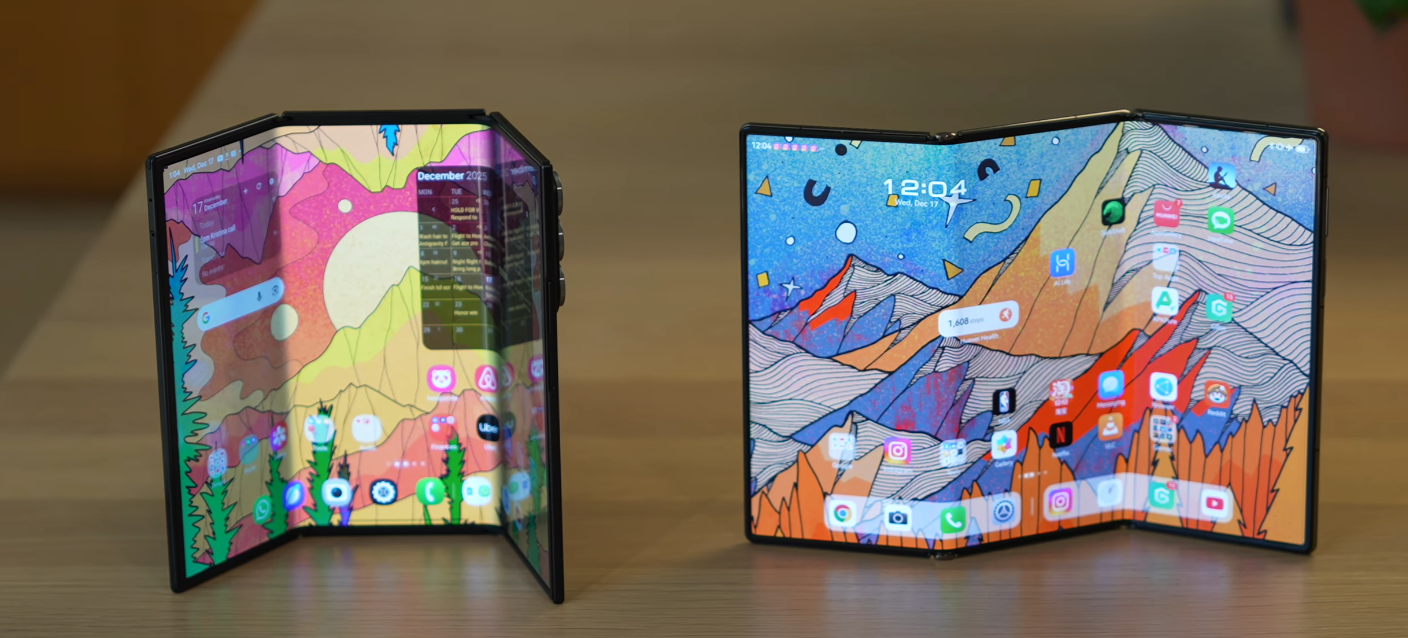
For years, foldable phones have promised more space without quite earning it. Bigger screens unfolded, but habits stayed small. Video still played inside black bars. Multitasking looked impressive in demos, then collapsed into novelty once real work began.

The Samsung Galaxy Trifold breaks that pattern, not by being clever, but by finally being literal about what it is offering. This is not a phone that occasionally stretches. It is a device that unapologetically becomes something else when opened, then folds back down and waits for the next demand.
That difference sounds subtle. It is not.
Samsung’s recent restraint makes this stand out
Samsung’s last generation of foldables leaned toward discipline. Thinner frames. Fewer visual theatrics. A sense that the company was sanding down the category rather than inflating it. The Galaxy Z Fold 7 fits squarely in that mindset, a confident, conservative sibling built to disappear into daily routines.
The Trifold arrives from the opposite direction.
It does not try to vanish. It insists on being used differently.
Read another way, the Trifold functions less like a next step and more like a boundary exercise. After years spent tightening the Fold into something dependable, Samsung is deliberately pushing scale, weight, and complexity back into view to see where friction returns. The contrast frames the device not as a replacement, but as a release valve. One product stabilizes the category. The other stretches it far enough to test where it strains.
The screen finally earns its size
Open the Trifold fully and the reason for its existence becomes obvious. A 10-inch display changes how content fits, not just how big it appears. Shows fill the screen properly. Documents stop looking compressed. Maps stop feeling cropped.
This is the first folding phone that treats scale as functional rather than decorative.
The difference shows up most clearly in motion. Watching video no longer requires rotating, zooming, or accepting wasted space. The panel runs at 120 Hz in games, and while outdoor brightness does not chase extremes, it holds up well enough to keep the illusion intact.
For the first time, unfolding a phone does not feel like an abstract exercise. It feels practical.
Dex moves from accessory to foundation
The Trifold’s most revealing feature is not the hinge. It is Dex.
Samsung has supported Dex for years, often as a novelty or a side option for power users willing to connect cables and monitors. On the Trifold, Dex runs locally. No external display required.
That change resets expectations. The device stops acting like a phone pretending to be a computer and starts behaving like a compact workstation that happens to collapse back into your pocket.
With a wireless keyboard and mouse, the Trifold supports a workflow that approximates a lightweight laptop. Apps run in windows. Tasks stay visible. The 10-inch screen provides enough room to think, not just react.
Dex matters here because the Trifold is allowed to be awkward. Samsung can afford to let software strain at the edges when the device is not tasked with reassuring the mass market. This is where the company’s long game becomes visible. Foldables stop being framed as luxury phones and start acting like modular computing devices.
Engineering compromises you cannot ignore
None of this comes free.
At 309 grams and nearly 13 mm thick when folded, the Trifold announces its presence. In the hand, it can feel like carrying an overbuilt tool rather than a sleek object. The weight settles over time, but it never disappears.
Samsung’s inward-folding design protects the inner display, a choice that prioritizes durability over flexibility. The trade-off is the loss of intermediate folding positions. The device is either closed or fully open. There is no halfway state.
Folding must follow a strict sequence. Left panel first, then right. Try the reverse and the phone responds with an insistent vibration that leaves no ambiguity. It is clever, but it reinforces the sense that this device demands intention.
Familiar parts, unfamiliar purpose
Under the surface, much of the hardware mirrors the Fold 7. Cameras, lenses, processor, speakers. This is not where Samsung spent its budget.
The Snapdragon 8 Elite for Galaxy remains capable. 16GB of RAM keeps Dex fluid. Speakers punch above expectations for something this thin. The camera system performs well in good light, though zoom quality trails some Chinese flagships.
The point is not excellence in isolation. It is adequacy in service of something larger.
Samsung clearly chose to invest in form factor and software leverage rather than chasing spec supremacy.
Living with it reveals the cracks
Extended use surfaces friction points that demos hide.
Battery life struggles under sustained, heavy use. A large screen invites constant interaction, and the battery drains accordingly. This is not a device that disappears once the novelty fades.
App continuity is inconsistent. Some apps restart when unfolding, breaking momentum. Samsung appears to have prioritized stability over elegance, a choice that makes sense technically, even if it disappoints experientially.
There is also a conspicuous omission. No S Pen support. On a 10-inch display, the absence is glaring, and it undercuts the device’s productivity narrative.
These are not deal-breakers. They are reminders that this category is still negotiating its boundaries.
Huawei showed the idea, Samsung reframes it
Huawei arrived earlier with a dual-hinge foldable, and credit is due. But Samsung’s version reframes the idea for broader markets by prioritizing protection and ecosystem integration.
Huawei preserved flexibility. Samsung chooses containment.
The result is a device that feels safer to carry, even if it sacrifices some elegance. For users who intend to live with the phone rather than admire it, that trade may matter more than it first appears.
A prototype that hints at permanence
The Galaxy Trifold recalls the original Galaxy Fold in one important way. It feels like a declaration rather than a conclusion.
The first Fold was imperfect, heavy, and occasionally awkward. It still became the foundation for everything that followed. The Trifold carries that same energy, less polished, more ambitious, openly unfinished.
It suggests that Samsung sees foldables not as a single category, but as a spectrum. Conservative devices that refine the idea. Bold ones that stretch it until new uses emerge, then pull the lessons back into safer designs.
If the Fold 7 represents stabilization, the Trifold represents permission.
Not permission to chase spectacle, but permission to experiment again in public. To treat a phone as a workspace. To accept discomfort as part of progress. To test ideas internally before asking them to scale.
That tension is not a contradiction. It is strategy.
And it explains why this device exists at all.
Go to TECHTRENDSKE.co.ke for more tech and business news from the African continent.
Follow us on WhatsApp, Telegram, Twitter, and Facebook, or subscribe to our weekly newsletter to ensure you don’t miss out on any future updates. Send tips to editorial@techtrendsmedia.co.ke
TechTrends Media Podcasts

