Two Promises Rose from the Steam of Olkaria. One Roars with Machinery While the Other Exists Only on Paper.
Only one of these grand visions is turning steam into steel while the other is still waiting for someone to pick up a shovel.


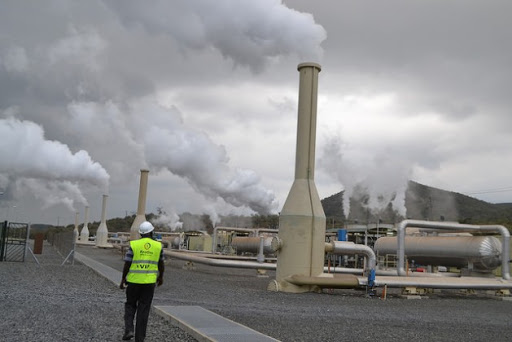
Olkaria was supposed to symbolize Kenya’s big leap into the future — a geothermal valley where battery-powered vehicles and AI-ready data halls could coexist, each feeding off carbon-free steam rising from the earth. Two headline projects embodied that promise: Aquilastar’s EV plant in Olkaria, now steadily taking shape, and a billion-dollar data center campus announced with great ceremony by Microsoft and G42.
Only one is actually moving.
The Factory That Showed Up Before the Press Forgot
Aquilastar’s site doesn’t resemble the glossy renderings shared during its launch. There are no drone shots of finished buildings or choreographed ribbon cuttings. What does exist are crews pouring foundations, steel framing being lifted into place, and transport trucks arriving with machinery. Most megaprojects in East Africa spend their first year on paper; this one is pouring concrete.
The company isn’t just positioning itself as an assembler of vehicles. It’s already negotiating long-term power contracts with KenGen, seeking to embed geothermal supply directly into its energy mix. If successful, Aquilastar would have one of the world’s few EV plants tethered to baseload renewable energy — not solar peaks or diesel backup.


That alone changes the economics. Consistent geothermal supply means predictable production costs, which could give Kenyan-made EVs an advantage over imported Chinese or European units that still rely on mixed-power grids. For a newcomer brand, that’s a rare chance to win not by scale, but by stability.
Meanwhile, the Data Center That Looks Like a Hallucination
Just a few kilometers away sits the empty plot that was supposed to house East Africa’s first geothermal-powered hyperscale cloud campus. Announced with global fanfare, the Microsoft–G42 deal was positioned as a geopolitical statement — Africa claiming its digital sovereignty instead of renting server racks abroad.
Today, there’s nothing there. Not even a bulldozer. Officials insist it is “still on track.” Investors whisper that financing details haven’t been finalized. Engineers in Naivasha say they haven’t been issued permits. It’s less a scandal than a silence.
This delay is revealing something uncomfortable: energy alone doesn’t guarantee execution. Geothermal can heat a server hall or charge a vehicle, but one industry is clearly more willing to move fast with imperfect information while the other waits for flawless alignment.
What Happens If the Factory Finishes First?
If Aquilastar completes its facility before the data center breaks ground, Olkaria will become known less for cloud sovereignty and more for physical production. That could force a strategic rethink. Instead of competing for foreign cloud tenants, Kenya may find itself nurturing a cluster of energy-intensive manufacturing — EVs today, battery recycling or hydrogen electrolysis tomorrow.
This isn’t necessarily a downgrade. In fact, it might prove smarter. The world is oversupplied with cloud capacity but still short on low-emissions industrial output. A functioning assembly line is more persuasive to ordinary Kenyans than a hyperscale building full of machines they never see.
There’s also a scenario in which the unfinished data deal quietly attaches itself to the momentum of the EV plant — perhaps even transforming into a co-location hub designed around mobility analytics, fleet management, or battery monitoring. Less monumental, more useful.
The Real Difference Between Promise and Proof
Government press statements love symmetry — cleaner energy, smarter machines, global recognition. On the ground, symmetry rarely survives. Aquilastar’s EV plant in Olkaria is already proving one crucial fact: progress measured in steel and sweat has more credibility than progress measured in PDFs and podium speeches.
Kenya will still need cloud infrastructure to hold its digital ambitions together. But for now, it’s the car factory — not the server farm — that’s offering a working demonstration of what geothermal-powered development actually looks like.
The future may still include both. Only one has shown up.
Go to TECHTRENDSKE.co.ke for more tech and business news from the African continent.
Mark your calendars! The GreenShift Sustainability Forum is back in Nairobi this November. Join innovators, policymakers & sustainability leaders for a breakfast forum as we explore sustainable solutions shaping the continent’s future. Limited slots – Register now – here. Email info@techtrendsmedia.co.ke for partnership requests.
Follow us on WhatsApp, Telegram, Twitter, and Facebook, or subscribe to our weekly newsletter to ensure you don’t miss out on any future updates. Send tips to editorial@techtrendsmedia.co.ke
TechTrends Media Podcasts

