

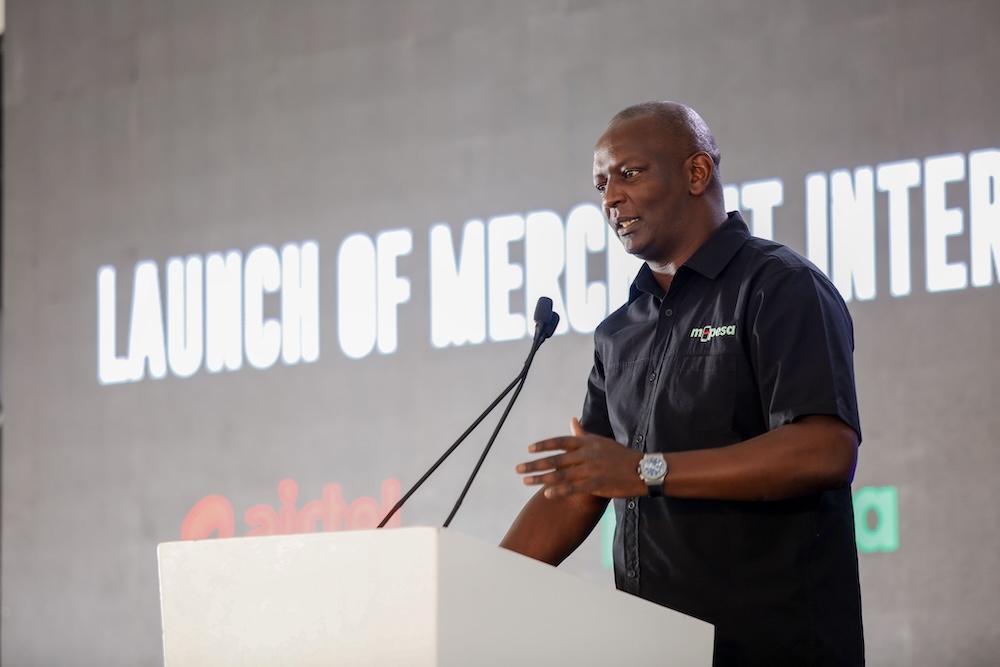
Sitoyo Lopokoiyit’s decision to leave Safaricom at the end of next month closes a chapter that coincides with an unsettled phase for M-PESA Africa itself. The platform is larger than at any point in its history, present in 8 countries, serving over 60 million customers and more than 5 million businesses. Yet scale has brought new complications. Expansion has widened reach while raising harder questions about ownership, growth limits, and what kind of institution M-PESA is becoming.

Leadership exits at this level rarely sit in isolation. They tend to surface tensions already present inside the business. In this case, the departure arrives after several years in which M-PESA moved from a Kenyan success story into a regional financial infrastructure project. That transformation demanded a different kind of management, one less focused on rapid adoption and more concerned with governance, partnerships, and regulatory balance across markets that do not behave the same way.
Lopokoiyit’s tenure coincided with that transition. He inherited a system already dominant in Kenya and helped push it outward, both geographically and institutionally. The question now is whether the structure he helped build can continue expanding without the internal alignment that came from long institutional memory.
From telecom product to financial system
M-PESA’s evolution during the past decade often gets described in product terms. Payments, savings, credit, merchant tools. The more consequential change happened beneath that surface. The platform stopped being simply a telecom service and began operating as financial plumbing across several economies.


That evolution required negotiation with banks, card networks, technology partners, and regulators who viewed mobile money with both interest and caution. Partnerships with firms such as Visa, PayPal, Ant Financial, Microsoft, and Huawei expanded reach beyond domestic transfers. They also introduced external dependencies that reshaped decision making inside the organisation.
Growth outside Kenya exposed structural differences. In some markets, mobile money remained a substitute for banking. In others, it competed directly with established financial institutions. Managing those contradictions required careful pacing. Expansion brought visibility, but it also narrowed room for experimentation. A platform serving tens of millions cannot move with the same flexibility it once had.

The long arc of institutional knowledge
Lopokoiyit joined Safaricom in July 2011, long before M-PESA became shorthand for African fintech ambition. His early work around agent aggregation helped formalise a distribution model that later spread across mobile money ecosystems beyond Kenya. That background mattered because M-PESA’s strength has always rested less on technology than on networks of trust built through agents and merchants.
Leadership shaped inside that environment tends to prioritise operational realities over narrative. The system works because cash still moves physically at the edges, even as transactions become digital. Maintaining that balance across 8 countries requires familiarity with how informal economies behave, how liquidity moves at month end, how regulation responds when transaction volumes grow faster than oversight frameworks.
When such experience exits, replacement becomes less straightforward than appointing another executive. Institutional memory carries unwritten assumptions about risk, partnerships, and pace.
Expansion brings new friction
The ambition behind M-PESA Africa has been clear for years. Build interoperability across borders, deepen merchant acceptance, and anchor the platform within global payments networks. Each objective introduces friction.
Cross-border payments expose currency controls and compliance rules that differ sharply between jurisdictions. Merchant ecosystems demand investment that does not always translate into immediate revenue. Global partnerships increase visibility, which in turn attracts scrutiny from regulators concerned about market concentration.
Safaricom and Vodacom have managed these pressures so far, though not without debate about how far M-PESA should extend beyond its telecom roots. The platform now sits somewhere between a payments network and a financial institution, without fully belonging to either category. That ambiguity creates opportunity, but also uncertainty about future direction.
A leadership exit and unresolved questions
The announcement of Lopokoiyit’s departure came without drama, yet timing invites interpretation. M-PESA Africa is no longer in its formative stage. Growth expectations remain high, while margins face pressure from competition, regulation, and the cost of maintaining infrastructure across multiple markets.
Leadership transitions at this point tend to reveal strategic differences rather than personal ones. The next phase may demand deeper integration with banking systems, or a renewed focus on profitability within existing markets rather than geographic expansion. Either path alters how M-PESA positions itself in relation to Safaricom’s core telecom business.
There is also the question of identity. M-PESA began as a Kenyan innovation responding to local needs. Its current scale pushes it toward becoming a continental financial platform. Those two identities do not always sit comfortably together.


