
Ethio Telecom Expands 4G and 5G Plans After Vendor Talks at Mobile World Congress 2026
Ethio Telecom begins the next phase of its network expansion after vendor negotiations at Mobile World Congress.

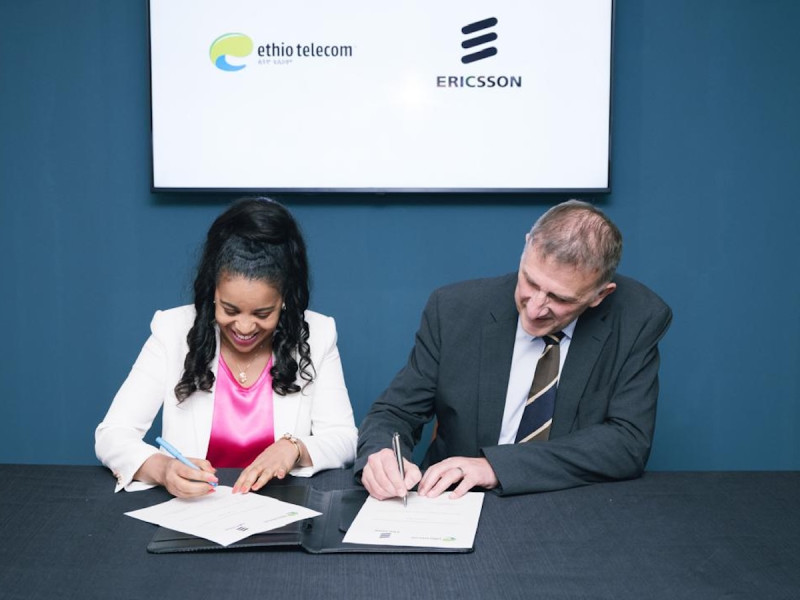
Ethio Telecom vendor deals announced after Mobile World Congress 2026 define the next phase of Ethiopia’s national telecom infrastructure expansion. The state-owned operator confirmed agreements and negotiations with Ericsson, Huawei, ZTE, and Nokia to upgrade radio access infrastructure, extend 4G coverage, expand 5G capabilities, and deploy rural connectivity systems across the country.
Ethio Telecom signed a formal network expansion agreement with Ericsson covering 1,500 mobile sites. Negotiations with Huawei and ZTE concluded in principle but remain unsigned.
The programme sits within Ethio Telecom’s “Next Horizon: Digital & Beyond” strategy and focuses on coverage expansion, capacity upgrades, and modernization of core network systems. The vendor structure reflects existing network management zones already divided between global equipment suppliers. The outcome consolidates Ethiopia’s reliance on large multinational telecom vendors while extending national population coverage to 85% in Ericsson’s operational region.
What did the Ethio Telecom Ericsson agreement cover?
The Ericsson agreement expands and upgrades 1,500 mobile network sites under Ericsson’s management in Ethiopia. The project includes 4G capacity expansion, new 5G deployments, rural connectivity installations, and the upgrade of 502 existing 3G sites to support 4G services.

The work increases LTE availability across additional towns and raises regional population coverage to 85%.
Ethio Telecom signed the agreement with Ericsson during Mobile World Congress 2026 in Barcelona. The project includes deployment upgrades across 1,500 sites inside Ericsson’s network management zone.
The programme upgrades 502 3G locations to 4G readiness. It introduces specialized rural connectivity systems at 75 locations without access to commercial electricity infrastructure.
LTE services will expand to 157 additional towns, increasing the number of connected towns in the Ericsson zone to 276.
Ethio Telecom maintains vendor-defined network territories where each equipment supplier manages a designated infrastructure segment. Expanding inside Ericsson’s zone avoids interoperability disruptions while raising capacity inside an existing architecture.
The upgrade path also reflects the declining operational value of 3G networks in markets where mobile data demand is rising faster than voice usage.
4G will remain the primary capacity layer for Ethiopia’s mobile data traffic during the next infrastructure cycle. The 3G upgrade programme will accelerate the retirement of legacy network layers.
Why is Ethio Telecom still working with multiple infrastructure vendors?
Ethio Telecom operates a multi-vendor network structure involving Ericsson, Huawei, and ZTE to distribute infrastructure risk and maintain supplier competition. Each vendor controls specific network regions and equipment domains within the national telecom system.
This structure allows upgrades without replacing the entire network architecture.
Ethio Telecom confirmed that negotiations with ZTE concluded during Mobile World Congress 2026. Discussions with Huawei advanced and are approaching final agreement.
Huawei already holds a large share of Ethio Telecom’s infrastructure footprint, particularly in earlier 3G and 4G rollouts.
Senior executives from Huawei, ZTE, Ericsson, and Nokia met with Ethio Telecom leadership during the event.
The Ethiopian telecom network developed through successive infrastructure procurement cycles rather than a single national rollout. Each cycle introduced additional vendors.
Replacing vendor systems would require large capital outlays and service disruption risks. Maintaining a multi-vendor structure preserves operational continuity while spreading procurement leverage.
Future infrastructure contracts will likely continue along vendor management zones rather than full network consolidation.
How does the expansion programme address rural connectivity gaps?
The Ethio Telecom expansion programme deploys rural mobile systems at 75 off-grid sites to extend coverage into areas without commercial electricity. These installations rely on specialized power solutions designed for low-density population zones.
The objective is to increase rural mobile access while limiting infrastructure operating costs.
Many Ethiopian rural regions lack stable grid electricity and fixed telecommunications infrastructure. The Ericsson project includes rural solution deployments designed for these conditions.
The sites support voice and mobile data services while operating independently of conventional grid power.
The installations target communities currently outside commercial telecom coverage zones.
Rural infrastructure expansion in Ethiopia remains constrained by power availability and low subscriber density. Telecom operators must design lower-cost deployments to justify expansion beyond urban markets.
Government expectations for universal connectivity place pressure on the state operator to reach regions where traditional commercial models remain weak.
Low-power rural base stations will expand as Ethiopia pushes toward nationwide population coverage targets.
What role does Nokia play in Ethio Telecom’s modernization plans?
Nokia completed a proof of concept project with Ethio Telecom and is preparing to launch an Innovation Excellence Centre in Ethiopia. The collaboration focuses on network innovation, training, and development of advanced digital capabilities.
The centre will support technical research and workforce development.
Ethio Telecom confirmed discussions with Nokia during Mobile World Congress 2026 regarding the proof of concept results.
Both parties are preparing to establish a joint Innovation Excellence Centre aimed at technology development and capacity building inside Ethiopia’s telecom sector.
The initiative focuses on innovation training and applied technology research.
The Nokia partnership emphasizes knowledge transfer rather than large-scale infrastructure procurement. Telecommunications infrastructure projects increasingly combine equipment supply with technical training.
Operators in emerging markets often rely on vendor partnerships to build domestic engineering capacity.
Innovation partnerships will expand as telecom operators attempt to localize network engineering expertise.
How does the modernization programme support Ethiopia’s digital economy goals?
Ethio Telecom’s modernization programme supports Ethiopia’s digital economy strategy by expanding 4G coverage, preparing 5G infrastructure, and enabling AI-enabled network management. These upgrades improve network reliability, mobile data speeds, and service capacity.
Digital platforms depend on nationwide mobile connectivity.
The modernization effort forms part of the “Next Horizon: Digital & Beyond” corporate strategy. The programme includes radio access upgrades, core network modernization, and expansion of 4G capacity.
Ethio Telecom leadership met with global telecom operators and technology firms at Mobile World Congress 2026 to discuss digital infrastructure development.
AI-enabled network optimization tools were included in vendor discussions.
Ethiopia’s digital economy ambitions require consistent national mobile coverage. E-commerce, financial services, and digital government platforms depend on stable data infrastructure.
Network upgrades address both traffic growth and institutional pressure for broader connectivity.
Mobile network upgrades will continue to anchor Ethiopia’s digital services expansion.
Key Facts
What did Ethio Telecom sign with Ericsson at Mobile World Congress 2026?
Ethio Telecom signed a network modernization agreement with Ericsson covering 1,500 mobile sites in Ethiopia. The project upgrades 502 existing 3G sites to 4G readiness, deploys rural connectivity at 75 locations without grid electricity, and expands LTE coverage to 157 additional towns within Ericsson’s network management region.
Why does Ethio Telecom use several telecom equipment vendors?
Ethio Telecom operates a multi-vendor network using Ericsson, Huawei, and ZTE infrastructure systems. Each supplier manages a designated portion of the national network. This structure avoids large-scale system replacement costs and allows incremental upgrades while maintaining operational continuity across Ethiopia’s telecom infrastructure.
How many towns will receive new LTE coverage from the Ericsson project?
The Ericsson modernization programme extends LTE services to 157 additional Ethiopian towns. The total number of towns covered within Ericsson’s operational network zone will reach 276 after completion of the infrastructure upgrades.
How will rural areas benefit from the Ethio Telecom expansion programme?
Ethio Telecom plans to deploy specialized mobile base stations at 75 rural locations that lack access to commercial electricity infrastructure. These systems use alternative power solutions to deliver voice and mobile data services in remote Ethiopian communities outside traditional telecom coverage areas.
What is the Nokia Innovation Excellence Centre in Ethiopia?
Ethio Telecom and Nokia are preparing to launch an Innovation Excellence Centre in Ethiopia following the completion of a joint proof of concept project. The centre will focus on telecom technology training, digital innovation research, and engineering capacity development within the Ethiopian telecommunications sector.
Go to TECHTRENDSKE.co.ke for more tech and business news from the African continent and across the world.
Follow us on WhatsApp, Telegram, Twitter, and Facebook, or subscribe to our weekly newsletter to ensure you don’t miss out on any future updates. Send tips to editorial@techtrendsmedia.co.ke

