A Small Solar Centre Opens in Nairobi While the Country Rethinks How It Powers Homes
A small room filled with solar panels and wiring diagrams ends up raising a much larger question about how Kenyans plan to power everyday life

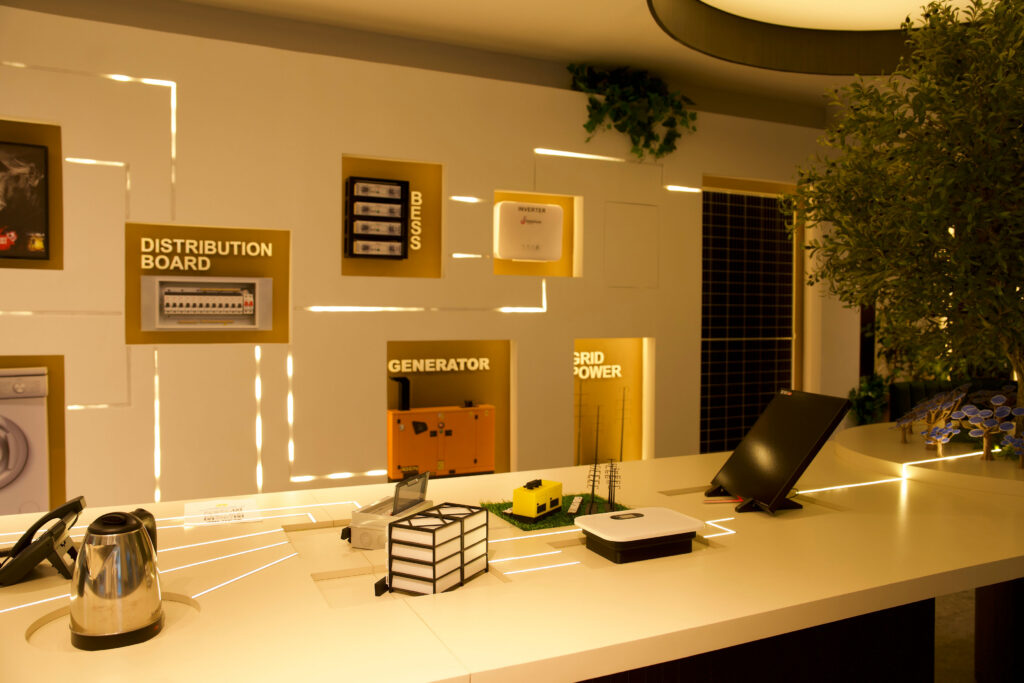
Inside the mall corridors of Sarit Centre, a new space invites visitors to handle solar panels, inspect inverters and walk through the mechanics of a rooftop system. The display belongs to SpenoMatic Group, which has opened what it calls an interactive solar learning centre in Nairobi.

The room itself is modest. Panels mounted on demonstration frames. Screens explaining kilowatt hours. Technicians answering questions from passersby who wandered in while running errands.
Yet the centre arrives at a moment when solar adoption in Kenya is being driven less by curiosity and more by arithmetic. Electricity bills have climbed. Businesses run the numbers. Households do the same. Solar has moved from the margins of the conversation into the middle of it.
The displays help demystify a technology that, for many people, still feels abstract. But the forces pushing solar into daily life lie well beyond the walls of the mall.


The Math Behind Kenya’s Solar Interest
Kenya already runs one of the most renewable-heavy electricity systems in the world. As of June 2025, renewable sources accounted for about 80.5 percent of installed electricity capacity. That includes geothermal, hydropower, wind and solar.
Solar remains a smaller piece of the system, though its growth has been noticeable. Installed solar capacity reached roughly 514 MW when grid-connected plants and private installations are combined. Electricity generation from solar climbed to 491.5 million kWh in 2023, a 28 percent increase from the previous year.
Several utility-scale plants helped lift that figure. The 40 MW Kesses solar farm in Uasin Gishu joined existing sites near Malindi and Cedate, raising output from the national grid.
Even so, the most interesting activity may be happening away from those large plants. Rooftops are filling with panels. Warehouses are installing arrays. Schools and clinics are adding backup systems that double as primary power during the day.
The reason is simple. Electricity tariffs for commercial users often range between Sh20 and Sh30 per kWh. Over the lifespan of a solar installation, the cost of solar electricity can fall between Sh8 and Sh12 per kWh. That difference has begun to reshape investment decisions.
It is not ideology. It is arithmetic.
The Rooftop Economy Taking Shape
Kenya’s solar market increasingly resembles a patchwork of small decisions made by property owners, businesses and institutions rather than a handful of massive national projects.
A typical rooftop system for a home or small enterprise costs around Sh180,000 to Sh250,000 per kW installed. For many households that figure remains steep. Financing options are limited and bank lending for solar equipment remains uneven.
Still, installation firms report steady demand. Businesses that rely heavily on daytime electricity find solar particularly attractive because their usage matches sunlight hours. Warehouses, manufacturing lines, retail complexes. Anywhere machines or refrigeration run throughout the afternoon.
Battery storage adds another layer of complexity. Prices have fallen over the past decade, but storage still pushes overall system costs higher. Some customers skip batteries altogether and run hybrid systems tied to the grid.
That approach has become increasingly common in Nairobi. Solar covers daytime loads. The grid fills the gaps.
The Unusual Structure of Kenya’s Energy System
Kenya’s energy mix produces a curious dynamic for solar.
The country already relies heavily on renewable generation. Geothermal alone contributes close to half of electricity supply, largely through fields developed by KenGen in the Rift Valley. Hydropower and wind fill additional portions of the mix.
Because of that foundation, solar expansion does not replace fossil fuels in the way it does in many other countries. Instead it layers onto an already renewable-heavy system.
This creates a different kind of debate. Grid planners are less concerned about carbon reductions and more concerned about stability. Solar output rises and falls with sunlight, which complicates forecasting for a grid dominated by steady geothermal output.
Yet rooftop solar sits outside much of that balancing challenge. A factory generating electricity on its own roof reduces demand on the grid rather than feeding power into it.
From the grid operator’s perspective, thousands of small rooftop systems behave differently from a single large solar farm.
Kenya’s Ambition for 100 Percent Renewable Electricity
Government policy has embraced the broader renewable trajectory. Kenya’s energy strategy aims for 100 percent renewable electricity generation by 2030.
Achieving that target depends on several moving parts. Geothermal expansion remains central. Wind projects continue along the Rift Valley corridor. Solar adds flexibility and speed because installations can be built quickly compared with large power plants.
Solar also plays a role in areas where extending the national grid remains expensive. Off-grid and mini-grid systems already power thousands of rural homes.
What remains unresolved is financing. High upfront costs still limit adoption for many households and small firms. Developers have been pressing for tax incentives, streamlined permitting and new financing models that spread costs across longer periods.
Without those tools, solar adoption in Kenya could remain concentrated among wealthier households and large commercial users.
The Mall as an Energy Classroom
Which brings the story back to the new centre at Sarit.
The idea behind the space is simple: people tend to trust technologies they can see. Panels mounted on roofs are easy to ignore. Equipment displayed at eye level invites questions.
Visitors can trace how sunlight becomes electricity, examine inverters that convert current for household use and calculate how much power their homes might consume.
It functions partly as education and partly as persuasion. Many first-time solar buyers hesitate because the technology feels opaque. Demonstrations soften that barrier.
Whether such spaces significantly accelerate solar adoption in Kenya remains uncertain. A showroom cannot fix financing constraints or grid policy debates.
But it does reveal how the solar industry now approaches the public. The conversation has moved from engineering diagrams to everyday economics. Electricity bills. Payback periods. Reliability during outages.
Those topics resonate far more strongly than technical specifications.
A Market Still Taking Shape
Kenya’s solar story is still unfolding.
Large solar farms are coming online. Rooftop installations continue to spread through Nairobi and other urban centres. Equipment costs have declined, though financing remains uneven.
At the same time, electricity demand keeps rising as cities expand and industries grow. Solar offers one answer, though not the only one.
The learning centre at Sarit may look like a small addition to the city’s retail landscape. Yet its existence reflects a broader pattern. Solar power has entered the public conversation not as an environmental slogan but as a practical calculation.
For many Kenyans, the question is no longer whether solar works. The question is whether the numbers add up.
Go to TECHTRENDSKE.co.ke for more tech and business news from the African continent and across the world.
Follow us on WhatsApp, Telegram, Twitter, and Facebook, or subscribe to our weekly newsletter to ensure you don’t miss out on any future updates. Send tips to editorial@techtrendsmedia.co.ke

