
PayPal Finds Itself Courted After a 46% Drop, as Takeover Interest Tests Its Independence
A payments pioneer that once set the terms of online trust now finds itself being valued, dissected, and quietly weighed by rivals who think they can do more with its scale

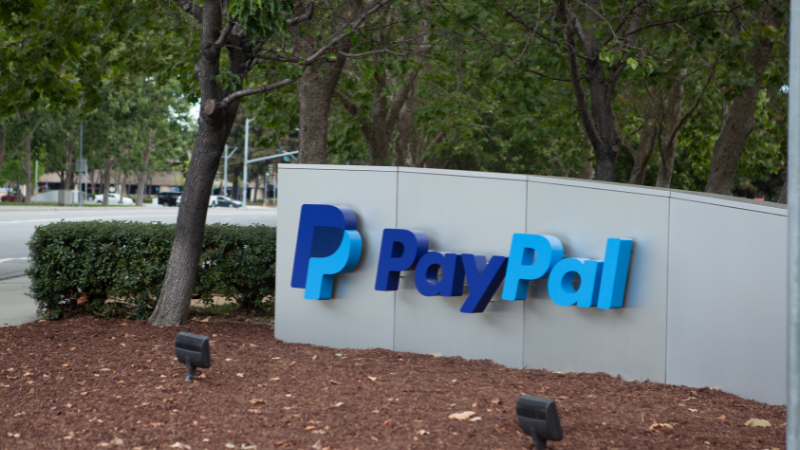
PayPal is back in play, though not in the way it once imagined. After a 46% stock slide over 12 months, the company is drawing takeover interest from multiple directions. At least 1 large rival is studying the whole enterprise. Others are circling specific assets. The conversations are early. The interest is real.
The market reacted fast. Shares rose as much as 9.7% in New York trading before settling near $44.38, giving the company a market value of about $40.9 billion. For a firm that once defined online payments and commanded far richer multiples, that number carries a certain sting. Not collapse, but contraction. Not crisis, but vulnerability.
This is what makes PayPal takeover interest more than opportunism. It is a referendum on how durable first-mover advantage really is in consumer finance.
A Network Built for the Desktop Era
PayPal was born in the late 1990s, when buying something online felt risky and clunky. It thrived because it made digital transactions tolerable. Then mainstream. At its peak, it stood between banks, merchants, and customers with enough scale to dictate terms.
Today, it processes nearly $2 trillion in annual transaction volume. It owns Venmo, the most recognizable peer-to-peer payments network in the United States. Its brand recognition spans continents.
Yet scale in payments can age faster than it compounds. The friction PayPal once removed has been absorbed into operating systems and hardware. Paying through Apple Pay or Google Pay no longer feels like an overlay. It feels native. Invisible. Embedded in the device itself.
That difference matters. PayPal sits on top of the stack. Its rivals are built into it.
A Leadership Reset Under Pressure
There is also the matter of governance. Former CEO Alex Chriss was ousted in February after a turnaround plan failed to deliver. Fourth-quarter revenue and profit missed analyst estimates. Payment volume growth continued to cool.
Board chair Enrique Lores is set to assume the CEO role on March 1. He inherits a company valued at $40.9 billion, down sharply from prior highs, and a shareholder base that has grown impatient.
The incoming chief executive does not have the luxury of abstract strategy decks. He faces a capital structure question. Does PayPal remain independent and attempt another rebuild, or does it become part of a larger ecosystem that can absorb its network and spread fixed costs across broader rails?
The takeover interest tightens that clock.
The Asset Hunt Beneath the Headlines
Not every suitor wants the whole company. That detail is telling.
PayPal is not a monolith. It is a bundle of assets: merchant acquiring relationships, cross-border capabilities, branded checkout, unbranded processing, and Venmo’s peer-to-peer dominance. A buyer could carve out the consumer network. Another might prize the merchant stack. A third might want the data exhaust, the behavioral trails left behind by billions of transactions.
In a market that increasingly prizes integrated commerce, PayPal’s infrastructure becomes attractive for firms that lack network depth. Payments remain a tollbooth business. Control the rails and you skim value from volume. Lose that control and you negotiate for margin.
There is also the emerging question of agentic commerce. As AI systems begin to transact on behalf of users, payments networks that can authenticate identity and move funds at scale gain new relevance. The phrase sounds futuristic, yet the mechanics are mundane: authorization, risk scoring, settlement. PayPal already does this at industrial scale.
The irony is hard to ignore. A company criticized for failing to modernize could become indispensable to firms building automated commerce layers on top.
The Valuation Tension
At $44.38 per share, PayPal trades far below its earlier peaks. A $40.9 billion market cap prices in stagnation, competitive erosion, and execution risk. It also prices in skepticism about management’s ability to reignite growth.
Yet valuation cuts both ways. For a strategic acquirer with a stronger balance sheet, the same $40.9 billion tag might look digestible. Particularly if cost synergies or cross-selling opportunities can justify a premium.
The math is straightforward. If a buyer sees $2 trillion in annual transaction volume as under-monetized, and believes margin expansion of even 100 basis points is achievable, the upside compounds quickly. In payments, small percentage changes on large flows produce material earnings deltas.
The open question is whether those improvements require ownership or simply partnership.
The Structural Problem No One Can Ignore
There is a deeper tension beneath the takeover chatter. PayPal’s original advantage lay in being an intermediary between banks and consumers. Over time, the largest technology platforms learned to intermediate the intermediary.
When Apple controls the hardware and operating system, and Google controls search and Android distribution, the wallet becomes part of the platform’s core offering. That compresses the space for standalone players.
PayPal still owns its brand. It still owns Venmo’s social payment graph. It still moves staggering sums of money. But the center of gravity in digital commerce has migrated closer to ecosystems that control identity, hardware, and discovery.
Takeover interest reflects that structural drift. It suggests the market sees more value in PayPal as a component than as a sovereign platform.
Independence or Absorption
If no transaction materializes, PayPal remains public, independent, and under scrutiny. Enrique Lores would then need to articulate a strategy that restores confidence without leaning on nostalgia. That likely means sharper capital allocation, product rationalization, and perhaps divestitures that preempt activist pressure.
If a full acquisition emerges, the buyer inherits both opportunity and constraint. Payments businesses operate under strict regulatory oversight, capital requirements, and cross-border compliance regimes. Integration risk is not abstract. It is operational and immediate.
A partial sale introduces its own complications. Strip out Venmo and the remaining entity changes character. Sell merchant assets and the consumer network loses muscle. Each path rearranges the company’s economic profile.
What seems clear is this: PayPal takeover interest has forced a reckoning. The company that once defined online trust now has to prove it still commands it.
The market has already rendered one verdict in the form of a 46% decline. The next one may arrive in the shape of a bid, or in the harder form of rebuilding alone. Either way, the era when PayPal could rely on incumbency is over.
Go to TECHTRENDSKE.co.ke for more tech and business news from the African continent and across the world.
Follow us on WhatsApp, Telegram, Twitter, and Facebook, or subscribe to our weekly newsletter to ensure you don’t miss out on any future updates. Send tips to editorial@techtrendsmedia.co.ke

