
teleStream Puts Ethio Telecom at the Center of Ethiopia’s Television Economy
The satellite dish has been a fixture of urban rooftops for years, but Ethio Telecom now wants television to run through its own cables and servers instead

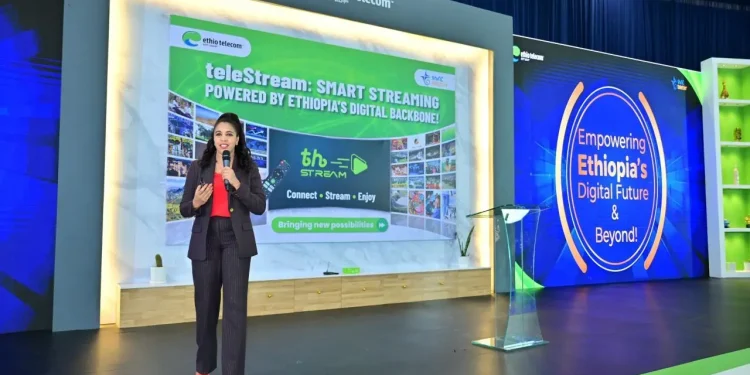
In much of Ethiopia, television has long arrived by way of a metal dish fixed to a rooftop, angled toward distant satellites paid for in foreign currency. That hardware has been more than a consumer device. It has been a financial pipeline outward.
Now Ethio Telecom wants to reroute that flow.
The state operator has introduced teleStream, an internet-based television platform that runs over fixed broadband and SIM-enabled set-top boxes. More than 60 live channels and over 350 video-on-demand titles are available at launch. The company is presenting it as a substitute for satellite television, not a companion. The distinction is deliberate.
Satellite TV has always carried two burdens. The first is technical vulnerability. Heavy rain disrupts reception with weary predictability. The second is economic. Broadcasters lease satellite capacity from foreign providers, typically paying in USD. For a country managing scarce foreign exchange, that structure is hard to ignore.


By hosting teleStream on domestic cloud infrastructure and delivering content over fibre, 4G and 5G networks, Ethio Telecom is attempting to internalize both transmission and payment. Content rides the same pipes that already carry data traffic. Foreign currency outflows tied to satellite leases could narrow. That arithmetic is not incidental.
A Telecom Operator Rewrites Its Own Business Model
Telecom operators across Africa have spent years trying to extract more value from broadband. Data revenues have grown, but margins compress as prices fall and usage becomes commoditized. Entertainment offers stickier demand. Once a household is habituated to a content platform, churn becomes more expensive.
Ethio Telecom’s teleStream is not an isolated product launch. It arrives alongside a new digital operations support system designed for zero-touch provisioning. Customers can subscribe, modify packages or report faults through the telebirr SuperApp and settle payments via telebirr mobile money. The company is threading content, billing and identity into one ecosystem.
That architecture is the point. A satellite provider sells television. A telecom operator with cloud hosting, broadband access and mobile money can sell an environment. The customer relationship deepens. So does data visibility.
The move reflects a broader pattern in state-backed operators that operate at national scale. Infrastructure ownership becomes leverage in adjacent markets. The question is whether Ethiopia’s regulatory framework will treat teleStream as a telecom service, a broadcasting service or something in between. That classification will shape licensing obligations, content oversight and competitive guardrails.
Forex, Sovereignty and the Economics of Transmission
The foreign exchange argument carries weight in Addis Ababa. Satellite capacity leases often require multi-year commitments denominated in USD. When reserves are thin, even routine renewals strain budgets. Replacing those arrangements with domestically hosted distribution reframes television as a local cost center rather than an imported service.
Ethio Telecom says teleStream’s broadcasts are hosted on its local cloud for lower latency. Reduced latency improves user experience, but the economic layer may matter more. If television channels migrate to domestic infrastructure, the central bank sees fewer satellite payments crossing borders.
There is also a sovereignty dimension. Satellite transmission places a portion of national media distribution outside domestic control. Internet Protocol delivery hosted within Ethiopia moves that control inward. Governments across Africa have paid attention to that distinction, particularly after episodes of political tension where control over communication channels became strategic.
Yet sovereignty comes with trade-offs. Centralizing distribution through a state-owned telecom operator consolidates technical control. That can streamline deployment. It can also concentrate influence over what is carried and how.
Hotels, Schools and the Institutional Customer
Ethio Telecom is targeting hotels and guest houses that currently manage multiple satellite dishes. For hospitality operators, the calculus is practical. One broadband connection and a fleet of set-top boxes may be easier to maintain than dozens of dishes exposed to weather and theft.
The institutional pitch extends to schools and universities. TeleStream is framed as a channel for remote learning and digital libraries. Hospitals are mentioned as venues for awareness programming. These are not marginal add-ons. They position teleStream as infrastructure for public information, not merely entertainment.
The promise of ad-supported and paid content also draws in local creators. If domestic distribution reduces costs, smaller producers may find entry easier. Advertising agencies are offered targeted placement opportunities. That is the familiar language of digital platforms, now translated into a national telecom context.
Still, the economics of streaming are unforgiving. Content acquisition costs accumulate. Audiences expect breadth and recency. If teleStream leans heavily on local channels and a modest on-demand catalogue of 350 titles, retention will depend on price sensitivity and broadband penetration.
Broadband Reality Checks
Internet television depends on reliable connectivity. Ethiopia has expanded fibre and mobile broadband coverage in recent years, including 4G and 5G deployments in urban centers. Yet coverage and quality vary outside major cities.
Satellite TV has one advantage: once the dish is installed, reception does not depend on last-mile fibre or mobile data capacity. teleStream shifts that dependency onto network performance. During peak hours, bandwidth contention can erode video quality. Customer frustration is rarely patient.
Ethio Telecom’s network scale gives it reach. Its monopoly status ended formally in 2022 with the entry of a second operator, but its infrastructure footprint remains dominant. teleStream leverages that footprint. The competitive question is whether rival networks will be allowed to carry teleStream or whether the service remains tightly coupled to Ethio Telecom’s access lines.
If it is exclusive to the operator’s own broadband and SIM-enabled devices, teleStream becomes a customer retention tool as much as a media platform. If it is open across networks, it becomes a national streaming service competing on content and price.
The Politics of Distribution
Television distribution has never been neutral. Satellite dishes allowed households to access foreign channels beyond domestic broadcasters. Internet streaming can widen that aperture further, depending on licensing.
teleStream’s catalogue at launch, more than 60 live channels, suggests a curated environment rather than an open platform. The degree of editorial independence embedded in that curation will draw scrutiny over time.
Ethiopia’s media landscape has experienced periods of tightening and loosening regulation over the past decade. A state-owned telecom operator running a centralized streaming platform adds a new layer to that environment. Control over distribution infrastructure can influence which voices are amplified and which are sidelined.
At the same time, domestic hosting could encourage local production. Lower transmission costs may free resources for content development. The balance between oversight and creativity will determine whether teleStream becomes a conduit for diverse storytelling or a controlled pipeline.
The Regional Pattern
Across Africa, telecom operators have experimented with television platforms before. Some have struggled with licensing complexity and content costs. Others have folded streaming into bundled data packages to drive average revenue per user upward.
What sets Ethiopia apart is the scale of a single, state-backed operator embedding streaming into its national network and payment system. teleStream is not entering a saturated market dominated by global players. International streaming platforms operate in Ethiopia, but broadband penetration and payment friction have limited mass adoption.
That leaves room for a domestically priced service integrated with telebirr. Mobile money penetration can lower subscription barriers. If billing is seamless, uptake could accelerate.
The counterweight is competition from entrenched satellite habits. Households that invested in dishes and decoders may not abandon them quickly, particularly in areas where broadband is uneven.
The Next Contest
Ethio Telecom’s teleStream is an attempt to consolidate infrastructure, content and payment within one national framework. It is also a bet that internet delivery can replace satellite distribution in a country where foreign exchange constraints and digital ambitions coexist.
If broadband performance keeps pace and pricing remains accessible, teleStream could anchor households more firmly to the operator’s ecosystem. If connectivity falters or content feels thin, satellite dishes will remain fixed to rooftops, stubborn and serviceable.
The larger story sits beyond television. When a telecom operator becomes a content distributor, cloud host and payment intermediary at once, it edges closer to being a digital state utility. Ethiopia is testing that model in real time, not in theory.
The dish on the roof still points skyward. The fibre in the wall runs underground. teleStream is asking which direction the country prefers to look.
Go to TECHTRENDSKE.co.ke for more tech and business news from the African continent and across the world.
Follow us on WhatsApp, Telegram, Twitter, and Facebook, or subscribe to our weekly newsletter to ensure you don’t miss out on any future updates. Send tips to editorial@techtrendsmedia.co.ke

