How Share Trading Works Inside M-Pesa App and What Retail Investors Are Walking Into
The stock market slips into the M-Pesa routine, bringing new investors in while quietly changing how participation itself feels


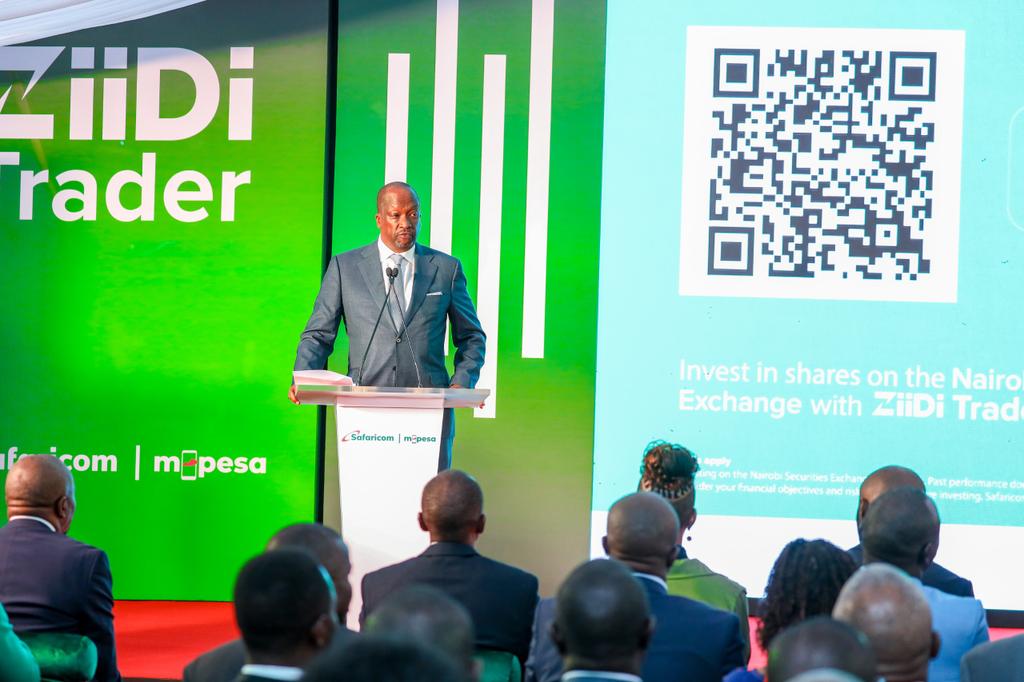
Kenya’s stock market has entered the M-Pesa ecosystem. Ziidi Trader places share trading inside the mobile money application, allowing investors to buy and sell Nairobi Securities Exchange equities using the same wallet used for daily transactions. Entry no longer depends on opening a CDS account or navigating brokerage onboarding. Participation begins inside an interface already embedded in everyday financial life.

Ziidi Trader collapses that distance. The service places share trading inside the M-Pesa application, reducing participation to a familiar action. A PIN unlocks access. Payment happens from the same wallet used for groceries, transport, or rent. The barrier moves from access to judgement. Anyone with a smartphone can now buy shares on the Nairobi Securities Exchange without passing through the traditional brokerage journey.
The early numbers tell their own story. Within days of activity, 7,962 of 14,300 share orders were processed through the platform, giving it a 55 percent share of transactions by volume while accounting for 2.0 percent of traded value. The imbalance is revealing. Small retail trades are arriving first. Large capital remains elsewhere.
That distinction may define the platform’s trajectory more than its launch optics.


Access Comes First, Ownership Follows Behind
Ziidi Trader works through an omnibus CDS account managed by Kestrel Capital. Investors do not hold individual CDS accounts. Instead, shares sit in a pooled account while internal records attribute ownership to individual users. Dividends and voting rights still flow through the system, but the structure changes the psychological relationship between investor and asset.
For seasoned market participants, direct ownership has always carried symbolic weight. A CDS account represented entry into the market’s formal architecture. Ziidi Trader treats ownership as an outcome rather than a prerequisite. The mechanics fade into the background.
That convenience solves one problem and introduces another. Investors gain speed, but lose visibility into the underlying plumbing of the market. The broker becomes an intermediary in a way that feels less visible than before. For new entrants, that distinction may not matter. For regulators and institutional investors, it eventually will.
The model resembles global retail platforms that prioritise participation over structural familiarity. The difference in Kenya lies in scale. M-Pesa sits on a base of roughly 35 million users, while the NSE has just over 1 million CDS accounts. Even modest conversion rates change the market’s composition.
Volume Without Value, For Now
The early trading pattern reflects retail behaviour rather than institutional conviction. High order volumes paired with low traded value suggest smaller ticket sizes, cautious entry, and experimentation. The Sh500,000 mobile transaction cap reinforces that pattern. Large investors remain constrained by design.
Yet the NSE’s recent history explains why the platform has arrived at this moment. Equity prices rallied over the past 2 years, but participation barely moved. Investor numbers rose by 2,621 to 1.3 million traders, a growth rate of 0.2 percent. Market performance failed to translate into new entrants.
Ziidi Trader addresses that gap directly. It does not attempt to deepen institutional liquidity. Instead, it widens the funnel at the bottom. The logic is simple. A larger pool of small investors increases daily activity, even if individual trades remain modest.
Whether that translates into sustained liquidity depends on behaviour over time. Retail investors tend to enter during optimism and retreat during downturns. The platform lowers entry friction but cannot remove market risk. Losses will arrive alongside gains. The first extended downturn will test how durable this new participation really is.
Inside the App: How Buying and Selling Shares Works
The mechanics of trading through Ziidi Trader follow the logic of M-Pesa rather than the traditional brokerage process. An investor first opts into the service through the mini application located under the financial services section of the M-Pesa app. Activation requires the standard M-Pesa PIN, followed by a one-time password sent by Safaricom to confirm access. Existing M-Pesa know your customer records are used for onboarding, so there is no document upload or separate account opening stage.
Once inside, the platform presents a market overview showing listed companies, current prices, and recent trading activity. Selecting a company opens the trading interface where an investor chooses whether to buy or sell shares. Market depth information appears alongside the order window, including available volumes and prevailing bid and ask prices. Investors can enter their own price or select the best available market price at that moment.
Payment for purchases is drawn directly from the M-Pesa wallet after confirmation. There is no need to transfer funds into a separate trading account. When shares are sold, proceeds are credited back to the wallet once the transaction settles through the exchange process. The experience mirrors ordinary mobile payments, although the underlying transaction remains a stock market trade subject to price movement and market timing.
A portfolio view allows investors to track holdings, current valuation, and profit or loss positions over time. Shares are held within the broker’s omnibus CDS account, with internal records identifying individual ownership for dividend payments and shareholder rights. For many first-time investors, the process feels closer to managing savings than entering a trading floor. The simplicity is intentional, though it places greater responsibility on the investor to understand price risk before pressing the confirm button.
Safaricom’s Financial Services Expansion Finds Its Next Layer
The platform also sits within Safaricom’s longer arc away from reliance on person-to-person transfers. Financial services already account for a growing share of revenue, and Ziidi Trader extends that logic into capital markets. Fees from trading, settlement, and ecosystem activity introduce new income streams without requiring Safaricom to become a broker itself.
The pattern is familiar. The Ziidi Money Market Fund, approved in November 2024, reached 1.15 million customers by September 2025. That growth demonstrated how quickly savings behaviour can migrate once embedded in M-Pesa’s interface. Equity trading represents a more volatile proposition, but the distribution advantage remains the same.
There is also a subtle institutional recalibration underway. The NSE, brokers, and regulators have spent years attempting to attract retail investors through education campaigns and procedural reforms. Safaricom has done it through interface design. The market moves closer to the phone rather than asking users to move toward the market.
The Question of Advice in a Self-Directed Market
Ziidi Trader currently offers no investment advisory. Investors see prices, volumes, and company descriptions, then make decisions independently. For experienced traders, that autonomy is expected. For first-time investors, it introduces risk that cannot be solved through usability alone.
Retail participation tends to follow narratives rather than fundamentals. Momentum trading, herd behaviour, and short holding periods often dominate early adoption phases. Without embedded research or advisory layers, the platform may amplify speculative behaviour before financial literacy catches up.
Safaricom has indicated that advisory tools could appear later. That raises another tension. Advice within a distribution platform alters responsibility. The line between enabling access and guiding decisions becomes thinner, especially when losses accumulate.
A Market Expands, but Power Concentrates
Ziidi Trader widens access to equities while consolidating infrastructure around a small number of institutions. Safaricom controls distribution. Kestrel Capital sits as the sole broker within the system. The NSE provides market access. Each gains from scale.
For the broader brokerage industry, the implications are less comfortable. Traditional onboarding processes now look slow and administrative by comparison. Brokers may need to rethink how they attract retail clients when access no longer depends on them directly.
At the same time, concentration creates dependency. If retail participation increasingly flows through one platform, market dynamics begin to mirror the incentives of that platform. Pricing structures, product placement, and interface design start influencing investment behaviour indirectly.
None of this is unusual in digital finance. It simply arrives faster when a platform already sits at the centre of everyday transactions.
From Payments to Participation
Kenya’s financial system has long demonstrated that behaviour follows convenience. Mobile money altered how people send and store value. Ziidi Trader attempts to extend that logic into ownership itself.
The early figures show curiosity more than conviction. Small trades, high activity, cautious exposure. Whether that evolves into long-term investing or short-term speculation will depend less on technology and more on experience. Markets teach through outcomes, not onboarding flows.
What is clear is that the boundary between daily finance and capital markets has narrowed. Equity trading no longer requires entering a separate financial world. It now lives inside the same application used for ordinary transactions.
That alone changes how the stock market is perceived. Not as a distant institution, but as another option on a phone screen.
[Secure Your Seat at Africa Tech Summit Nairobi 2026 | February 11–12 here] Use code TTRENDS10 at checkout to save 10% on your pass and join the leaders building Africa’s $1 trillion cross-border payment future.
Go to TECHTRENDSKE.co.ke for more tech and business news from the African continent.
Follow us on WhatsApp, Telegram, Twitter, and Facebook, or subscribe to our weekly newsletter to ensure you don’t miss out on any future updates. Send tips to editorial@techtrendsmedia.co.ke

