WhatsApp Strict Account Settings Emerge as Public Privacy Fights Escalate
Public disputes keep flaring and the app responds by reducing exposure


When WhatsApp began rolling out Strict Account Settings, the timing looked accidental only at first glance. The feature arrived during a week when the app’s security architecture was being debated in public, not in white papers or court filings, but across timelines and quote-tweets. Strict Account Settings sit buried inside privacy menus, framed as optional and presented without fanfare. Yet their function is unmistakable. They narrow who can reach you, how quickly, and under what conditions.

There is no dramatic redesign. No overhaul of encryption language. No public countdown. Instead, the feature appears as an extra layer, quietly constraining the social perimeter of an account. Contact attempts slow. Unknown senders face friction. The app behaves less like a public square and more like a locked entryway where access is no longer assumed.
That restraint is deliberate. WhatsApp is not unveiling a new promise. It is responding to a problem that has grown larger than assurances.
Why the perimeter matters more than the vault
For years, messaging platforms treated encryption as the primary proof of safety. Lock the message content and the system holds. That logic has thinned.


Most harm does not require breaking cryptography. Harassment, impersonation, phishing, coercion, and unwanted exposure occur before encryption becomes relevant. The damage is social first. A message can be fully encrypted and still be harmful if it reaches the wrong person at the wrong moment.
Strict Account Settings reflect that reality. They do not modify the cryptographic core. They regulate access. Who can initiate contact. How persistence is handled. Whether friction exists before a conversation begins.
This is perimeter security rather than vault security, and it arrives as correction rather than innovation.
A credibility gap platforms can no longer contain
The timing is not incidental. Messaging security has shifted from a technical discussion to a public contest over trust. Claims now travel through reposts, screenshots, and quote-threads before audits or courts weigh in. Authority fractures quickly.
That fracture became visible when allegations tied to a whistleblower lawsuit moved from legal filings into public feeds. The claims were reposted by a prominent account, then amplified further by a platform owner who used the moment to question WhatsApp’s security outright while promoting a competing product.
The response came just as publicly. WhatsApp’s head, Will Cathcart, replied directly, denying the allegations in categorical terms. He pointed to the architecture of end-to-end encryption, emphasized that message keys remain on user devices, and dismissed the lawsuit itself as meritless. He went further, attacking the credibility of the law firm behind it by invoking its past defense of spyware vendors accused of targeting journalists and officials.
This is totally false. WhatsApp can’t read messages because the encryption keys are stored on your phone and we don’t have access to them. This is a no-merit, headline-seeking lawsuit brought by the very same firm defending NSO after their spyware attacked journalists and…
— Will Cathcart (@wcathcart) January 27, 2026
The exchange did not resolve the issue. Denial met assertion. Rebuttal met persistence. Screenshots outlived corrections. For users watching in real time, the technical details mattered less than the visibility of disagreement itself.
WhatsApp cannot referee that environment. What it can do is reduce exposure to it. Strict Account Settings function as a hedge. They do not ask users to decide which side is correct. They offer a way to limit who gets through at all.
When credibility fragments in public, software compensates by narrowing access.
How Strict Account Settings are enabled
Activating Strict Account Settings is a deliberate act, not a background tweak. From WhatsApp’s main settings menu, users navigate to Privacy, then Advanced, where the option appears only on a primary device. Enabling it applies the platform’s most restrictive defaults in one step, limiting unsolicited contact, reducing account discoverability, and tightening access at the account level. The setting cannot be toggled from linked devices, reinforcing that it is meant to lock the account itself, not just the interface.
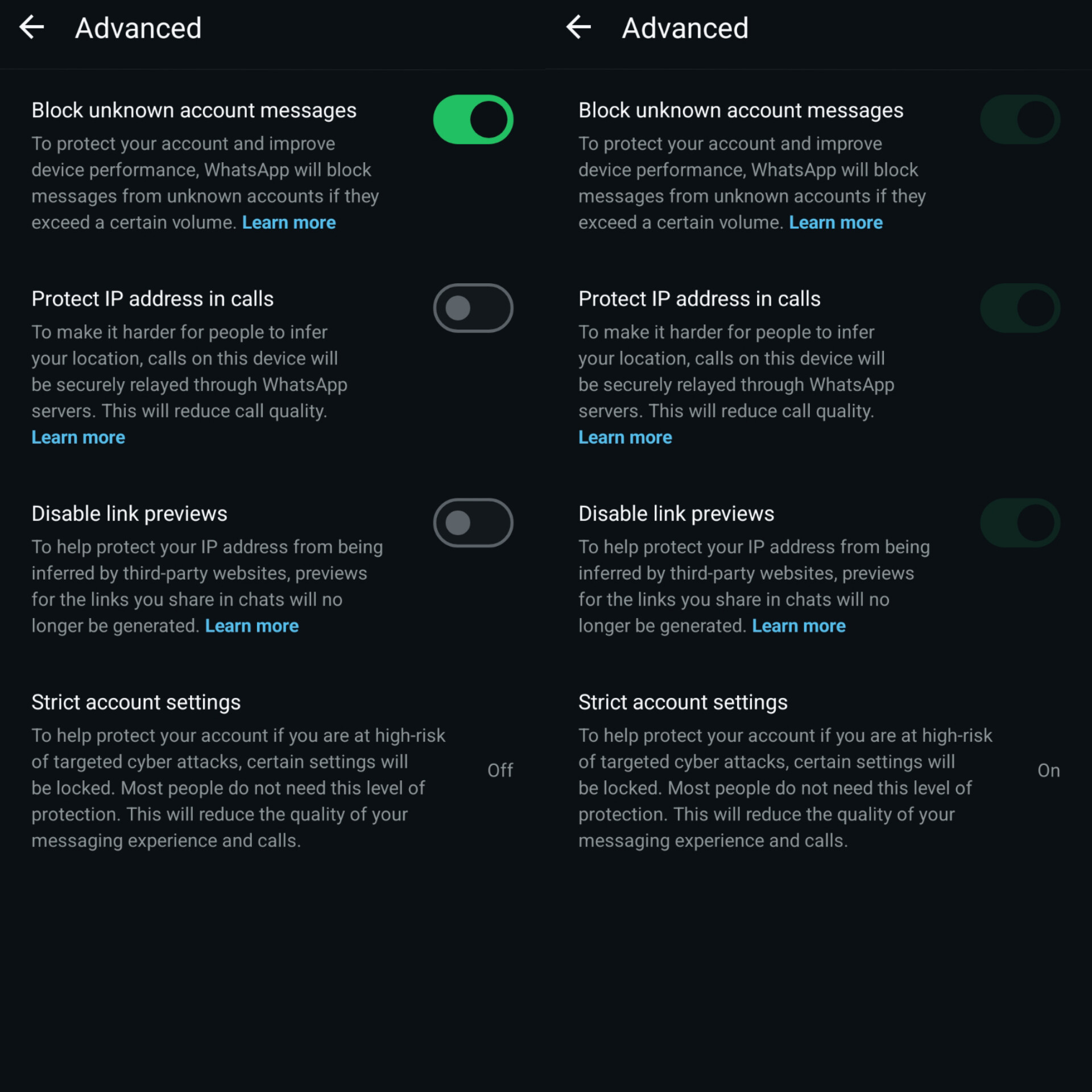
The friction is intentional. This is control that must be chosen.
Pressure without panic
It would be easy to frame the feature as a regulatory reflex. It is not. No single statute forced its appearance. Nor does the rollout suggest a single triggering incident. Instead, it reflects accumulation.
Spam continues to scale. Scam campaigns adapt faster than reporting systems. Contact discovery remains a vulnerability, particularly where phone numbers circulate widely across services. Users describe exhaustion more often than fear. Fewer interruptions. Fewer unknowns. Fewer moments of having to decide whether to engage.
Strict Account Settings respond to that fatigue. They do not promise safety. They promise distance.
Crucially, nothing locks by default. No contacts disappear overnight. Users must opt in. Control is offered, not imposed.
The audience the design quietly acknowledges
The settings are not aimed at users whose messaging circles rarely expand. They speak to journalists, organizers, public figures, small business operators, and anyone whose number travels farther than intended. People who receive messages they did not solicit but cannot fully avoid.
That audience understands the tradeoff. Reduced exposure also means fewer unexpected connections. Slower access can feel colder. WhatsApp is betting that, right now, control outweighs openness.
It marks a cultural adjustment for a platform long defined by frictionless reach. Complexity is entering by necessity, one toggle at a time.
Encryption remains untouched, by design
There is a temptation to read Strict Account Settings as an admission of weakness in message security. It is not. The encryption model remains intact. Keys stay on devices. Protocols are unchanged.
The separation is intentional. WhatsApp draws a line between content protection and access management. One remains technical and invisible. The other becomes configurable and human. This avoids reopening cryptographic debates while still addressing social risk.
Safety, the design implies, does not live in mathematics alone.
A broader pattern across platforms
WhatsApp is not alone. Across major platforms, reach is being narrowed rather than expanded. Restricted replies, follower approvals, gated messaging, and contact filters share the same instinct. Fewer doors. More locks. Slower entry.
What makes WhatsApp’s move notable is how long it resisted this logic. The app’s identity was built on universal reach. Each added barrier represents not just a feature change, but a philosophical one.
Openness, it turns out, does not scale cleanly.
Where this leaves users
Strict Account Settings do not resolve the trust disputes surrounding messaging platforms. They step around them. Instead of asking users to arbitrate competing claims, WhatsApp offers a practical response. Reduce exposure. Curate access. Accept a smaller surface area.
The feature is unlikely to dominate headlines. It does not need to. Its presence is the signal, if you know where to look. A platform built on reach is learning how to refuse it, quietly, one account at a time.
That shift, more than any public denial or viral accusation, signals where private messaging is heading next.
[Secure Your Seat at Africa Tech Summit Nairobi 2026 | February 11–12 here] Use code TTRENDS10 at checkout to save 10% on your pass and join the leaders building Africa’s $1 trillion cross-border payment future.
Go to TECHTRENDSKE.co.ke for more tech and business news from the African continent.
Follow us on WhatsApp, Telegram, Twitter, and Facebook, or subscribe to our weekly newsletter to ensure you don’t miss out on any future updates. Send tips to editorial@techtrendsmedia.co.ke

