A $1.5 Million Boost for Farm to Feed and a New Bet on Kenya’s Fight Against Food Waste
Farm to Feed is betting that better logistics and stronger networks can repair a food chain that keeps breaking before it delivers value.


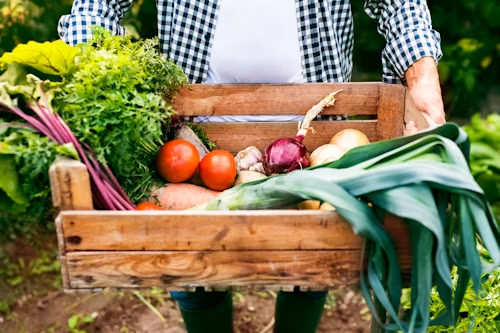
Kenyan agritech startup Farm to Feed has raised $1.5 million in new capital to expand its network of smallholder farmers and deepen its fight against food loss. The round, led by Delta40 Venture Studio with participation from several global impact investors, blends equity and non-dilutive funding to support its next growth phase.
The Nairobi-based startup, founded in 2021 by Claire van Enk, Anouk Boertien and Zara Benosa, runs a B2B platform that aggregates produce often rejected for cosmetic reasons—items that are edible but too small, too large or oddly shaped for formal retail markets. By linking these farmers directly to restaurants and food processors, the company gives value to crops that would otherwise rot before reaching consumers.
Backing impact with scale
Of the total amount, $1.27 million came in equity from investors including the DRK Foundation, Catalyst Fund, Holocene, Marula Square, 54Co, Levare Ventures and Mercy Corps Ventures. Another $230,000 was provided through DEG’s DeveloPPP Ventures programme, a non-dilutive fund run by Germany’s development finance institution.
For Farm to Feed, the capital is not just to grow faster but to grow deeper. The team plans to extend operations beyond the five counties it currently serves and onboard more farmers across Kenya, where roughly 40 percent of food produced never reaches the table.

“This funding allows us to expand our reach, connecting more farmers to a market that is increasingly demanding sustainably produced food,” said CEO Claire van Enk in a statement. The company also plans to strengthen its digital systems, expand semi-processed product lines, and prepare for regional expansion.
A bigger problem beneath the surface
Behind the funding story lies one of the country’s more persistent economic contradictions. Kenya’s agricultural sector feeds millions and drives rural employment, yet it loses close to half of what it grows before sale. A recent World Resources Institute report pointed to recurring gaps in cold storage, logistics and export quality standards that discard nutritious produce long before it spoils.
Farm to Feed’s approach aims to plug into this overlooked space—reconnecting broken supply links rather than replacing them. By collecting surplus and cosmetically imperfect produce, it creates a parallel channel that rewards farmers and saves emissions that would result from decomposing waste. Since launch, the company says it has onboarded 6,500 farmers, sold over 2.1 million kilograms of produce and prevented 247 tonnes of carbon dioxide equivalent.
Where agritech meets climate economics
The funding also underscores growing investor interest in ventures that tie profit to environmental outcomes. For Delta40 Venture Studio, which focuses on African startups combining sustainability and technology, Farm to Feed represents an example of how small operational fixes in local supply chains can deliver measurable global benefits.
The startup’s rise mirrors a broader trend among African agritechs moving beyond basic digitization toward end-to-end value optimization—from farm-level forecasting to waste recovery and alternative product lines. In Kenya, that evolution is happening alongside tighter food security pressures, urban growth and erratic climate conditions that complicate traditional farming models.
Beyond survival economics
For now, Farm to Feed’s next test lies in execution: turning momentum into scale while keeping costs low enough to make recovery markets viable. If it succeeds, the company could become part of a new playbook for African agriculture—one where digital systems, logistics and sustainability targets converge around practical economics rather than ideals.
The $1.5 million raise brings its total funding to $1.7 million, following a pre-seed round in 2024. In a sector where many startups stall after pilot phases, the renewed investor confidence suggests that the market for waste recovery, once dismissed as marginal, may finally be finding commercial footing.
Go to TECHTRENDSKE.co.ke for more tech and business news from the African continent.
Follow us on WhatsApp, Telegram, Twitter, and Facebook, or subscribe to our weekly newsletter to ensure you don’t miss out on any future updates. Send tips to editorial@techtrendsmedia.co.ke

