Canon’s R6 Mark III Is the Moment the Hybrid Camera Finally Grows Up
Built around the rhythm of constant motion, the R6 Mark III treats stills and video as one craft instead of two competing worlds.


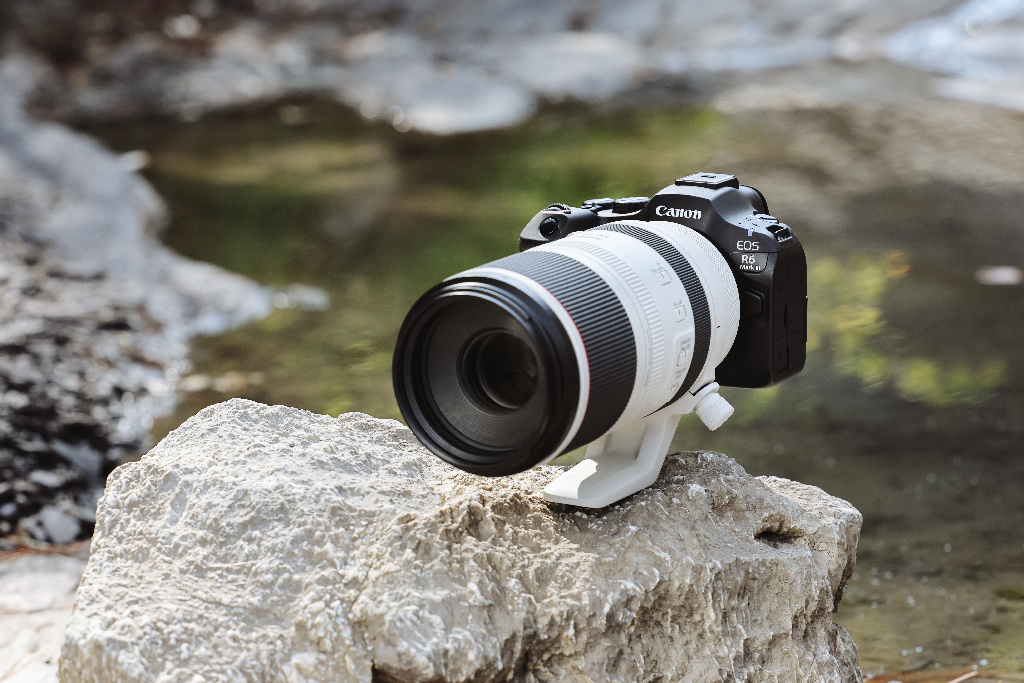
Canon’s unveiling of the EOS R6 Mark III alongside the RF 45 mm F1.2 STM in Dubai marked a measured recalibration in how image makers approach their craft. The release signaled a turn toward hybrid fluency — the ability to move between stills and cinema-grade video without breaking rhythm. Positioned between the R6 Mark II and the R5 Mark II, the new model avoids extremes in favor of refinement, tailored to the everyday realities of working photographers and filmmakers.

Key Specs
- 32.5-megapixel full-frame CMOS sensor
- DIGIC X processor
- 40 fps electronic / 12 fps mechanical shutter
- Up to 7K RAW Light video, oversampled 4K 60 p
- Dual card slots — CFexpress Type B + UHS-II SD
- Up to 8.5 stops of in-body stabilisation
- ISO 100 – 64 000 (expandable)
- Dual Pixel AF II with people, animal and vehicle tracking
- Open Gate recording, waveform monitor, C-Log 2 / 3
- Weight: ≈ 699 g
A Familiar Body With Smarter Nerves
The body feels instantly recognisable. Canon has refined rather than reinvented, knowing many R6 users will upgrade for speed and workflow improvements. A full-size HDMI port, tally lights, and better menu logic are practical responses to hybrid demands. Reviewers in Kenya and the Gulf found the ergonomics unchanged but more deliberate — particularly the re-mapped buttons for faster switching between stills and video.
Field testers noted that the weather sealing and 699-gram build let the camera handle tough environments without overheating, even during extended 4K recording. Battery endurance has also improved modestly: a single LP-E6P cell managed close to two hours of continuous 4K 60 p in warm conditions, enough for most location shoots.
While the design maintains the balance of the R6 line, Canon has improved heat dispersion around the card compartment and grip. That’s a subtle engineering change, but one that hybrid creators — especially event and wedding shooters — will notice over long sessions.

Resolution With Restraint
Canon’s new 32.5-megapixel sensor brings higher detail while keeping the forgiving low-light performance that made the R6 series popular. The files remain efficient, offering a practical trade-off between flexibility and storage space — especially compared with the heavier R5 RAW files. Real-world ISO tests showed clean results up to ISO 10 000, usable even under dim ambient lighting.
Autofocus remains one of Canon’s strongest cards. Dual Pixel AF II tracks eyes, animals, and vehicles with an intelligence that now includes trains and horses. For those weighing it against Sony’s Real-time Tracking, Canon’s advantage lies in its predictability: it locks, follows, and rarely wavers. The Register People Priority mode — allowing up to ten faces to be pre-saved — has proven invaluable for event work.
In fast panning scenarios, rolling-shutter distortion is minimal but not entirely absent; the sensor’s readout is quick enough for action, though Sony’s stacked architecture still holds a marginal edge in that specific area.
Cinema Inside the Still Camera
Hybrid shooters will find the biggest transformation here. The R6 Mark III records 7K RAW Light internally at 60 p, alongside oversampled 4K 60 p and 4K 120 p. That means no external recorder is required for cinema-grade quality — a practical response to the question of whether this camera can replace a dedicated cinema model for short films or branded work.
Open Gate capture simplifies reframing for vertical or widescreen formats, while waveform and false-color tools — borrowed from Canon’s cinema line — make exposure management faster on set. In testing, the body maintained roughly 90 minutes of continuous 4K before heat warnings appeared, a notable gain over the R6 Mark II.
The addition of both C-Log 2 and C-Log 3 provides flexible grading options. C-Log 2 offers broader dynamic range for professionals, while C-Log 3 gives a gentler curve ideal for quick post workflows. Autofocus remains steady even in low light, another improvement over earlier R-series bodies.
When compared with Nikon’s Z6 III, the Canon’s internal RAW capture and superior color rendition stand out. Sony’s A7 IV still holds an advantage in codec flexibility, but Canon’s skin tone handling and stability appeal to filmmakers seeking a consistent look straight out of camera.
The Lens That Completes the Equation
Canon’s RF 45 mm F1.2 STM joins the launch as more than a companion — it’s the creative anchor of the system. The 45 mm focal length sits comfortably between portrait and reportage, making it a natural everyday lens. At just 346 g, it’s Canon’s lightest f/1.2 option, designed for those who want cinematic depth without the cost or heft of professional glass.
Its optical character is notably consistent. The nine-blade aperture delivers smooth bokeh without harsh edges, and sharpness remains strong even wide open. For many shooters, this balance of blur and clarity is the lens’s quiet magic. Focus breathing is minimal, a sign that Canon built it with hybrid creators in mind.
Autofocus performance is brisk on the R6 Mark III and remains compatible across older EOS R bodies. The STM motor may not match Nano USM speed, but it’s quiet and stable enough for interviews or handheld video work. Together, the R6 Mark III and RF 45 mm F1.2 STM feel like a statement about creative accessibility — high-spec tools designed to keep up with real-world workflows.
Regional Perspective: Canon’s Ground Game
The decision to host the world reveal in Dubai wasn’t incidental. Canon Central and North Africa has become a vital hub for the brand’s expansion across emerging creative economies. With over 40 active country operations and training initiatives like Canon Miraisha, the company has invested heavily in developing regional skills and infrastructure.
For creators in Nairobi, Accra, or Casablanca, the R6 Mark III answers a particular need: a single body tough enough for documentary work and flexible enough for commercial projects. Canon’s philosophy of Kyosei — living and working together for the common good — feels tangible here. By launching regionally, Canon signaled its recognition of a fast-growing class of hybrid storytellers shaping local visual industries.
Canon’s Evolution With Its Users
Rather than chasing headline specs, Canon’s focus here is on usability — how quickly one can shift from a 40 fps still burst to a graded 4K clip without losing flow. The interface refinements, menu customization, and improved thermal performance show a company learning from years of hybrid experience.
Battery life, ergonomics, and data management now feel balanced. It’s a mature camera for users who no longer separate their creative tools into “photo” and “video.” And while it lacks a stacked sensor, Canon compensates with reliable color, accessible codecs, and the consistency professionals depend on.
The R6 Mark III stands as the hinge point between consumer convenience and professional resilience. Many creators could replace both a DSLR and an entry-level cinema camera with this single body. That dual identity defines where Canon stands in 2025: pragmatic, grounded, and tuned to the rhythm of modern work.
Competitive Outlook
In the mid-range full-frame category, Canon now stands in direct contention with Sony, Nikon, and increasingly, Panasonic. Sony’s A7 IV maintains an advantage in codec variety and AI-assisted subject detection, while Nikon’s Z6 III remains faster in stacked-sensor bursts. Panasonic’s S5 II, however, has entered the same space with strong video features and active cooling.
Canon’s counter is integration: dependable autofocus, superior color, and an expanding RF ecosystem that bridges enthusiast and pro levels. The R6 Mark III also benefits from Canon’s maturing AI autofocus algorithms, which subtly learn subject motion across sessions. It’s less flashy than Sony’s AI-assisted systems but delivers stability over time.
For those asking which hybrid camera best balances stills and motion, the R6 Mark III makes a persuasive case — not because it dominates in any one metric, but because it performs across all of them with quiet confidence.
The Measured Middle
Canon’s latest releases reveal a brand that finally seems comfortable in its own evolution. The R6 Mark III finds the middle ground between the R5’s precision and the R6 Mark II’s accessibility, while the RF 45 mm F1.2 STM widens creative reach. Together, they embody Canon’s current logic: incremental, thoughtful refinement instead of radical change.
This isn’t a reinvention of Canon. It’s the sound of a company steadying its balance — and listening, at last, to the rhythm of the people who create with it.
Go to TECHTRENDSKE.co.ke for more tech and business news from the African continent.
Follow us on WhatsApp, Telegram, Twitter, and Facebook, or subscribe to our weekly newsletter to ensure you don’t miss out on any future updates. Send tips to editorial@techtrendsmedia.co.ke

