
Safaricom Engineer Iladho Galgallo Comes Back to Marsabit to Encourage Girls to Study STEM
Behind the mentorship talk sits a deeper question about who feels welcome in engineering before their career even begins

The road to Marsabit tests a lot of drivers thanks to how long it takes to reach there. It’s dusty, with trucks moving slowly on sections without asphalt. School-going students must start their commute before the first bell.

Iladho Galgallo went back to her alma mater, Moi Girls’ High School, Marsabit, mid-last month, with that memory in mind. What she noticed was that the students now wear a different uniform than what she wore, and the classrooms look different as well. Even with these changes, the distance between northern Kenya and its opportunities remains the same as before.
Years earlier, Iladho had travelled the same route from North Horr, and this journey used to take two days, and it would be longer if the road washed out or if a driver decided to wait for cargo.
There was uncertainty at school as well, from fees coming late or not at all. She remembers how often she was sent home from missed fee payments, and she had to miss school for 2 days to a week, and then had to catch up when fees were cleared.


These interruptions are not shown in education statistics, but they rather sit in the margins of a student’s life, and for many girls in pastoral counties, this pattern is more than familiar, especially after the fact that educating girls in this community is often considered unnecessary.
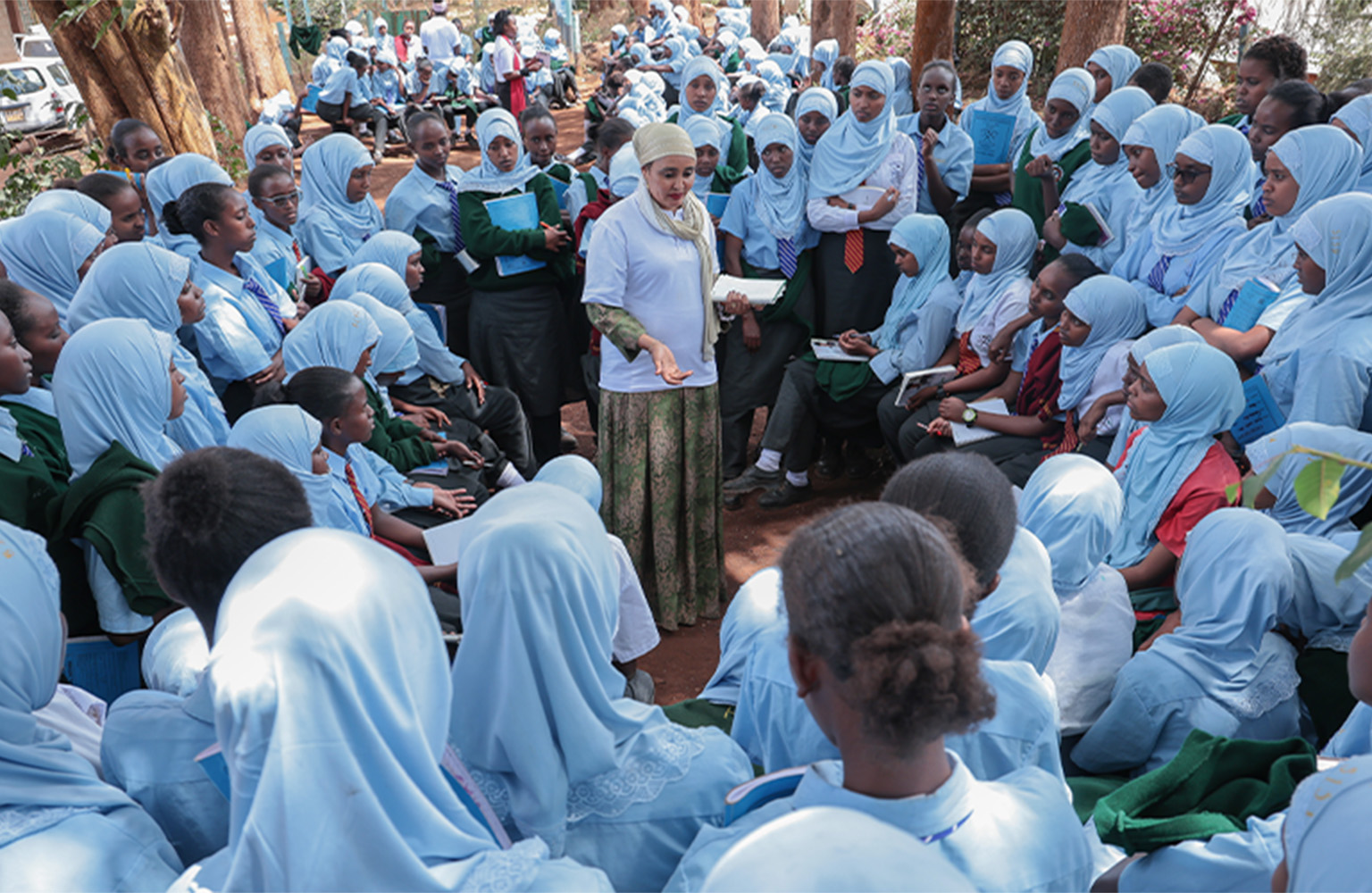
This time, Galgallo came back as a cloud solutions manager working at Safaricom. Her visit to the school is part of a mentorship programme aimed at encouraging girls to consider careers in science and technology.

The Unlikely Path Through Physics
Art subjects attract the majority when students choose subjects in many rural schools across Northern Kenya. Physics classes always sit at the far end of the timetable, and not a lot of students attend. Galgallo remembers how her Physics class was attended by only 4 students at Moi Girls.
It was clearly not a popular class, and with the fact that the school struggles to maintain and get equipment, and that physics teachers rotate throughout the school through short postings, which made students navigate the subject with improvised notes and shared textbooks.
Despite this, Iladho conitnued he rcommitment to Physics, and this decision did not come with a dramatic moment of clarity. It was more of a stubborn instinct that the engineering field would be her escape route from her financial struggles.
Yet small signals of possibility displayed themselves on the surface, from a visiting technician repairing a communications tower or a conversation with a teacher who studied science in university- these pieces accumulate.
But when Iladho finished her high school, she didn’t get enough grades to a traditional engineering course, and so she picked a diploma in telecommunications at the Technical University of Kneya, which was previously called Kenya Polytechnic.
Now diplomas don’t have a good public perception, at least when it comes to professional success, yet when you look at Kenya’s telecom infrastructure, they form a quiet backbone of technical labour.
From Diploma Graduate to Telecom Contractor
Iladho’s first job paid her KSh 5,000 per month.
When students graduate, there’s a moment of disappointment from the expectations that have been built over years of schooling, as they move to employment, when they first learn about the entry-level wages.
She moved through small contracting roles before joining Masaba Services, Safaricom’s telecommunications contractor, and this is where her pay grew to Ksh 15,000. She stayed at the company for three years.
It was here that she learnt about the practical side of telecom infrastructure, and it involved field visits and equipment checks. Maintenance assignments never get the attention, but they form the backbone of the network. This type of apprenticeship is often the building block for engineering careers.
What changed for her trajectory was mentorship. It was during this period when she was working on network projects that she met Lillian Kiambati, who is now Safaricom’s head of service management. and a participant in the telco’s Women in Technology initiative.
Galgallo then started applying for positions at Safaricom. It wasn’t until the fourteenth attempt that she got the call. What played an important role in keeping her in the process was the encouragement from Kiambati and other women involved in the menetroship programme.
She finally joined the company and furthered her education while working, and then she later transitioned from contractor to management when she moved into cloud solutions management.
At Moi Girls Marsabit, a Conversation About Girls and STEM
When Galgallo addressed students at Moi Girls Marsabit, the conversation moved beyond personal biography.
Northern Kenya continues to face an education gap shaped by geography and long-standing social expectations. In pastoralist communities, the opportunity cost of educating girls can remain high. Families often rely on daughters for household responsibilities or livestock work.
Infrastructure adds another layer. Travel distances stretch across hundreds of kilometres. Boarding schools provide access, but the financial burden often leads to interruptions in schooling.
In that environment, role models from similar backgrounds carry particular weight.
The presence of a female engineer who once wore the same uniform alters the sense of what a career path might look like. The effect works slowly. One student begins to imagine studying mathematics more seriously. Another considers taking physics even if classmates hesitate.
James Langat, Safaricom’s head of regional network implementation and operations, spoke to students about building strong academic foundations. Kiambati addressed the persistent belief that science subjects belong mainly to male students.
The message did not land in abstract terms for everyone in the hall.
Lavinia Rikunda, a student at the school, later said hearing women describe their paths into engineering had expanded her sense of possibility. Before the visit, she had not pictured herself working in technology. Afterward, she began considering software engineering as a career.
Moments like that rarely produce immediate results. Their impact often appears months or years later when a student chooses a subject combination or fills out a college application.
Technology Careers and the Geography of Aspiration
Kenya’s technology sector tends to cluster around urban centres. Nairobi holds the largest concentration of software companies, telecom headquarters, and cloud infrastructure teams.
For students in counties such as Marsabit, the industry can feel geographically distant.
Mentorship programmes attempt to narrow that psychological distance. Engineers return to their former schools and describe how the profession actually works.
Those conversations also reveal that technical careers now extend beyond traditional engineering roles. Computer science, information technology, statistics, and data analysis increasingly sit alongside classic telecommunications disciplines.
For students weighing subject choices, that wider landscape can matter.
A career in technology no longer depends on a single academic path.
The Changing Face of Kenya’s Telecom Workforce
Over the past 2 decades, telecommunications in Kenya has expanded from basic voice services into a dense digital ecosystem.
Network engineers now manage cloud infrastructure, enterprise systems, and data platforms that support millions of daily transactions. Maintaining those systems requires a workforce that blends traditional engineering with newer digital skills.
Women remain underrepresented in many technical roles, particularly in field engineering and network operations.
James Maitai, Group Chief Technology Officer at Safaricom, said technology programmes historically drew far fewer women. He recalled studying in an engineering class of 40 students where only 8 were women, a ratio that still echoes across many technical disciplines. Increasing that number, he added, remains one of the central challenges facing the technology workforce.
Mentorship initiatives attempt to address that imbalance through training programmes, professional networks, and direct encouragement within the education pipeline.
Engineers like Galgallo now occupy visible positions inside that ecosystem. Their presence offers a practical counterpoint to the long-standing assumption that technical work belongs to men.
Education in the North and the Slow Mathematics of Change
Marsabit County covers nearly 70,000 square kilometres. Settlements scatter across vast distances. Schools operate in conditions that differ sharply from urban classrooms.
Teachers often work with limited laboratory equipment. Internet connections can drop during lessons. Students travel long distances during school holidays.
Within that landscape, stories of persistence accumulate quietly. A girl who studies physics despite pressure to choose easier subjects. A student who boards a lorry for a 2-day trip to school. A graduate who returns years later to speak with the next cohort.
The transformation of opportunity in regions like this rarely arrives through dramatic announcements.
It moves gradually, through small changes in expectation.
What the Visit Might Set in Motion for Marsabit Girls
When Galgallo stood before the students at Moi Girls Marsabit, her message carried a simple premise. If she navigated those obstacles, others could do the same.
Students listened with the attentive silence common in school halls. Some took notes. Others looked out toward the hills beyond the campus.
Moments like that rarely produce immediate results. Their effect tends to appear later when a student selects physics or applies to a technical college.
For now, the story remains unfinished.
A former student returned. A few hundred girls heard what the road into engineering might look like. Somewhere in the audience, one of them may already be imagining the same journey.
Go to TECHTRENDSKE.co.ke for more tech and business news from the African continent and across the world.
Follow us on WhatsApp, Telegram, Twitter, and Facebook, or subscribe to our weekly newsletter to ensure you don’t miss out on any future updates. Send tips to editorial@techtrendsmedia.co.ke


