
Sh297 Billion at the Checkout as Kenya’s Card Payments Gain Ground
Mobile wallets still dominate the pavement economy, but the card reader is gaining confidence indoors

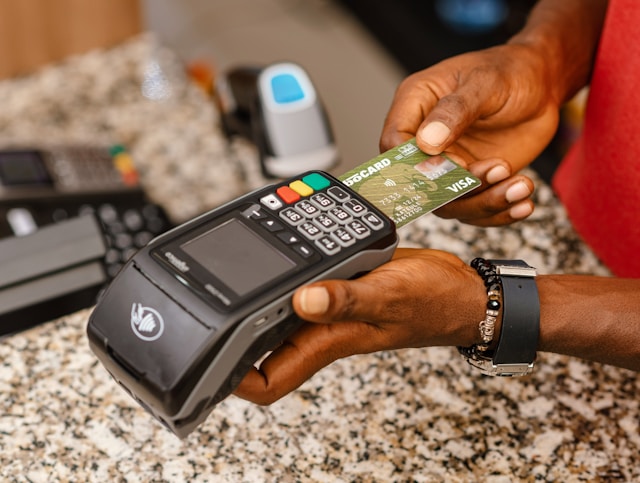
Kenya’s card payments at POS reached Sh297 billion in 2025. On paper, that is a modest climb from Sh291.9 billion in 2024. In context, it marks another year in which plastic money digs deeper into everyday retail life.

The number of card transactions rose 4.1 percent to 61.7 million, up from 59.3 million a year earlier. POS machines increased to 54,454 by December 2025 from 48,653 at the end of 2024. The trend is incremental, almost procedural. Yet it carries institutional weight.
For years, cards in Kenya occupied a narrow space. They were present in supermarkets, hotel lobbies, airline counters. They felt formal, slightly removed from the street economy. Now they are embedded in fuel stations, pharmacies, mid-tier restaurants, even some neighbourhood stores. Banks have pushed devices outward, merchant by merchant, estate by estate. The numbers reflect that slow territorial expansion.
There is nothing theatrical about Sh297 billion. It is simply the latest marker in a long climb that began with Sh43.6 million in 2010, when the Central Bank of Kenya first published full-year card usage data. By 2015, the value had reached Sh70.7 billion. Over the past decade, that base has multiplied more than 4 times. The curve is not steep. It is persistent.


Plastic Money in a Mobile Money Country
Cash remains dominant. The 2024 FinAccess Household Survey shows 79.8 percent of daily expenses are paid in cash. Mobile money accounts for 13.1 percent. Cards sit behind both.
The paradox is clear. Kenya built its reputation on mobile wallets. Cash still circulates in open-air markets, matatus, hardware stores. Yet card payments continue to edge upward.

Mobile money agent data adds texture. In 2025, the value of cash handled by agents declined 5.3 percent to Sh8.2 trillion from Sh8.7 trillion in 2024. At the same time, transaction volumes rose 2.5 percent to 2.6 billion from 2.5 billion. Smaller, more frequent transactions are becoming common. The average ticket is thinning.
Cards inhabit a different lane. They are used where formality meets record-keeping. Merchants absorb interchange and bank fees, so consumers feel no direct charge at the till. That structure matters. It alters behaviour. When payment feels costless to the buyer, friction fades.
This creates an unusual tension. Mobile money built its dominance on convenience. Cards now compete on familiarity and embedded infrastructure. A contactless tap inside a supermarket can feel simpler than initiating a wallet transfer, entering a till number, confirming a PIN. Not always. Sometimes the reverse is true. The point is that the consumer now has a choice at more counters than before.
The Pandemic Dip That Clarified the Pattern
The only interruption in the upward march came in 2020. Card payments fell to Sh157.7 billion from Sh177.3 billion in 2019. Lockdowns closed physical retail spaces. Mobility collapsed. POS machines sat idle.
By 2021, as restrictions eased, card transaction value recovered to Sh194.3 billion. The rebound did not overshoot. It resumed the pre-existing trajectory.
The episode underscored something structural. Card usage is tethered to physical retail. It thrives in supermarkets, restaurants, travel desks, hotels. When those sectors contract, card payments follow. Mobile money, by contrast, remains woven into person-to-person and small trader exchanges. Its resilience lies in ubiquity rather than infrastructure density.
This divergence continues to shape the payments contest.
Merchant Economics and the Hidden Calculus
Consumers are not charged at the POS terminal. Merchants absorb the fees. That decision anchors the card ecosystem. It also raises a practical question: why do merchants accept this cost?
Risk reduction is one answer. Less cash in drawers reduces exposure to theft and shrinkage. Reconciliation becomes easier. Accounting systems integrate card records with relative ease. For medium and large retailers, these efficiencies offset interchange costs.
Banks have leaned into this logic. They have expanded merchant onboarding campaigns and rolled out chip-and-pin cards, contactless capability, and tighter fraud controls. Trust matters in card economics. A single widely publicised breach can slow adoption. The steady upgrade of security infrastructure has been part of the expansion strategy.
There is another layer. As POS devices multiply, card networks entrench themselves in formal retail corridors. Once installed, terminals are rarely removed. They become part of the store’s operational furniture. Even if card usage per outlet remains modest, the network effect compounds over time.
Formal Retail as a Boundary Line
Kenya’s payment story often tracks the divide between formal and informal trade. Cards cluster in tax-registered, banked enterprises. Cash and mobile wallets dominate informal micro-trade.
The growth to 54,454 POS machines suggests formal retail is deepening. It also suggests banks see opportunity in the mid-market segment, not only flagship chains. Pharmacies, mid-range eateries, regional fuel stations. These are not glamour sectors. They are volume sectors.
Yet cards have not penetrated open-air markets or small kiosks in meaningful numbers. Infrastructure costs, settlement timelines, and merchant fees still act as barriers. Until that friction eases, the majority of low-value daily transactions will remain outside the card system.
This creates a layered payments landscape. High-frequency, low-value exchanges remain mobile or cash-based. Higher-value retail purchases are more likely to pass through cards. The border between these layers is not fixed. It moves gradually, guided by device costs, network reliability, and fee structures.
Competition Without Open Warfare
The decline in mobile money agent cash value alongside rising transaction counts hints at internal recalibration. Consumers appear to be distributing transactions differently. Larger retail purchases may migrate toward cards. Smaller, routine transfers continue through wallets.
There is no open conflict between channels. Banks issue cards and often partner with mobile platforms. Consumers move between systems depending on context. A supermarket run may involve a tap of a card. A boda boda fare remains a wallet transfer. A hardware store might accept either.
Over time, however, the economics could sharpen. If card acceptance widens further and merchants negotiate lower fees at scale, cards may capture more mid-range retail spending. Conversely, if wallet providers adjust pricing or integrate deeper with merchant systems, they could consolidate their hold.
Policy will influence the direction. Fee caps, interchange regulation, and digital taxation debates have already surfaced in courtrooms and regulatory forums. Even small changes in cost allocation can reconfigure incentives.
Institutional Patience and Long Horizons
From Sh43.6 million in 2010 to Sh297 billion in 2025, the arc is long. It reflects institutional patience rather than sudden transformation. The Central Bank of Kenya has recorded the climb methodically. Banks have expanded infrastructure year by year. Consumers have incorporated cards gradually into daily routines.
What stands out is not velocity but durability. With the exception of 2020, annual growth has been consistent. That steadiness suggests cards have secured a stable, if secondary, position in Kenya’s payment ecosystem.
The open question is whether that position remains secondary. If POS machines continue rising at a similar pace beyond 54,454 and transaction values keep inching upward, the compound effect over another 5 years could be substantial. A doubling from Sh297 billion would require sustained merchant onboarding and behavioural normalization. Neither is implausible.
Yet the gravitational pull of cash and mobile money remains strong. Cash is free to use and universally accepted. Mobile wallets are embedded in social and commercial life. Cards operate within a narrower corridor of formality and infrastructure.
Kenya card payments at POS have reached a new high. The figure itself does not rewrite the hierarchy of payments. It does, however, show that plastic money has carved out durable space in a market once thought to belong almost entirely to mobile wallets. The competition is no longer about novelty. It is about entrenchment.
Go to TECHTRENDSKE.co.ke for more tech and business news from the African continent and across the world.
Follow us on WhatsApp, Telegram, Twitter, and Facebook, or subscribe to our weekly newsletter to ensure you don’t miss out on any future updates. Send tips to editorial@techtrendsmedia.co.ke


