
Apple Made the iPhone Air Beautifully Thin — Samsung Made the S25 Edge Thin and Sensible
Samsung didn’t try to out-beautify the iPhone Air — it simply asked why thinness should come at the cost of hearing your mother on speakerphone

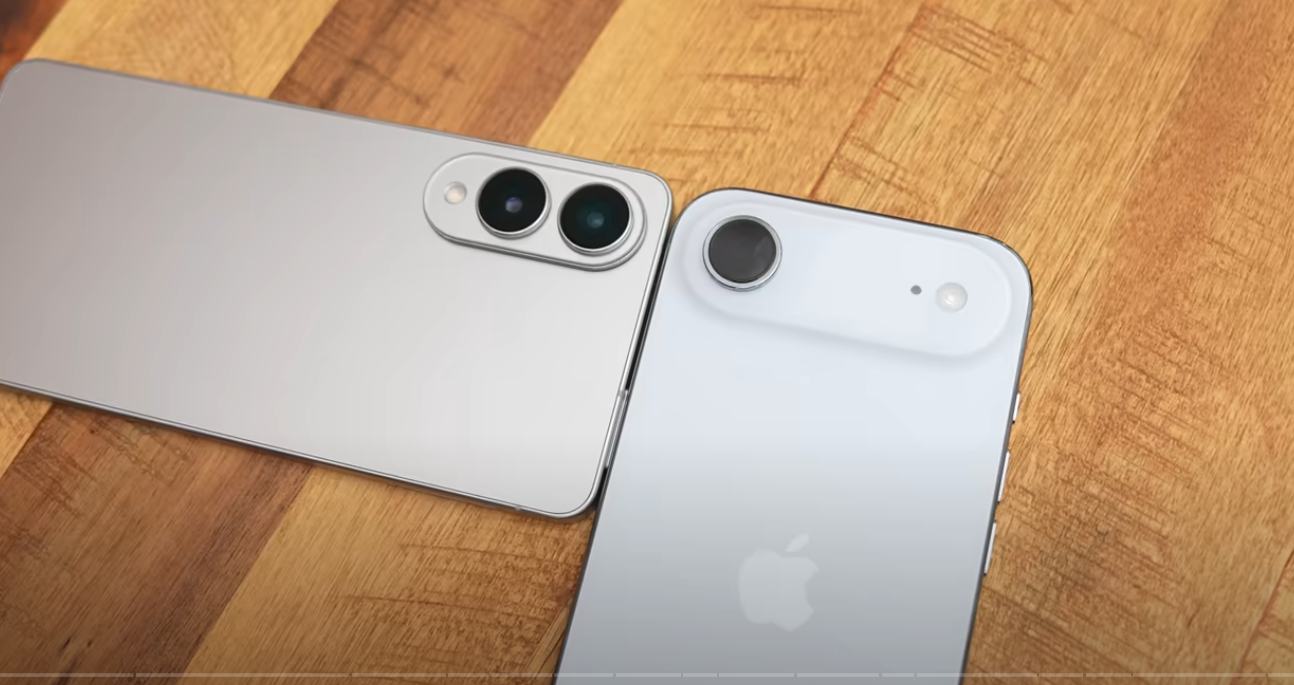
The first time you pick up the iPhone Air, you don’t just notice it — you underestimate it. It feels like a mock-up. A prop. A decoy phone that’s supposed to be swapped out for the real one. Then you unlock it, use it, and think: Well, damn. They actually did it.

Apple’s thinnest smartphone in years is a masterclass in industrial reductionism. But thinness is a sugar high. Delightful at first, forgettable once the novelty wears off. And that’s where the iPhone Air hits turbulence — not because it’s bad, but because it’s incomplete.
Here’s the problem: Samsung already released a similarly thin phone — the Galaxy S25 Edge — and quietly sidestepped half of the Air’s compromises. Which means Apple’s trade-offs weren’t forced by physics. They were choices.
The question now isn’t whether thin phones can exist. It’s whether Apple can build one without asking users to pretend the basics don’t matter.

Thinness in 2025: Novelty or Maturity?
For the first week, owning the iPhone Air feels like joining a secret club. Every handoff gets a reaction. Every pocket slip feels futuristic. Then muscle memory normalizes the weight, and what’s left isn’t wow, but wait… why did I give up all that for thinness?
That shift—from emotional thrill to rational audit—is where the Air stumbles.

- Battery: Fine for light users, stressful for heavy ones.
- Camera: One good lens, zero flexibility.
- Performance: Powerful hardware throttled by weak thermals.
- Speakers: Single mono driver in 2025 — genuinely baffling.
Meanwhile, Samsung looked at the same engineering constraints and said, “Okay, but what if we didn’t sacrifice the basics?”
Battery Life: Efficiency vs. Confidence
Apple’s efficiency tuning is world-class. The iPhone Air can last a full day if your definition of “usage” excludes gaming, navigation, or high-brightness video. It’s a careful phone — one that politely suggests you behave.
The S25 Edge, being almost as thin, faces similar thermal realities. But Samsung armor-plated it with a slightly larger battery and charging speeds that actually feel modern. Five minutes gives you meaningful recovery. Apple still treats fast-charging like a moral compromise.
Apple doesn’t need to abandon thinness. It needs to redefine it as confidence, not caution. Borrow the stacked-cell battery tech from the Apple Watch Ultra, pair it with 35W charging, and suddenly thin doesn’t mean tentative.
Camera Philosophy: Apple Went Simple. Samsung Went Overkill
The Air’s single-lens setup performs admirably — but it limits creative flexibility. Apple’s assumption seems to be: People rarely switch lenses anyway. Maybe true. But knowing you can is different from wishing you could.
The S25 Edge sidestepped that debate entirely by stuffing in a 200MP sensor and letting AI punch in digitally. Is that as good as optical glass? No. But for social media and travel zooms, it’s more than passable.
Apple’s Options:
- Software Compensation: Advanced digital zoom trained via image stacking.
- Modular Approach: A MagSafe telephoto puck. Wild idea? Sure. But this is the same company that sold $999 monitor stands.
Performance and Thermals: Samsung Cooled It. Apple Prayed
The iPhone Air has flagship silicon and 12GB of RAM — it just can’t stay cool long enough to show it. Sustained performance drops fast under load. You can have power or hold it. Not both.
Samsung, to its credit, didn’t pretend the problem didn’t exist. It embedded vapor chamber cooling into a phone nearly as thin. Not a miracle — just intentional design.
So no, this isn’t physics. It’s philosophy.
Speakers: The One Flaw Apple Can’t Spin
This is the only outright failure. A single mono speaker in 2025 is indefensible for a $700+ phone. Not “quirky” or “minimalist.” Just inadequate.
FaceTime outdoors? Impossible. Cooking with the fan on? Forget it. Apple knows better — it just didn’t prioritize it.
Samsung didn’t even make a big deal about stereo sound in the S25 Edge. It’s just there. Unremarkable because it should be.
Quick Comparison Snapshot
| Feature | iPhone Air | Galaxy S25 Edge |
|---|---|---|
| Speaker Setup | Mono | Stereo |
| Thermal Design | Basic Heat Spreaders | Vapor Chamber |
| Charging Speed | ~20W | ~25W (faster ramp) |
| Camera Flexibility | Single Lens | High-Res Digital Zoom |
| Battery Philosophy | Efficiency | Recovery |
Apple’s Roadmap to Redemption: Thinness Without Compromise
If Apple is serious about defining the future of ultra-light devices — not just flirting with it — then the second-generation iPhone Air can’t simply be thinner. It has to be smarter about thinness. Samsung has already shown that restraint is not the only response to physics. Ingenuity is.
Here’s how Apple can turn the iPhone Air from design marvel with caveats into design benchmark without qualifiers.
Rethink Battery Philosophy: From Efficiency to Elasticity
Apple currently treats battery life like a sealed budget — spend carefully, ration resource-intensive features, and reward disciplined users. That’s fine in theory. In practice, people don’t change their habits just because their phone is delicate.
Instead of only optimizing drain, Apple needs to optimize recovery.
- 35W MagSafe fast charging would allow short “sip charges” to meaningfully restore health — something Samsung already does comfortably.
- Stacked battery architecture, borrowed from the Apple Watch Ultra or AirPods case design, could preserve thinness while boosting density.
- Bonus: AI-based charging modes that detect gaming or travel patterns and pre-buffer power strategically, not passively.
Fix Thermals the Right Way — Quietly and Aggressively
If Apple can build titanium frame reinforcement for drop resistance, it can certainly build it for heat dissipation. Vapor chamber cooling shouldn’t be a “gaming phone” feature. It should be standard in anything with Pro-class silicon.
Potential solutions:
- Graphite heat funnels routed along the frame instead of beneath the screen.
- A perforated titanium rib hidden under the back glass to distribute heat outward more evenly.
- Or the nuclear option: push MagSafe beyond charging — turn the back of the phone into a passive heat radiator when docked.
Samsung already proved cool-and-thin is achievable. Apple just needs to admit it.
Restore the Sensory Experience — Thin Shouldn’t Mean Fragile
The iPhone Air feels delightful in hand, but it risks feeling weightless in the wrong way — as in lacking substance. There’s a difference between slim and hollow. Between refined and compromised.
Some very Apple solutions:
- Reintroduce tactile feedback through tuned vibration resonance — imagine the Haptic Engine subtly vibrating through the titanium frame to make the device feel denser than it is.
- MagSafe grip bands or skins designed to add controlled weight where desired — not clumsy cases, but modular personality.
Thin should flex, not flinch.
Rebuild Trust in the Basics — Sound, Camera, Continuity
Apple’s keynote language is often built around big pillars: privacy, ecosystem, longevity. User trust is their greatest asset — so why risk eroding it over something as basic as audio clarity in a phone call?
- Stereo sound must return, full stop. No artful justification. No spatial trickery. Just two drivers, well tuned.
- The single-lens strategy either needs computational backup or hardware augmentation — crop-zoom mastery or modular enhancement.
- And finally — iOS should acknowledge Air users explicitly. Maybe via a “Thin Mode” — slight UIs tweaks, thermal-aware task shifting, context-aware audio amplification.
Not limitations — acknowledgements.
The Next iPhone Air Has No Excuse
The first iPad Air was lovely but underpowered. It took Apple two generations to make thinness feel complete. The iPhone Air is now in that same adolescence.
Samsung has already demonstrated that thin phones can still be whole. Apple must decide whether the next Air is a design stunt — or a standard-setter.
One more year of compromise? Or the year thin finally grows up?
Go to TECHTRENDSKE.co.ke for more tech and business news from the African continent.
Mark your calendars! The GreenShift Sustainability Forum is back in Nairobi this November. Join innovators, policymakers & sustainability leaders for a breakfast forum as we explore sustainable solutions shaping the continent’s future. Limited slots – Register now – here. Email info@techtrendsmedia.co.ke for partnership requests.
Follow us on WhatsApp, Telegram, Twitter, and Facebook, or subscribe to our weekly newsletter to ensure you don’t miss out on any future updates. Send tips to editorial@techtrendsmedia.co.ke
TechTrends Media Podcasts


