
Samsung Galaxy A57 Holds Its Ground in a Crowded Midrange Market
The Samsung Galaxy A57 arrives into a midrange market that feels tighter than it did a year ago

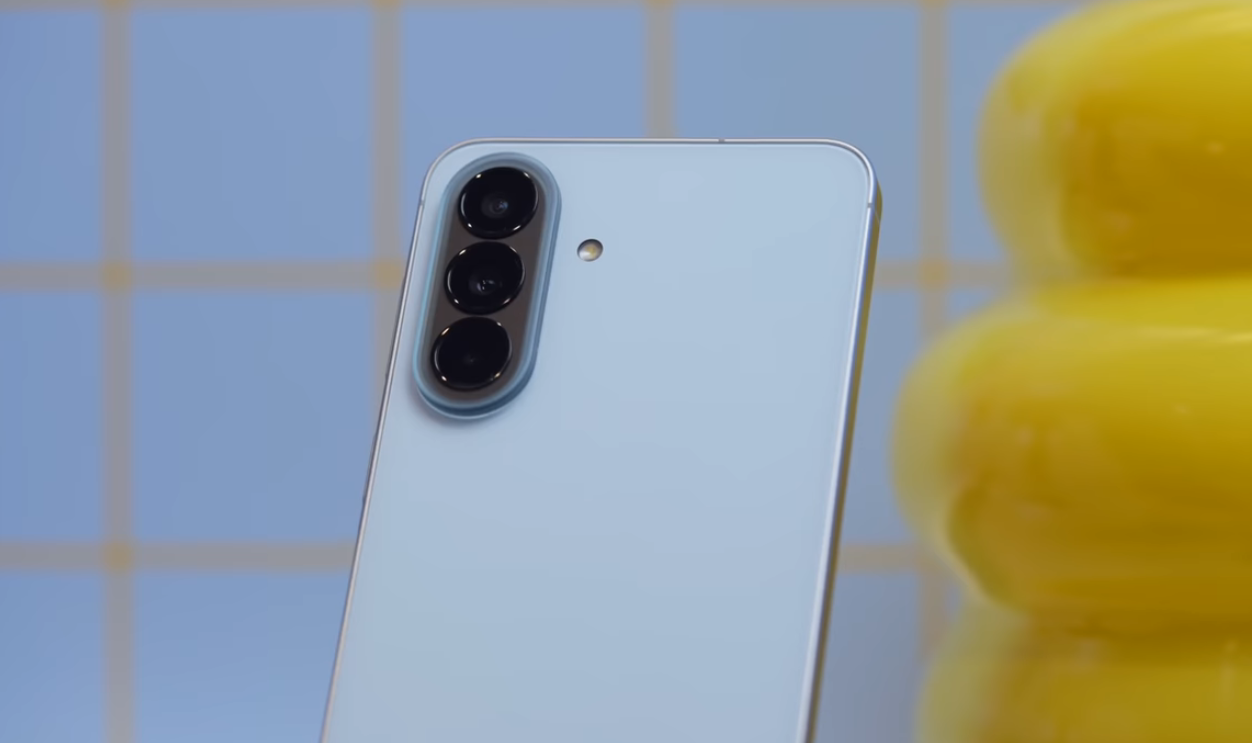
There is a certain familiarity to the new Samsung Galaxy A57 5G. Pick it up, turn it over, and it reads like a continuation rather than a statement. The silhouette holds. The camera stack stays where you expect it. Even the color names carry that faintly self-aware branding tone Samsung has leaned into for years.

But linger a bit longer and the device starts to reveal a different story. Not one of reinvention. Something narrower. More constrained. The Samsung midrange strategy in 2026 looks less like a push forward and more like a careful calibration under pressure.
The A57 sits at the center of that tension.
The Samsung Galaxy A57 5G is set to go on sale from April 10, with pricing in Europe starting at €529, a step up from last year’s model.

A thinner phone, a tighter brief
On paper, the A57 improves on its predecessor, the Samsung Galaxy A56 5G, in ways that are easy to list but harder to feel as a leap. The body drops to 6.9mm. Weight comes down to 179g. Bezels shrink just enough to change how the screen sits in the hand. The jump from IP67 to IP68 reads well on a spec sheet, even if most users will never test it beyond a splash.
Individually, each adjustment makes sense. Together, they describe a design team working within a fixed boundary rather than expanding it.

There is a pattern here. Samsung is refining the edges of the experience. Not the center.
That approach mirrors what has been happening across the broader smartphone market. Hardware cycles have slowed. Margins are tighter. The incentive is no longer to surprise, but to remove friction. The A57 fits that pattern almost too neatly.
The display story that doesn’t quite land
Samsung’s decision to bring back Super AMOLED+ for the A57 reads like a technical footnote that wants to be more than it is. Years ago, that label carried weight. It implied sharper subpixel layouts, better efficiency, a visible step up from standard AMOLED.
Today, the distinction is harder to locate in practice.
The A57 still runs a 120Hz panel with peak brightness around 1,900 nits. The experience is smooth, bright, and familiar. The thinner panel helps the device achieve its reduced profile, which matters more than the branding of the display technology itself.
This is where the midrange category gets complicated. Improvements are real, but they land in ways that are subtle enough to feel abstract. A user upgrading from a 2 or 3 year old phone will notice the difference. Someone coming from last year’s A56 may not.
Samsung appears comfortable with that gap.
Cameras that move faster, not further
The camera setup tells a similar story. The A57 keeps a 50MP main sensor, a 12MP ultrawide, and a 5MP macro lens that continues to exist largely for box-ticking reasons.
The interesting work happens behind the scenes.
Processing is quicker. Lens switching is smoother. The delay that once made transitions feel clumsy has been reduced to the point where it no longer draws attention. The Image Signal Processor has been tuned to handle low light more confidently, and portrait segmentation shows incremental gains.
None of this changes the ceiling of what the camera can do. It changes how it feels to use.
That distinction matters. Samsung is no longer chasing dramatic jumps in image quality in this segment. It is smoothing out the experience instead. The friction points are being sanded down, one by one.
There is an argument that this is the more honest form of progress. There is also a counterargument that it leaves the category stagnant.
Performance gains that stay within bounds
Under the hood, the Exynos 1680 replaces the previous generation chip, bringing a modest uplift in efficiency and sustained performance. The addition of a larger vapor chamber, roughly 13% bigger, suggests Samsung is thinking about thermal consistency rather than peak output.
This is not a phone designed to compete with flagships. It is designed to remain stable under everyday load. Apps open without hesitation. Multitasking holds up. Gaming runs, within limits that are understood rather than advertised.
The absence of microSD support, paired with storage options reaching 512GB, reflects a broader industry move. Internal storage has become the default path forward. Expandability is quietly being retired across price tiers.
The A57 follows that script without deviation.
AI arrives, but in fragments
Software is where the gap between midrange and premium devices becomes more visible.
The A57 ships with One UI 8.5 on Android 16 and carries a trimmed set of AI features. Circle to Search expands its scope. Voice transcription becomes more accessible. Editing tools gain a bit more flexibility. There is integration with assistants like Gemini and an updated Bixby that can handle basic system actions.
It is a curated experience. Not the full stack seen on Samsung’s flagship line.
This creates an interesting dynamic. The tools are present, but their limits are clear. Users get a taste of what the ecosystem can do, without full access to its capabilities.
Samsung seems to be drawing a line that is both technical and strategic. AI is being distributed across the lineup, but not evenly.
Pricing pressure and the narrowing gap
The A57 enters the market at a higher price point than its predecessor. In some regions, the increase sits around €50. In others, promotional pricing softens the impact, but the direction is clear.
Midrange phones are getting more expensive.
At the same time, older flagship models and “fan edition” devices often drop into similar price bands. A device like the Samsung Galaxy S25 FE can, at times, sit uncomfortably close to the A57 in cost while offering features like wireless charging and a telephoto lens.
This creates a tension that did not exist as sharply a few years ago. The midrange buyer now faces a different calculation. Pay for a new device with incremental refinements, or stretch slightly for older premium hardware with broader capabilities.
Samsung is not alone in this. Competitors like Oppo and Vivo are pushing aggressively into the same space, often with more conspicuous hardware features.
The A57 holds its ground through consistency rather than spectacle.
A market that no longer rewards excess
There is a broader pattern emerging across the smartphone industry. The midrange category has matured to the point where excess is no longer rewarded. Users expect reliability, longevity, and a degree of polish that used to belong to premium devices.
Samsung’s answer with the A57 is to refine what already works.
The company leans on its update policy, offering up to 6 years of software and security support. It improves durability. It tightens the design. It smooths performance. It introduces AI in controlled doses.
Each decision is measured.
What is missing is any sense of risk.
Where this leaves the A57
The Samsung Galaxy A37 5G exists alongside the A57 as a more affordable option, but the gap between them reinforces the same idea. The A57 is where Samsung concentrates its midrange identity. The A37 follows.
The A57 does not attempt to redefine the category. It consolidates it.
That may be enough. For many buyers, it will be. The phone is competent, balanced, and unlikely to disappoint in daily use.
But there is a lingering question that the device does not fully answer. If each generation continues along this path of careful refinement, at what point does the upgrade itself lose urgency?
Samsung appears to be betting that consistency can carry that weight.
It is a pragmatic bet. Whether it holds depends less on what the A57 does, and more on how much more the midrange buyer is willing to wait for something that feels genuinely new.
Mark your calendars! The GreenShift Sustainability Forum is back in Nairobi this August. Join innovators, policymakers & sustainability leaders for a breakfast forum as we explore sustainable solutions shaping the continent’s future. Limited slots – Get your early bird tickets now – here. Email info@techtrendsmedia.co.ke for partnership requests.
Go to TECHTRENDSKE.co.ke for more tech and business news from the African continent and across the world.
Follow us on WhatsApp, Telegram, Twitter, and Facebook, or subscribe to our weekly newsletter to ensure you don’t miss out on any future updates. Send tips to editorial@techtrendsmedia.co.ke

