
Kenya and the EU Align on Data Governance and AI as Digital Infrastructure Expands
What EU–Kenya digital talks present as alignment begins to expose a gap between growth ambitions and control over data

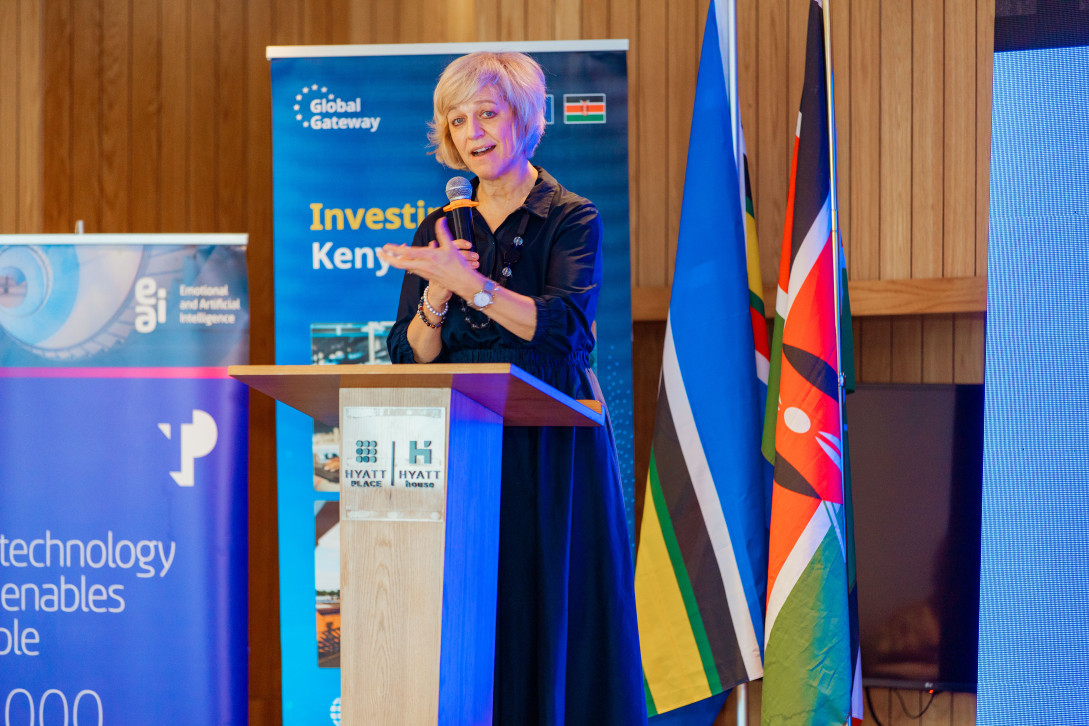
Fifty years is a long time in diplomacy. Long enough for habits to form, for language to settle into routine. What happened in Nairobi this morning did not feel routine. The European Union and Kenya chose to mark that anniversary by stepping into a more exacting space: how digital systems are built, governed, and ultimately controlled.

The launch of the EU–Kenya digital dialogue places Kenya in a small group of partners, alongside countries like Brazil and Australia, and the first of its kind on the continent. That positioning carries weight. It frames the relationship not just as cooperation, but as part of a broader effort to shape how digital systems are organised across regions.
H. E Henriette Geiger, Ambassador of the European Union to Kenya, framed it as a need for structure. Collaboration without a framework, she suggested, risks producing activity without consequence. The dialogue, in her telling, is meant to discipline that relationship, to move it from scattered projects into something that can produce measurable transformation.
Transformation here lands on infrastructure, data systems, and artificial intelligence. Operating layers, not abstractions.


From Development Partner to System Architect
For years, the EU’s presence in Kenya sat comfortably in development cooperation. Funding programmes, supporting regulatory capacity, backing sectoral initiatives. That posture is now giving way to something more embedded and more structured within the broader EU–Kenya Strategic Dialogue that has been in place since 2021.
Geiger spoke openly about the EU’s role in shaping Kenya’s regulatory environment. Data protection frameworks. AI strategy. Policy scaffolding that sits upstream of any investment decision. It is a familiar European approach. Build the rules first, then let capital follow.

There is a logic to it. Investors prefer predictability. Governments want coherence. But regulatory design is not neutral. It carries assumptions about risk, privacy, competition, and control. When those assumptions travel, they do not always land cleanly.
Renate Nikolay, from the European Commission, leaned into that tension without quite resolving it. Europe, she said, does not want to be seen only as a regulator. It wants to be an innovator. The distinction is doing heavy lifting. Europe’s global reputation has been shaped by its rulemaking. Its ambition now stretches further, into production, into technological capacity.
That ambition carries a second layer: sovereignty. Ms. Renate Nikolay, Deputy Director General of the Directorate General for Communications Networks, Content and Technology (DG Connect) at the European Commission spoke about the need for Europe to secure its own technological future. The implication is hard to miss. Partnerships like this are not just outward-facing. They are also about securing position in a world where digital systems are increasingly tied to geopolitical leverage.
Kenya’s $5 Billion Question
On the Kenyan side, the numbers are more direct. Eng. John Tanui placed the requirement for the country’s digital buildout at $5 billion. Infrastructure, connectivity, software capacity, data systems. A wide field, with no single financier. It stretches from expanding fiber networks and reinforcing submarine cable links to building out the less visible layers, where data is stored, processed, and moved. That includes the push for local data infrastructure, systems that can hold and manage information within Kenya’s own jurisdiction rather than routing it outward by default. Beyond that sits the harder ambition, developing software capacity and artificial intelligence systems that are not simply adopted, but shaped locally.
The figure invites participation. It also exposes dependency.
Kenya is not short of partners in this space. American firms, Chinese infrastructure players, multilateral lenders. Each comes with its own model. Pricing structures, governance standards, operational expectations. The European Union is entering a crowded field, but with a different pitch.
| Partner Model | Core Value Proposition | Primary Infrastructure | Regulatory Alignment |
|---|---|---|---|
| European Union | Institutional Alignment | Sovereign Cloud & Resilience | Data Adequacy (GDPR) |
| United States | Market-Led Innovation | Submarine Cables & Platforms | Private Sector Standards |
| China | Scale and Speed | Fiber Networks & Hardware | State-to-State Agreements |
Not speed. Not scale alone. Something closer to institutional alignment.
Tanui’s framing leaned toward openness. Kenya will work with multiple partners. Public and private capital will both play a role. There is an emphasis on creating an environment where investment can land and scale. Government, in this telling, sets the conditions. The market fills in the rest.
It sounds straightforward. It rarely is.
Data, Trust, and the Politics of Flow
One of the more technical threads in the discussion carries long-term weight. Data adequacy. The EU is moving toward recognising Kenya’s data protection regime as compatible with its own.
On paper, this is about enabling data flows. In practice, it does more. It lowers friction for European firms operating in Kenya. It also shapes how data is handled, stored, and transferred. Once established, those pathways persist. They begin to define where data can live, where it can be processed, and who holds leverage over those decisions. The question is no longer just about regulation, but about the physical and logical infrastructure that sits underneath it.
Nikolay described it as the easiest way to build trust. There is truth in that. But trust, in this context, is also a regulatory construct. It is defined by standards, audited through compliance, enforced through systems that are often external to the local market.
Kenya’s advantage here is clear. A young, technically capable workforce. A growing base of digital firms. The prospect of becoming a preferred destination for IT outsourcing is not hypothetical. It is already underway.
The question sits elsewhere. Whether that positioning allows Kenyan firms to move upstream. Into ownership, into design, into decision-making roles that define how systems evolve.
The Private Sector Is Expected to Carry the Weight
There is a consistent thread across the EU’s positioning. Government builds the environment. The private sector delivers scale.
Geiger was explicit on this point. Public funding can start things. It can de-risk early stages. But long-term sustainability sits with private actors. That includes European firms entering the Kenyan market, and Kenyan firms trying to grow within it. In practice, that capital tends to move first toward areas where returns are clearer, connectivity, service delivery, outsourcing pipelines. The higher layers, where systems are designed, owned, and monetised over time, do not always localise as easily.
This is where the model reveals its limits. Private capital follows return. It does not always align with national priorities, especially in sectors like digital infrastructure where timelines stretch and margins fluctuate.
The EU’s Global Gateway framework sits in the background here. Blended finance, guarantees, structured investment vehicles. Tools designed to make projects viable where they might otherwise stall. Yet those tools come with conditions. Procurement structures, partner preferences, technical standards.
The result is a layered system. Public policy shapes the environment. Financial instruments guide investment. Private firms execute. Each layer carries influence.
The AI Question Is Not About Tools
Artificial intelligence appears repeatedly in the conversation, often framed as opportunity. Both sides speak of becoming “AI makers.” It is an appealing phrase. It also hides the harder part.
Building AI capacity is not only about talent or compute. It is about data access, research ecosystems, ownership of models, and the ability to deploy them at scale. These are unevenly distributed.
Kenya has made early moves. A national AI strategy. Ongoing work on policy. Engagement with international partners. The foundations are there. What remains uncertain is how much of the value chain will be anchored locally. Whether compute infrastructure will sit within reach, whether data can be retained and reused at scale, and whether locally built systems can move beyond application layers into something more foundational.
Europe’s interest in linking its AI ecosystems with Kenyan counterparts points to collaboration. It also introduces asymmetry. European research infrastructure, funding capacity, and institutional depth remain stronger. Partnerships tend to reflect that imbalance, even when framed as mutual.
| Strategic Pillar | EU Focus (The Regulator) | Kenya Focus (The Maker) |
|---|---|---|
| Main Objective | Safety & Ethical Oversight | Economic Growth & Job Creation |
| Infrastructure | Energy-Efficient Standards | Local Compute & Data Centers |
| Governance | Risk-Based Rules (AI Act) | Innovation Sandboxes & Policy |
| Metric of Success | Compliance & Trust | Adoption & Value-Chain Ownership |
Between Openness and Control
At one point, the conversation turned to the future of the internet. Fragmentation, regional blocs, competing standards. Nikolay pushed back against the idea of a divided system. She spoke in favour of openness, of maintaining a global network.
It is a familiar position. It sits alongside a more complicated reality. As countries invest in their own digital sovereignty, the architecture of the internet becomes less uniform. Standards diverge. Data regimes tighten. Access can become conditional.
Kenya is navigating this landscape in real time. It is building systems while the global rules are still in motion. That creates space for choice. It also creates risk. Decisions made now, on infrastructure, on data governance, on partnerships, will be hard to unwind later.
The Conversation Moves, the Questions Stay
The EU–Kenya digital dialogue is designed to produce outcomes. Pilot projects. Investment flows. Technical cooperation. Those will come. The machinery is already in place.
What remains less settled is where control will ultimately sit. Not in the abstract, but in the operational layers. Who maintains systems? Who defines standards? Who holds leverage when disputes arise?
There is also the question of value. Whether local firms move into positions where they can shape, not just implement. Whether infrastructure, data systems, and emerging AI capabilities become assets that can be directed from within, or remain tied to external ecosystems long after they are deployed.
None of this will be resolved in a single forum. But the direction is clearer now. This is no longer about cooperation in the broad sense. It is about architecture. And architecture has a way of outlasting the moment it was agreed.
Go to TECHTRENDSKE.co.ke for more tech and business news from the African continent and across the world.
Follow us on WhatsApp, Telegram, Twitter, and Facebook, or subscribe to our weekly newsletter to ensure you don’t miss out on any future updates. Send tips to editorial@techtrendsmedia.co.ke


