
The Nairobi Securities Exchange Is Getting a Crowd, and Most of Them Are Trading Shares Through Their Smarthpones
What used to require paperwork and brokerage calls now happens inside a mobile wallet most Kenyans already use every day

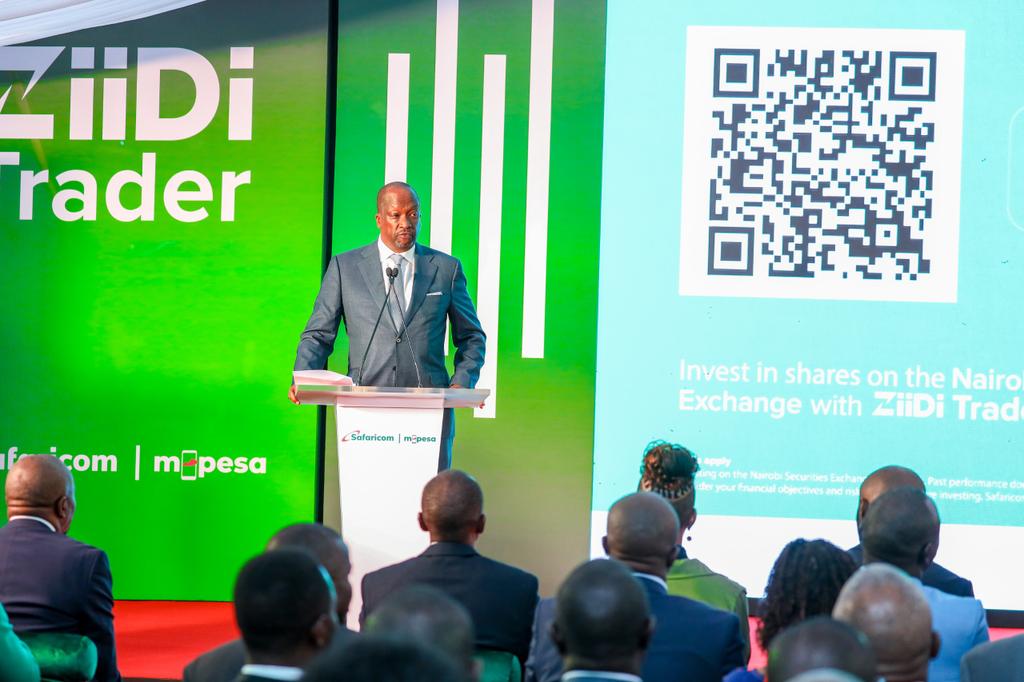
The Nairobi Securities Exchange has spent years searching for retail investors. It found them in a place few people in the market once took seriously as a trading gateway: a mobile wallet.

M-Pesa share trading is now drawing small investors into the exchange in volumes the traditional brokerage system rarely reached. Data from February 5 to March 10 shows individual traders spent an average of Sh2,621 per purchase through the Ziidi Trader platform embedded inside the M-Pesa app. Each order averaged 277 shares.
Those numbers describe something modest on the surface. A few thousand shillings per trade hardly looks like the fuel of a market boom. Yet the behaviour underneath the numbers hints at a larger development. The stock market is no longer a place entered through brokers’ offices or long registration forms. It now sits inside the same application people use to pay a taxi or send school fees.
The practical consequence appears in the order book. Between February 5 and March 10 the platform processed 268,936 share purchase orders. That equals 62.04 percent of the 433,498 total orders recorded across the entire exchange during that period.


Volume, not value, is the story here.
For decades the exchange struggled to deepen its retail base. Now thousands of small orders arrive daily from phones.

The Rise of the Micro-Investor
Retail investing often begins with a psychological barrier rather than a financial one. Brokerage procedures can look intimidating. Market terminology tends to reinforce that distance. M-Pesa share trading has stripped much of that friction away.
Opening access required almost no new documentation. The platform relies on Safaricom’s existing know-your-customer records. A user’s M-Pesa PIN becomes the authorization tool for trading activity.
The result has been rapid participation. More than 200,000 investors have opted into Ziidi Trader since launch. That number carries historical weight inside Kenyan capital markets. The NSE needed 9 years to reach 200,000 investors before the platform existed.
This time the market arrived in weeks.
The M-Pesa Effect on NSE Trading Dynamics
| Metric | Pre-Platform Baseline | Post-Launch (Feb 5 – Mar 10) | Impact / Shift |
| Daily Equity Deals | ~7,000 | 26,169 | 3.8x increase in activity |
| Share of Total NSE Orders | N/A | 62.04% | Mobile is now the primary gateway |
| Average Purchase Value | High (Institutional) | Sh2,621 | Shift toward micro-investing |
| Average Shares per Order | N/A | 277 Shares | Entry-level retail accumulation |
| Investor Growth (200k) | 9 Years | < 5 Weeks | Unprecedented adoption speed |
Note: Data reflects trading activity processed via the Ziidi Trader platform between February 5 and March 10, 2026.
Eric Ruenji, founder and chairman of Theo Capital Holdings, described the trend in straightforward terms. Ordinary citizens are entering the capital markets in larger numbers.
The order data supports the claim. Retail users placed 214,048 buy orders against 54,888 sell orders during the measured period. Investors are accumulating shares rather than cycling quickly through positions.
That pattern suggests a retail culture closer to saving than speculation.
A Market Built on Small Orders
For traders who follow the exchange closely, the more revealing detail lies not in participation counts but in how activity has altered the mechanics of trading.
Before the platform went live, the NSE averaged fewer than 7,000 equity deals per day. Two weeks into the rollout, the number had climbed sharply.
By February 18, total orders reached 26,169. That represented a 3.8-fold increase compared with the 6,761 deals recorded before February 4, the last trading day before mobile share access began.
The change is visible inside trading terminals. The market now receives streams of smaller instructions. Individual orders are often worth only a few thousand shillings.
Yet those instructions accumulate quickly.
The Ziidi Trader consistently accounts for more than 62 percent of daily orders on the exchange. In value terms, however, its contribution remains modest. The platform currently represents around 2.5 percent of the total value traded.
That gap between volume and value tells a simple story. Retail investors are participating in large numbers, but institutional investors still dominate the money.
Markets have seen this dynamic before. High order counts can alter liquidity patterns even when capital flows remain concentrated elsewhere.
Brokers Step Aside, But Not Entirely
Direct share access through a mobile wallet once alarmed traditional brokers. The fear was blunt. If investors could buy shares directly, brokerage houses might become irrelevant.
Reality has taken a different shape.
Trades placed through the platform still pass through a licensed intermediary. Kestrel Capital executes orders through a single omnibus account that holds the purchased shares.
In practical terms the broker remains in the chain, though its role looks different from the old retail brokerage model. The client relationship now sits with the mobile platform rather than a brokerage desk.
The arrangement reduces administrative overhead while keeping the regulatory architecture intact. Investors receive faster execution and anonymity within the pooled account structure.
For the exchange itself, the system offers a way to expand participation without dismantling the brokerage framework.
The IPO Effect: Kenya Pipeline and the Retail Surge
The timing of the rollout intersected with a moment when retail interest was already building.
During the recent Kenya Pipeline Company initial public offering, the platform became a major entry point for small investors. Out of 73,000 individuals who bought into the offer, 36,000 placed their orders through M-Pesa.
The convenience of the process mattered. Applying for shares once involved paperwork, physical forms, and often a trip to a broker’s office. Now it required little more than a few taps.
Political leaders noticed.
President William Ruto and Treasury Cabinet Secretary John Mbadi both referenced the platform when discussing citizen participation in national assets. The language reflected a longstanding policy ambition. Kenya has spent years trying to broaden local ownership of major companies.
Mobile trading may provide the most practical route yet.
A Retail Base the NSE Has Chased for Years
The Nairobi Securities Exchange has rarely lacked ambition. It has lacked participation.
Retail investors historically formed a thin layer beneath a market dominated by institutions, pension funds, and foreign investors. Attempts to expand the base have appeared in various forms over the past decade.
Investor education campaigns. Online trading portals. Policy conversations about lowering barriers.
The results were slow.
M-Pesa share trading introduces a structural advantage none of those efforts possessed. The infrastructure already sits in millions of pockets. M-Pesa has more than 30 million active users across Kenya.
The exchange now taps into a behavioural routine that exists long before the idea of buying a stock enters someone’s mind.
A person checks their phone to send money, notices the trading tab, and curiosity takes over.
Small trades follow.
A Different Kind of Liquidity
Retail participation often produces a certain rhythm in markets. Orders arrive frequently but in small sizes. Liquidity appears in bursts rather than large institutional blocks.
The NSE is beginning to show those characteristics.
Higher order counts improve price discovery because more participants interact with the market. Yet the dominance of micro-orders also means total turnover can remain relatively stable even while activity rises.
That seems to be happening already. Ziidi Trader contributes a large share of orders but only around 2.5 percent of traded value.
Over time the balance could evolve in several directions.
If retail investors gradually increase their investment size, the platform may begin influencing price formation in a meaningful way. If participation remains small and sporadic, the platform will function mainly as an entry ramp rather than a capital engine.
Either outcome still carries consequences for the exchange.
The Long Bet: 9 Million Investors by 2029
The Nairobi Securities Exchange has set an ambitious target. The market aims to reach 9 million individual investors by December 2029.
That figure sounds ambitious until one considers the scale of Kenya’s mobile economy. M-Pesa users already number in the tens of millions.
Even modest participation rates could push the exchange toward its goal.
Safaricom executives point to the speed of early adoption as evidence. Esther Waititu, the company’s chief financial services officer, recently noted how quickly the investor base reached 200,000 users.
Her point was less about the number itself and more about what enabled it. When a financial process becomes part of a routine application people open every day, adoption tends to accelerate.
Markets often underestimate the importance of convenience.
A New Culture Around Equity Ownership
There is a deeper social angle beneath the trading data. For many Kenyans the stock market has long existed at a distance from daily economic life.
Mobile trading begins to dissolve that separation.
Someone who spends Sh2,621 on shares is not behaving like a hedge fund manager. The purchase resembles a savings decision. A small bet on the future of a company, placed alongside routine financial activity.
Over time that behaviour can change how people relate to corporate ownership.
Retail investors who buy a handful of shares may begin paying attention to earnings reports, dividend announcements, and company governance. Markets develop civic dimensions when participation spreads widely enough.
Kenya has seen hints of that phenomenon before, particularly during earlier public share offers.
The difference now lies in scale and frequency.
The Unfinished Questions
Even in its early weeks the platform raises a few unresolved questions.
One concerns investor education. Easy access does not automatically produce informed trading decisions. Retail investors may enter the market without a clear understanding of valuation or risk.
Another issue sits with regulation. A system handling hundreds of thousands of small orders requires robust monitoring to detect unusual trading patterns.
Then there is the question of patience. Retail enthusiasm can fade if markets deliver extended periods of weak returns.
Yet there is also the possibility that mobile share access becomes an ordinary feature of financial life in Kenya.
If that happens, the Nairobi Securities Exchange will look very different from the institution many investors remember. The trading floor would no longer represent the centre of the market. The centre would sit in the phones of millions of citizens.
And every now and then someone would buy a few shares while paying a bill.
Go to TECHTRENDSKE.co.ke for more tech and business news from the African continent and across the world.
Follow us on WhatsApp, Telegram, Twitter, and Facebook, or subscribe to our weekly newsletter to ensure you don’t miss out on any future updates. Send tips to editorial@techtrendsmedia.co.ke


