
Is xAI Worth $200B? Musk’s Denial and Market Hype Leave More Questions Than Answers
A $200 billion price tag puts xAI in rare company, but the startup has yet to prove it can turn experiments like Grok into a real business.

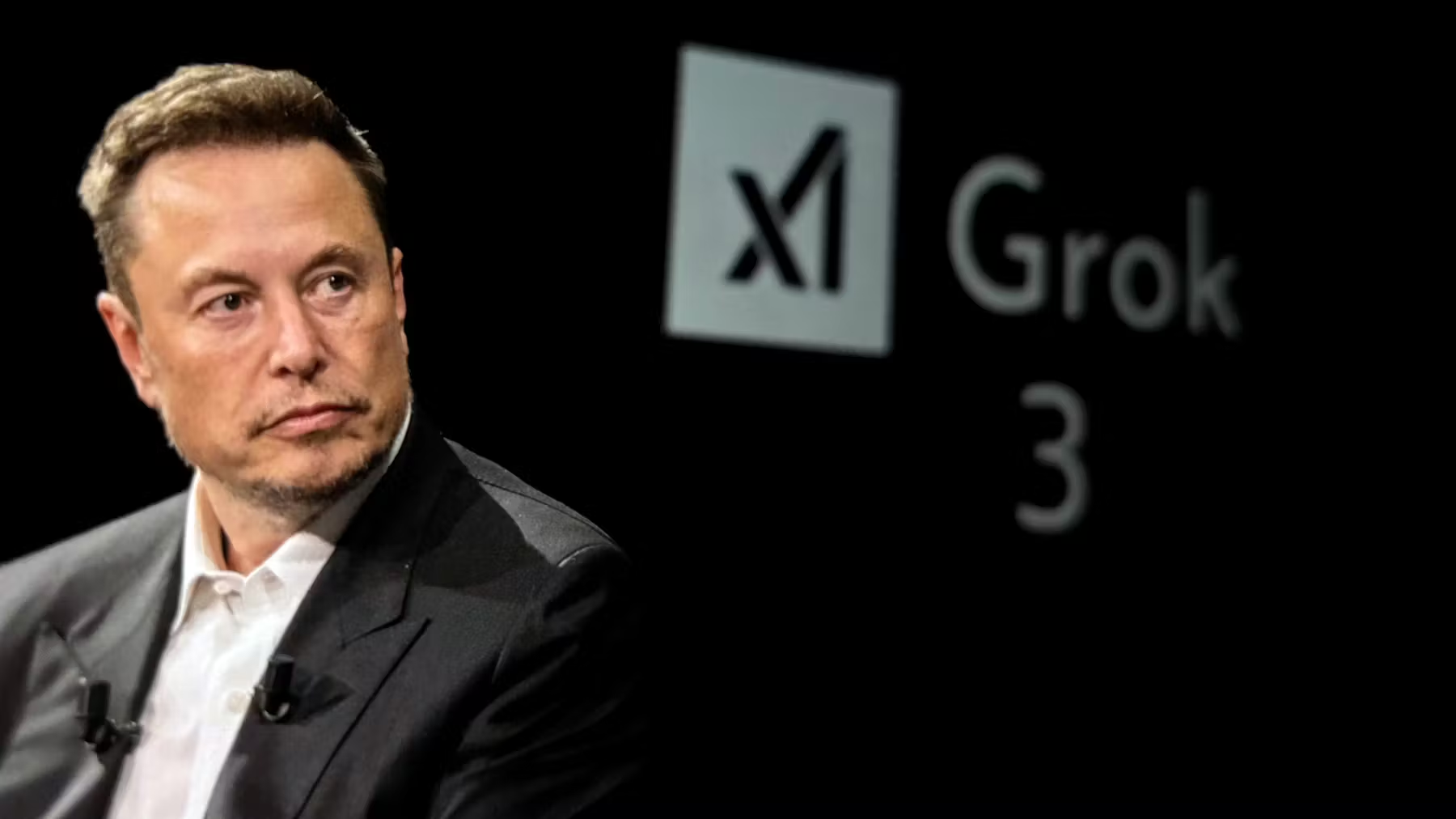
Reports that Elon Musk’s artificial intelligence startup xAI has raised $10 billion at a $200 billion valuation have set off a storm of speculation. Depending on who you listen to, this is either a validation of Musk’s strategy to challenge OpenAI and Anthropic, or a prime example of overheated hype in private markets. The story becomes even murkier when you factor in Musk’s own denial on X, his favored platform.

This tension—between breathless investor excitement, Musk’s unpredictable communication style, and the still unproven economics of large language models—demands more than just a headline. To make sense of it, you have to examine not only the funding numbers, but also the narratives surrounding them, the credibility of the sources, and the broader AI landscape.
The Valuation Puzzle: $200 Billion or Market Mirage?
At face value, a $200 billion valuation puts xAI in the same weight class as tech giants that have spent decades building revenue streams. For perspective, Meta was worth less than that at its 2012 IPO, despite hundreds of millions of users and a proven ad model.
So what justifies such a number for xAI, which only launched in mid-2023? Supporters would point to Musk’s track record: PayPal, Tesla, SpaceX, and to some extent, his ability to force industries into acceleration. But skeptics see this as another case of private-market froth, similar to what happened with WeWork or FTX—lofty numbers disconnected from sustainable fundamentals.
Valuations for private AI companies are essentially totally made up. This observation highlights the opacity of these deals. Without public filings, outsiders can only piece together rumors, insider leaks, and Musk’s own contradictory statements.
Musk’s Denial: Deflection or Disruption?
Shortly after CNBC and Bloomberg broke the story, Musk logged onto X and declared: “Fake news. xAI is not raising any capital right now.” This wasn’t just a rebuttal—it was a reminder of Musk’s unique role in shaping narratives.

Unlike most founders, he doesn’t play by the rules of corporate communications. His dismissal might be sincere, but it might also be tactical: buying time, throwing rivals off, or simply trolling journalists. After all, Musk has a history of announcing moves on social media before his companies formally confirm them—or denying developments that later turn out to be true.
The contradiction leaves analysts and investors with a dilemma: trust the CEO’s tweet, or trust the financial press citing multiple sources. That tension alone reveals how personality-driven this market has become.
AI’s Capital Hunger: Following the Money
Regardless of whether this specific round closes, one fact is clear: training frontier AI models is astonishingly expensive. OpenAI reportedly spends hundreds of millions of dollars annually just keeping ChatGPT operational. Anthropic and Google DeepMind face similar burn rates.
That’s why the $10 billion figure, though eye-catching, actually fits the trend. AI development has become a capital arms race, where each player is betting that scale and compute will produce a defensible moat. Musk himself has argued that only a handful of firms will be able to compete at the frontier because the barrier to entry is so high.
The unanswered question is whether such spending translates into durable revenue. Tesla sells cars. SpaceX sells launches. What does xAI sell, beyond a chatbot branded “Grok” that currently exists more as a novelty than a business model?
The OpenAI and Anthropic Benchmark
For investors, the obvious yardstick is OpenAI. Microsoft’s backing, now worth over $13 billion, has effectively turned OpenAI into a semi-subsidiary within the Windows ecosystem. Anthropic, with Amazon and Google both as backers, has positioned itself as a more cautious rival focused on AI safety.
Both companies have valuations hovering between $30 billion and $80 billion, depending on who you ask. That makes xAI’s alleged $200 billion valuation hard to square—unless you believe Musk’s involvement alone justifies a multiple that dwarfs his competitors.
Some observers argue that if xAI is worth $200 billion, then by the same logic, OpenAI should be worth $1.5 trillion. That line of reasoning exposes the absurdity in valuation math, and perhaps the desperation of investors who fear missing out on the next platform shift.
Musk’s Broader Fascination with AI
One dimension that often gets overlooked is Musk’s longstanding ambivalence toward artificial intelligence. He was an early backer of OpenAI before breaking with the company. He has sounded alarms about AI risks, even calling it an existential threat. Yet he now runs an AI lab of his own, aggressively pursuing the same frontier models he once warned against.
This contradiction might be explained less as hypocrisy than as Musk’s standard approach: if something poses a risk, he’d rather be inside the arena shaping it than outside criticizing. The pattern is visible in his involvement in space, cars, energy, and now AI. The question is whether his instinct to move fast will clash with the ethical guardrails others are trying to build.
Investors’ Blind Spot: Hype vs. Fundamentals
The forums and commentary sections are full of incredulity. Critics point out that xAI has yet to prove a business case. Grok has novelty, but no clear monetization strategy. Meanwhile, Musk’s companies are often stretched thin. Tesla faces growing competition in EVs, while X is still struggling with advertising revenue under his ownership.
So why would investors line up to pour in $10 billion? One explanation is the Musk premium: the belief that if anyone can turn hype into reality, it’s him. Another explanation is fear of missing out in a sector that has minted sky-high valuations overnight.
But this raises deeper questions: are investors funding innovation, or simply inflating another bubble? And if AI development turns out to be less commercially viable than expected, who absorbs the fallout?
What This Means for the Global AI Race
If the funding reports are true, xAI instantly becomes one of the most valuable AI startups in history. That shifts the competitive map, especially against US rivals, but also globally. China’s AI labs are backed by state resources, and Europe is scrambling to regulate before it falls further behind.
For Africa, Latin America, and other emerging markets, the spectacle of Musk’s billion-dollar rounds underscores a growing divide. While local AI startups struggle for single-digit millions in seed funding, Silicon Valley giants are burning billions on speculative models. That imbalance may shape who controls AI infrastructure, data, and standards for years to come.
The Unanswered Questions
Amid all the noise, a few questions remain unresolved:
- Did this funding round actually happen, or are insiders inflating rumors?
- If xAI is valued at $200 billion, what revenue or products justify it?
- How long before investors demand real returns, not just big numbers?
- And perhaps most crucially: will Musk’s unpredictability become a strength or a liability in convincing partners to trust xAI?
These uncertainties don’t just affect Musk—they ripple across the entire AI ecosystem. If xAI falters, it could sour investor appetite for the sector. If it succeeds, it could reset the benchmarks for what startups can raise.
Between Vision and Vapor
The story of xAI’s alleged $200 billion valuation isn’t really about a single company. It’s about the broader phenomenon of AI hype colliding with capital markets, where ambition often outpaces reality. Musk’s involvement ensures attention, but attention isn’t revenue.
Until xAI proves that Grok or any other product can generate lasting income, the valuation will remain speculative. The AI boom has produced extraordinary innovations, but also raised the risk of bubbles. Musk’s latest play sits right at that fault line—between vision and vapor, between the promise of a new intelligence age and the possibility of another spectacular overreach.
Go to TECHTRENDSKE.co.ke for more tech and business news from the African continent.
Mark your calendars! The TechTrends Pulse is back in Nairobi this October. Join innovators, business leaders, policymakers & tech partners for a half-day forum as we explore how AI is transforming industries, driving digital inclusion, and shaping the future of work in Kenya. Limited slots – Register now – here.
Follow us on WhatsApp, Telegram, Twitter, and Facebook, or subscribe to our weekly newsletter to ensure you don’t miss out on any future updates. Send tips to editorial@techtrendsmedia.co.ke
TechTrends Media Podcasts

