
WhatsApp’s Group Chat Safety Feature Flags Risky Invites Early
WhatsApp now interrupts group invites with a warning screen — and it might just stop scams in their tracks


In its latest effort to blunt the rise of scam-driven group chats, WhatsApp is introducing a friction layer — a new safety overview that appears before users are added to unfamiliar groups.

The feature, rolling out globally, gives users a brief but important snapshot: when the group was created, how many members it has, and — crucially — who invited them. There’s also a visible warning about the risks of scams, along with tips on how to control who can add you to groups.
It’s not a flashy update. But in the context of how scams have evolved on messaging apps, it’s a meaningful shift. Fake job offers, crypto investment schemes, and rental scams are increasingly being coordinated through group chats — often seeded with AI-written messages and distributed across multiple platforms before landing on WhatsApp.
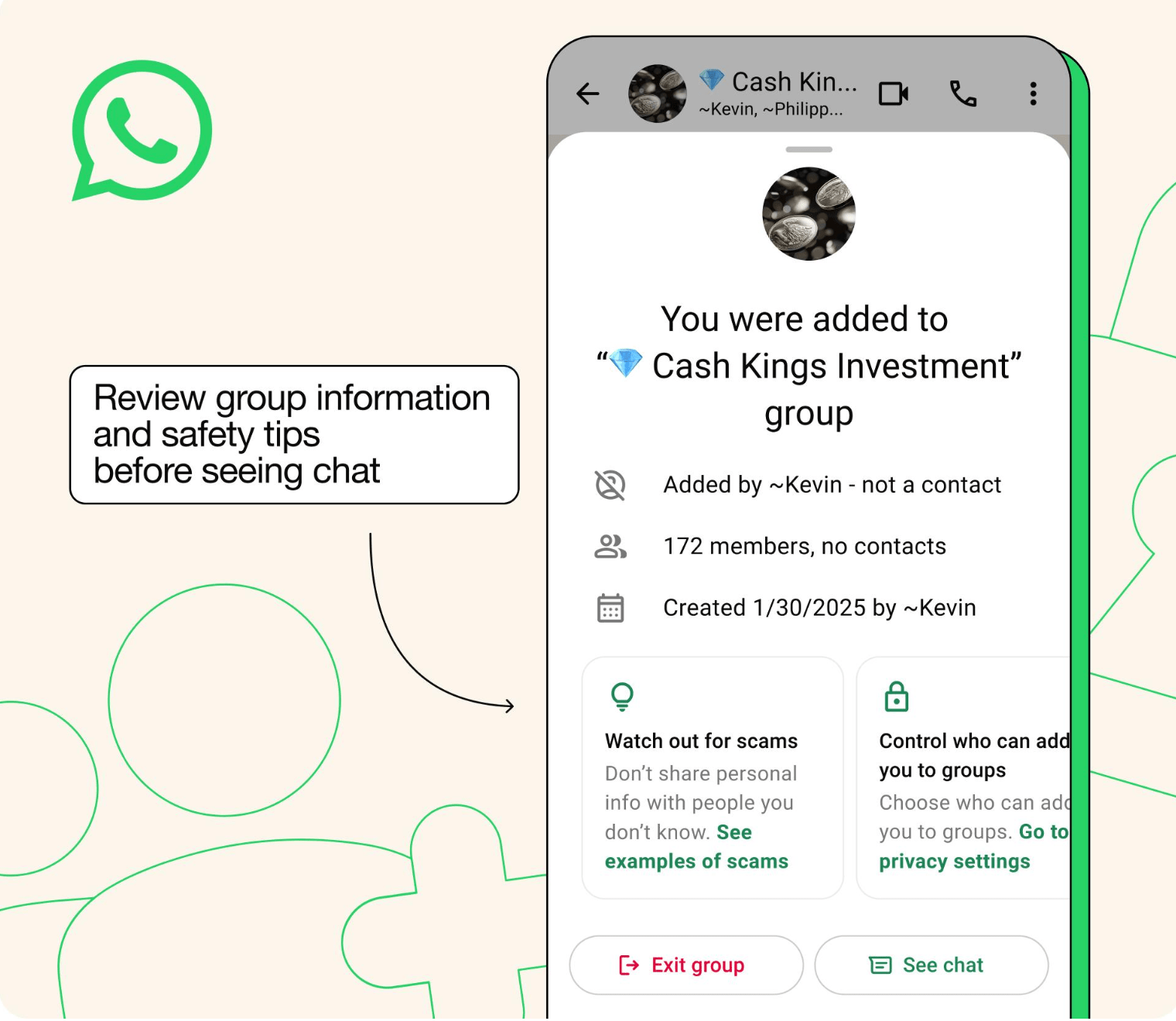

WhatsApp says the new safety overview builds on last year’s “context card,” which quietly surfaced basic group information. The difference now is visibility: the new overview appears as an interstitial page before a user joins. If something feels off, you can back out — no need to open the chat at all.
That preemptive pause matters. Scams often rely on speed, social pressure, and the illusion of legitimacy. By giving users a moment to evaluate the group’s credibility, WhatsApp is adding a subtle layer of friction — one that could make it harder for scammers to execute mass invitations unnoticed.

It’s also a response to broader scam trends. In June, WhatsApp worked with Meta and OpenAI to disrupt a scam operation in Cambodia that used ChatGPT to generate fake job ads. Victims were funneled into WhatsApp groups, asked to “like” TikTok videos, shown fake payout screenshots, and eventually nudged toward crypto deposits. Similar scams have mimicked e-commerce platforms, ride-hailing startups, and even government programs.
Clair Deevy, WhatsApp’s director of external affairs, said scammers are increasingly platform-hopping. A message might start on Instagram or Telegram before being pushed onto WhatsApp for the final bait. That handoff is part of what the new safety overview is designed to address.
Beyond this update, WhatsApp is testing other ways to disrupt unsolicited chats. One experiment includes prompting users to “pause” when contacted by people outside their address book — a small nudge to be cautious before engaging.
The challenge for WhatsApp — and Meta more broadly — is to keep the platform feeling frictionless while still protecting users in an environment where scams are smarter, faster, and more believable than ever.
Follow us on WhatsApp, Telegram, Twitter, and Facebook, or subscribe to our weekly newsletter to ensure you don’t miss out on any future updates. Send tips to editorial@techtrendsmedia.co.ke


